


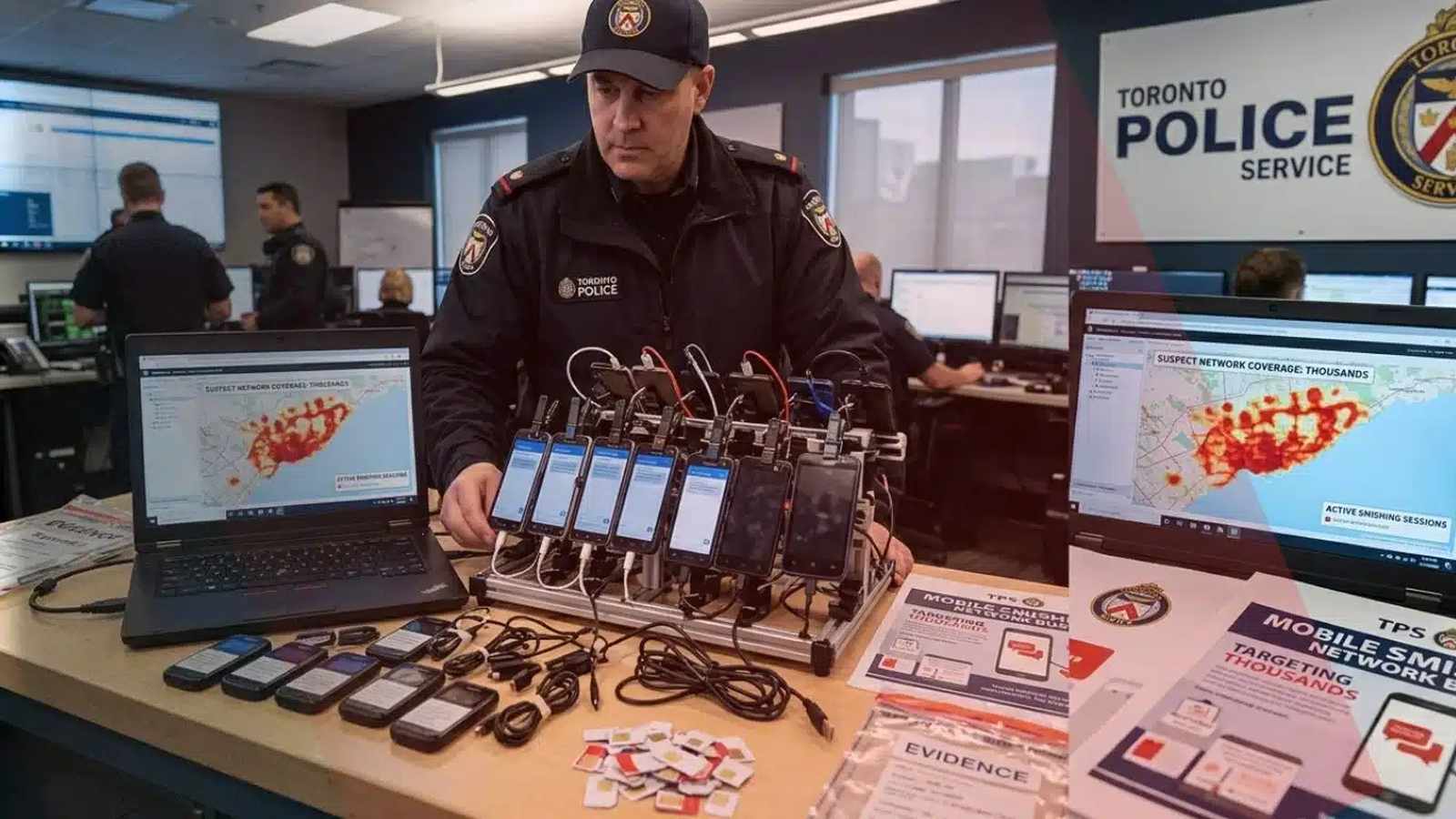
TORONTO (Azat TV) – Toronto police have dismantled a criminal network utilizing portable SMS blasters to mimic legitimate cellular towers, marking the first time such technology has been prosecuted in Canada. The investigation, dubbed Project Lighthouse, led to the arrests of three individuals who now face a collective 44 charges related to fraud and mischief.
How SMS Blasters Mimic Cellular Infrastructure
The seized devices functioned as portable signal traps, designed to broadcast a stronger signal than legitimate carrier towers in the immediate vicinity. Because mobile devices are programmed to connect to the strongest available signal, thousands of smartphones in downtown Toronto were automatically diverted from their carriers to the fraudsters’ hardware. Once a device connected to the rogue station, the operators were able to broadcast fraudulent text messages directly to the users. These messages were crafted to appear as legitimate alerts from banking institutions or government agencies, often containing links to phishing websites designed to harvest financial credentials and personal data.
Public Safety Stakes and Network Disruption
Beyond financial exploitation, the operation caused significant public safety concerns. Toronto Police Deputy Chief Robert Johnson confirmed that the rogue hardware triggered over 13 million network disruptions. By forcing devices to disconnect from legitimate towers, the hardware effectively blocked access to essential services, including 911 emergency calls. Authorities emphasized that the attack was indiscriminate, impacting any passerby or resident within the signal range of the mobile units, which were often concealed in vehicles.
The Future of Mobile Trust and Authentication
The sophistication of this hardware represents a shift from traditional software-based spoofing to physical, infrastructure-level interception. According to investigators, the seized technology was uniquely designed and highly effective at bypassing standard user-end security measures. As mobile networks continue to evolve, this case highlights a growing vulnerability in legacy communication protocols that are susceptible to localized signal hijacking. Police are currently urging the public to remain cautious of unsolicited links, even if the sender identity appears authentic, as the nature of these attacks renders traditional antivirus protections largely ineffective.
The successful arrest of the suspects and the neutralization of the equipment underscore the urgent need for carriers to modernize network authentication protocols, as the reliance on SMS for two-factor authentication becomes increasingly precarious in an era where physical cell tower mimicry is becoming a viable tool for organized crime.