
Quick Read
- The Russia-Ukraine war continues its relentless grind in 2026, mirroring patterns from 2025 with no decisive end in sight.
- Ceasefire talks, heavily influenced by Donald Trump, risk compelling Ukraine and Europe to accept Russia’s demands, which fundamentally oppose Ukraine’s sovereignty.
- Russia is making tactical gains on the front lines, including the capture of Bondarne in Donetsk, alongside persistent missile and drone strikes against Ukrainian cities.
- European nations remain largely unprepared for their own defense, relying heavily on uncertain US support, despite a potential 2027 reduction in American military presence in Europe.
- Daily combat is intense, with significant clashes reported in Pokrovsk and Huliaipole, and a recent Russian ballistic missile attack in Kharkiv causing casualties.
As the calendar turns to 2026, the devastating conflict in Ukraine shows little sign of abating, continuing the relentless pattern established in 2025. Despite optimistic pronouncements from figures like Ukrainian President Volodymyr Zelensky and former US President Donald Trump about an ongoing ‘peace process,’ the reality on the ground and in diplomatic corridors paints a far more perilous picture. For many, a ceasefire, if achieved, would not herald genuine peace but rather a dangerous pause that could solidify Russia’s strategic advantages and leave Europe more vulnerable than ever.
According to analysis by The Independent, the repeated promises of peace often feel like little more than ‘blind optimism’ or a desperate attempt to appease Donald Trump’s political ambitions. Russia, it seems, is content to wage war, consistently seeking to secure through diplomatic leverage what its forces have struggled to conquer in over a decade of conflict. Trump, in particular, has emerged as a key instrument in this strategy, reportedly blindsiding European leaders three times in 2025 by attempting to coerce Ukraine into accepting Russian demands under the guise of a ceasefire.
The Illusion of Peace: A Fraught Ceasefire Landscape
The notion of a ‘peace process’ often masks a deeper, more troubling dynamic. Each diplomatic scramble, while averting immediate disaster, has incrementally improved Russia’s negotiating position. A striking example cited by The Independent is Russia’s ’28-point plan’ from November 2025. Instead of being unequivocally rejected, it was treated as a basis for negotiation, leading to European endorsement of concepts like limiting the size of Ukraine’s armed forces – a significant concession that had previously been unthinkable.
This diplomatic dance is fundamentally mismatched. While Presidents Trump and Zelensky might genuinely believe they are 90 percent of the way to a peace agreement, this agreement is largely between Ukraine and the United States. A viable accord with Russia remains elusive because their core objectives are diametrically opposed: Russia seeks to eliminate Ukraine as a free and independent nation, while Ukraine fights for its very survival. The war, which began in 2014 and escalated dramatically in 2022, persists precisely because there is no common ground between these two positions.
Even a potential ceasefire is fraught with immense danger. History, particularly Russia’s actions in Georgia and Syria, demonstrates Moscow’s adeptness at co-opting Western leaders to impose impossible terms on victims, while granting itself complete freedom to violate agreements at will. There is little reason to believe that Russia would agree to a ceasefire it couldn’t exploit to its advantage, using any lull in fighting to reconstitute its forces for a future assault. Furthermore, an easing of hostilities could provide a convenient excuse for European leaders, many of whom are still looking for one, to pretend the problem has vanished and that the urgent need for rearmament has dissipated.
On the Ground: A Relentless Grind
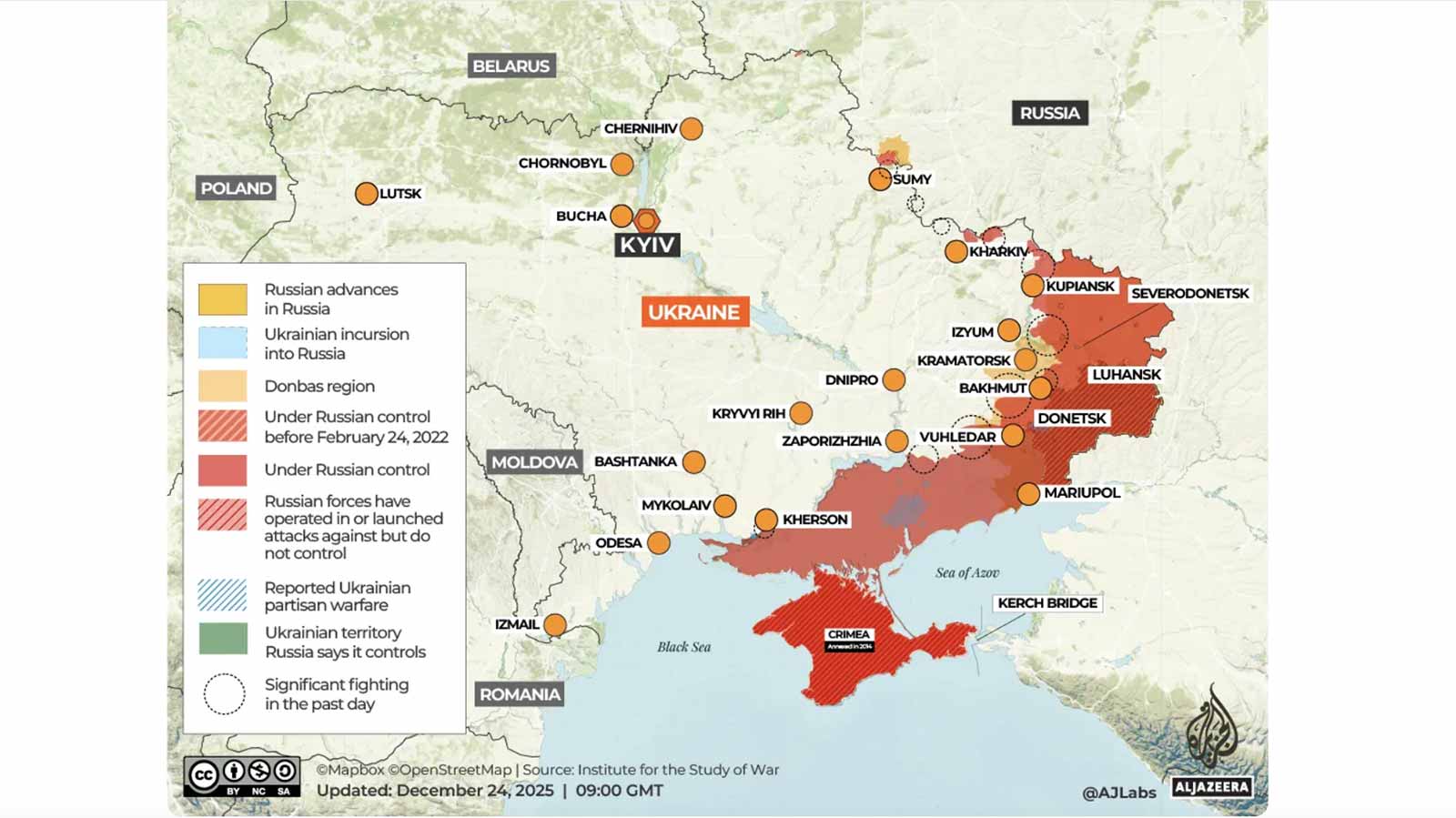
While diplomatic machinations unfold, the brutal reality of combat continues to define daily life in Ukraine. As of January 4, 2026, the 1,410th day of the war, fighting remains intense across various front lines. Al Jazeera reported a grim update, detailing how a Russian ballistic missile attack on Friday in Kharkiv tragically raised the death toll to four after striking a five-story residential building in the city center. Such attacks underscore the human cost of the conflict, with Ukrainian civilians enduring nightly drone and missile strikes targeting cities and critical infrastructure.
The front lines are a testament to a relentless grind. Ukrainian forces reportedly clashed 191 times with the Russian army in different sectors, with the heaviest fighting concentrated around Pokrovsk and Huliaipole. Russia, for its part, claimed recent gains, including the capture of the settlement of Bondarne in Ukraine’s Donetsk region. Moscow’s Ministry of Defence also reported repelling two Ukrainian attacks attempting to break through to Kupiansk in the Kharkiv region, an area where Russia has made recent advances. Overnight, Russian air defense systems reportedly shot down 90 Ukrainian drones over various Russian regions, highlighting the continuous aerial skirmishes.
Beyond the direct combat, strategic infrastructure remains a target. One of two high-voltage lines supplying electricity to the Russian-controlled Zaporizhzhia Nuclear Power Plant, seized by Moscow early in the invasion, was disconnected, according to the plant’s Russian management. These incidents demonstrate the multifaceted nature of the conflict, extending beyond direct military engagements to encompass civilian infrastructure and essential services.
Europe’s Crossroads: Defence, Dependency, and a Shifting Global Order
The war’s prolonged nature and the precariousness of a ceasefire cast a harsh light on Europe’s defense posture. The curtailing of US support for Ukraine was, for many, entirely predictable, as was Europe’s limited capacity to compensate for the shortfall. This weakness stems from years, even decades, of European nations refusing to invest adequately in their own defense, fostering a deep-seated dependency on the United States.
The situation is compounded by a mooted 2027 deadline for the United States to significantly reduce or even remove its support for European defense. The US’s new National Security Strategy reportedly outlines a vision of hemispheric defense, where America focuses solely on the Americas, leaving Europe and East Asia to contend with aggressive regional powers without the security guarantees they have relied on for generations. This stark vision, once confined to dystopian fiction, now looms as a real possibility, as predicted by Keir Giles in his 2024 book, Who Will Defend Europe.
Such a shift could pit the world’s remaining liberal democracies against a triumvirate of assertive autocracies: Russia, China, and a potentially isolationist United States. The resulting geopolitical landscape, as Giles warns, could eerily resemble George Orwell’s 1984, with the world divided into Oceania, Eastasia, and Eurasia. For now, US forces remain integrated with European defense structures, including NATO, but the unpredictability emanating from a potential Trump White House remains a potent factor. This unpredictability, while unsettling, does offer a peculiar benefit: Russia is unlikely to move against a NATO nation until it is absolutely convinced there will be no US retaliation. Trump’s erratic stance, paradoxically, currently denies the Kremlin that certainty.
Nonetheless, Europe’s inability to wean itself off defense dependency on the US has led to what The Independent describes as ‘craven pandering’ to the Trump White House throughout 2025. For Ukraine and its supporters, this has meant pretending that diplomatic flailing constitutes a genuine ‘peace process’ and clinging to the increasingly questionable idea that a US security guarantee against Russia holds any real value under the current administration. Russia, meanwhile, continues its reconnaissance for future moves on Europe through ‘hybrid’ attacks – sabotage and probing actions against civilian infrastructure and logistics points. European leaders often categorize these as ‘hybrid,’ despite intelligence chiefs pointing out the unhelpfulness of the term. The alternative, recognizing these as acts of war, implies uncomfortable political decisions that Europe has, so far, largely avoided.
Estimates vary on when Russia might be ready to resume open warfare against either Ukraine or a NATO member state, but they consistently indicate a timeline far sooner than Europe can realistically be prepared to defend itself. As 2026 begins, despite all the claims of imminent peace, the broader war against the West, as predicted by Giles at the end of 2024, appears nowhere near its end.
The confluence of ongoing battlefield realities, the complex and often self-serving nature of international diplomacy, and Europe’s persistent strategic vulnerabilities creates a deeply unsettling outlook for 2026. The true danger lies not just in Russia’s continued aggression, but in the collective illusion that a convenient ceasefire can substitute for genuine, robust defense and a unified, long-term strategy against an adversary whose fundamental objectives remain unchanged.