


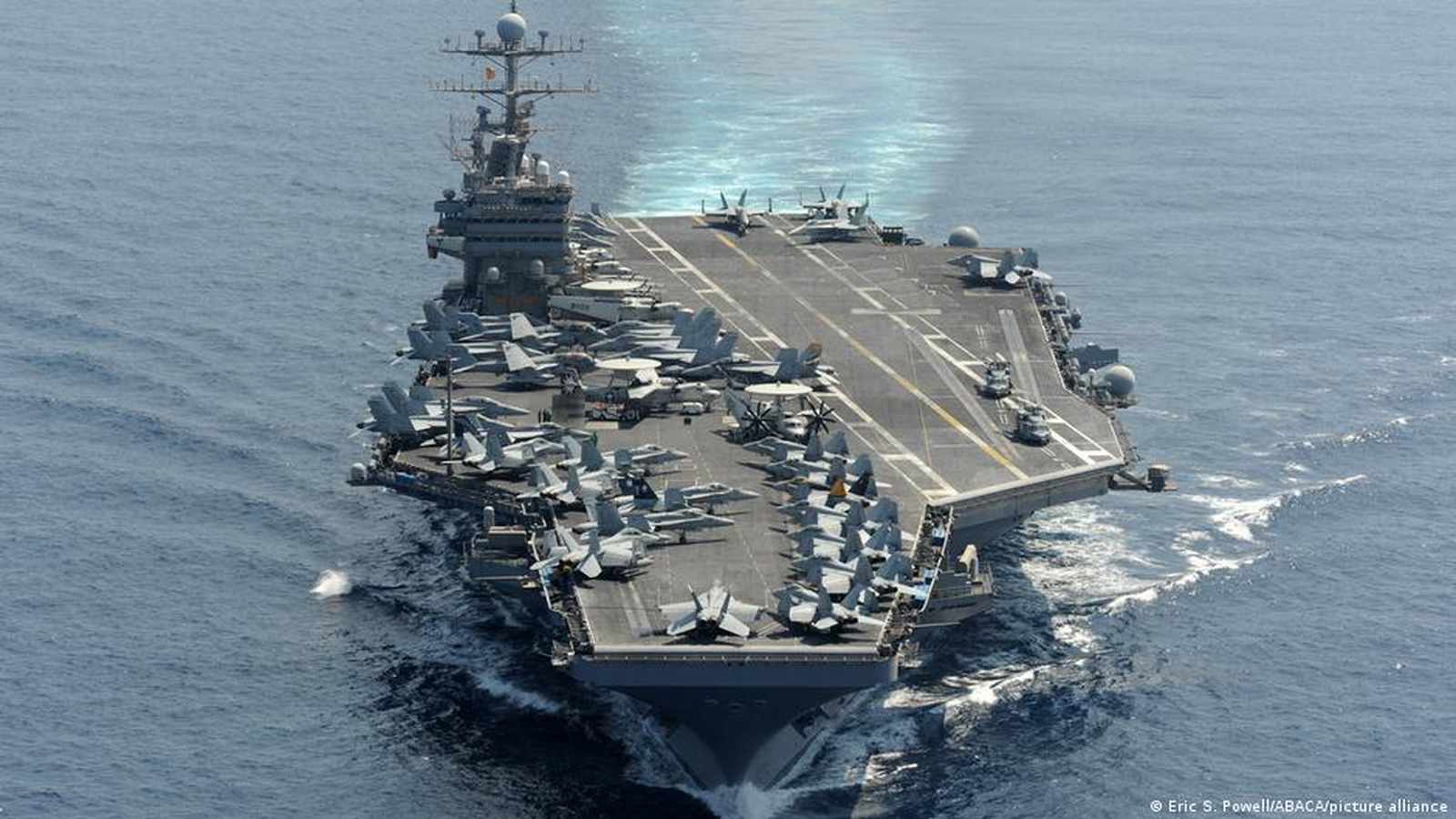
WASHINGTON (Azat TV) – The USS Abraham Lincoln carrier strike group arrived in the Middle East on January 27, 2026, intensifying the United States’ military posture in the region as the US Air Force prepares to launch large-scale readiness exercises and President Donald Trump issued new, stark threats against Iran over its nuclear program. This significant deployment and the accompanying military drills underscore Washington’s heightened focus on Iran amid escalating tensions and ongoing internal unrest within the Islamic Republic.
The USS Abraham Lincoln (CVN 72), a nuclear-powered aircraft carrier, entered the theater yesterday, accompanied by three Arleigh Burke-class destroyers and carrying nine squadrons of Carrier Air Wing (CVW) 9. While the exact composition is not fully disclosed, such strike groups typically also include a nuclear-powered attack submarine, further enhancing its operational capabilities, according to Aerospace Global News. President Trump has publicly termed the carrier strike group an ‘armada,’ stating its size surpasses the one previously deployed against Venezuela.
US Air Force Prepares ‘Agile Spartan’ Exercises
In conjunction with the carrier’s arrival, U.S. Air Forces Central (AFCENT), under U.S. Central Command (CENTCOM), is preparing to launch its multi-day ‘Agile Spartan’ readiness exercises. These drills are designed to demonstrate the ability to rapidly deploy, disperse, and sustain combat airpower across the vast CENTCOM area of responsibility. CENTCOM announced that Ninth Air Force (Air Forces Central) would be conducting these exercises, which include ‘launch and recovery procedures with small, efficient support packages.’
While these exercises are Air Force-led, it remains unclear if the USS Abraham Lincoln or its embarked air wing will be directly involved. AFCENT stated to The War Zone that ‘Agile Spartan’ is part of its ‘regular exercise schedule and not in response to current tensions.’ However, military analysts and open-source intelligence (OSINT) accounts, such as DefenceGeek, have noted that the timing of these exercises, coupled with the carrier’s deployment, has inevitably intensified scrutiny of US intentions in the region, making the optics difficult to ignore. CENTCOM emphasized that the exercise ‘reinforces peace through strength by fielding a credible, combat-ready, and responsible presence designed to deter aggression, reduce the risk of miscalculation, and assure partners.’
Trump Issues New Threats Against Iran’s Nuclear Program
The military buildup coincided with President Donald Trump’s new threats against Iran on Wednesday, January 28, 2026, urging the Middle Eastern nation to negotiate a new nuclear agreement. In a social media post, President Trump stated, ‘Hopefully Iran will quickly ‘Come to the Table’ and negotiate a fair and equitable deal — NO NUCLEAR WEAPONS — one that is good for all parties.’ He then referenced a past military operation, warning, ‘As I told Iran once before, MAKE A DEAL! They didn’t, and there was ‘Operation Midnight Hammer,’ a major destruction of Iran. The next attack will be far worse!’ ‘Operation Midnight Hammer’ refers to US strikes carried out during the 12-day conflict between Iran and Israel last year, as reported by DW.com.
These comments mark the second time this year that President Trump has threatened Iran. His earlier threats were linked to the major protests shaking the Iranian regime, with warnings of strikes if protesters were killed, a threat he later rolled back. However, the current threats explicitly target Iran’s nuclear ambitions, signaling a shift in the immediate focus of Washington’s pressure campaign. Iran’s Foreign Minister Abbas Araghchi promptly rejected the US approach, stating in televised comments on Wednesday, ‘Conducting diplomacy through military threat cannot be effective or useful. If they want negotiations to take shape, they must certainly set aside threats, excessive demands and raising illogical issues.’ He added that Iran stands ready for dialogue based on mutual respect but ‘IF PUSHED, IT WILL DEFEND ITSELF AND RESPOND LIKE NEVER BEFORE!’
Broader Regional Military Buildup Continues
Beyond the carrier strike group and the planned Air Force exercises, open-source intelligence has indicated a broader US military buildup across the CENTCOM region. This includes the deployment of additional F-15E Strike Eagle fighter jets from the UK to Jordan, an increased number of KC-135 tankers flying into Iraq, and the positioning of advanced air defense systems such as Patriot and THAAD. The United Kingdom has also moved Eurofighter Typhoons into the region in a ‘defensive capacity.’ However, OSINT accounts like Armchair Admiral express doubt that the UK would join offensive action against Iran unless a preemptive strike is launched by Tehran, though their participation in the defense of Qatar, Jordan, and Israel is deemed ‘almost certain.’ It remains unclear if Israel would participate in US-led offensive operations should President Trump authorize them.
The current situation unfolds against a backdrop of severe internal repression in Iran, where the US-based Human Rights Activists News Agency (HRANA) has recorded over 6,000 deaths, predominantly protesters, amidst the regime’s crackdown. Regionally, US allies such as the UAE and Saudi Arabia have reportedly denied Washington permission to use their airspace and territory for potential attacks on Iran, complicating any kinetic options. While Washington’s next move remains unclear, The Jerusalem Post suggested that the situation does not point to an imminent large-scale war, but rather options such as imposing a naval blockade on Iranian oil exports. Nevertheless, the United States has demonstrably positioned the military assets necessary both for potential strikes and for defending against any retaliatory response.
The confluence of a major naval deployment, significant air readiness exercises, and direct presidential threats against Iran highlights a deliberate and robust signaling strategy by the United States. This posture aims to project both deterrence and a readiness for kinetic action, yet it navigates complex regional diplomatic sensitivities and the stated unwillingness of key allies to facilitate offensive operations, indicating a multifaceted and potentially precarious path forward for Washington’s engagement with Tehran.