
Quick Read
- On September 19, 2025, the Moon, Venus, and Regulus appeared close together in the morning sky.
- Venus was the brightest planet next to the Moon, with Regulus as the brightest star in Leo.
- In select regions, a rare lunar occultation of Venus was visible as the Moon briefly hid the planet.
- Observers in North Jersey and other locations captured stunning photos of the conjunction.
- The best viewing time was 1–2 hours before sunrise, looking east.
Venus and the Moon: A Dazzling Pair in the Morning Sky
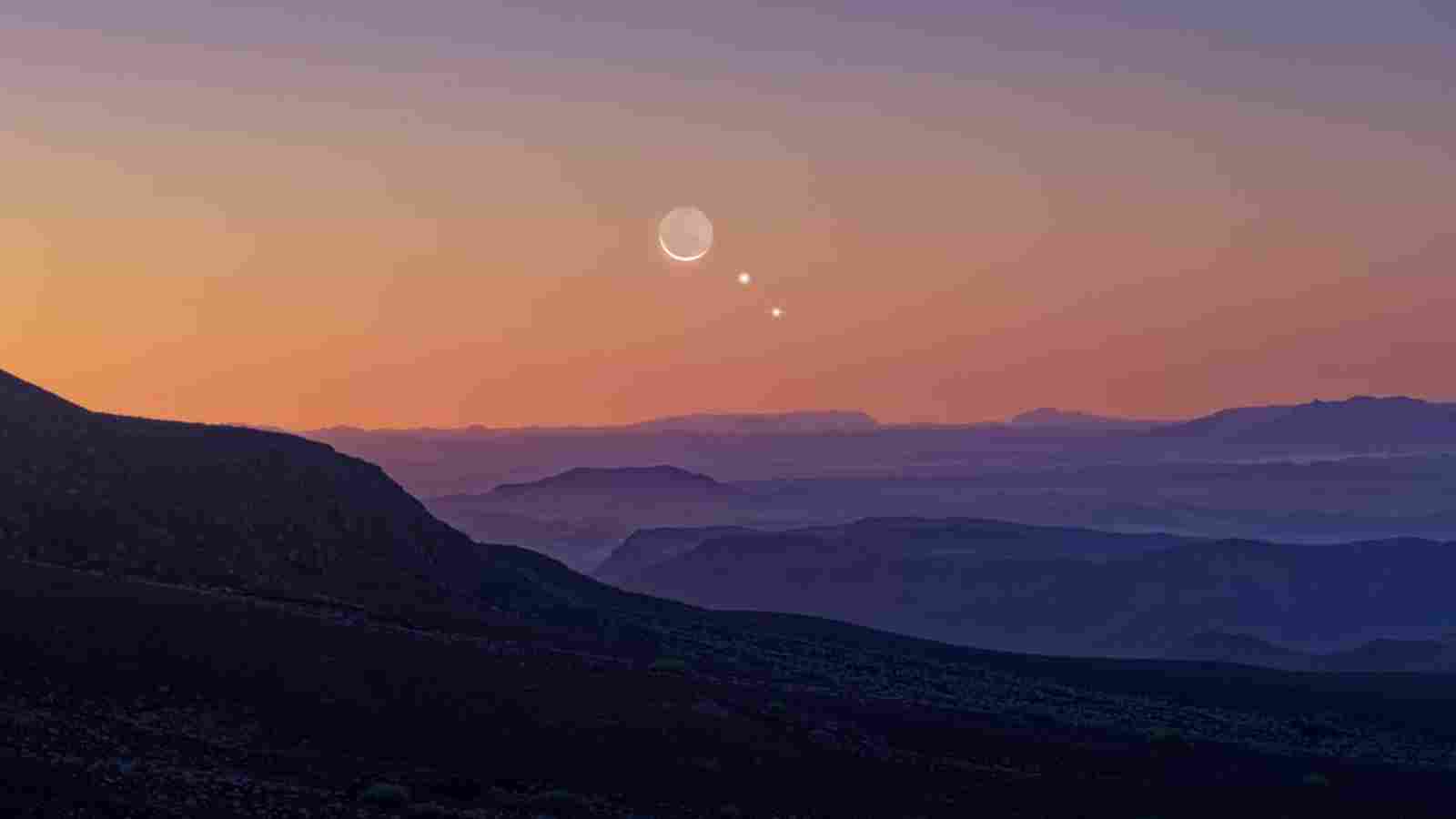
For those who woke before dawn on September 19, 2025, the eastern sky offered a rare celestial spectacle. The Moon, Venus, and Regulus—the brightest star in Leo—formed a compact trio, their close proximity painting an unforgettable picture across the morning twilight. Venus, the unmistakable ‘morning star,’ shone brilliantly beside the delicate crescent Moon, while Regulus added a subtle, steady glow to the composition. This gathering, known as a triple conjunction, is not just a treat for skywatchers; it’s a cosmic choreography unfolding above our heads.
The Moon that morning was a slender crescent, barely 5% illuminated. Its unlit side was softly aglow with earthshine, a phenomenon created by sunlight bouncing off our planet and gently lighting the lunar surface. Venus, meanwhile, was at its radiant best, shining at magnitude -3.9—outshining every other planet and star nearby. Regulus, though fainter at magnitude 1.4, held its own as the anchor of Leo’s constellation.
Global Views and Local Variations: How the Trio Appeared Worldwide
Depending on where you stood on Earth, the arrangement of the Moon, Venus, and Regulus varied just enough to make each observation unique. In places like New York, USA, all three objects were grouped so tightly they could fit under a fingertip held at arm’s length—less than one degree apart. In Sydney, Australia, the trio stretched out, forming a wider triangle across four degrees of sky.
From North Jersey, local photographers captured the alignment in towns such as Glen Rock, Pequannock, and Lincoln Park. Their images, shared by NorthJersey.com, showcased how the planetary conjunction looked just before sunrise, with the crescent Moon hanging low above rooftops and trees, Venus blazing nearby, and Regulus twinkling quietly in the background. The atmospheric haze of dawn lent the scene a painterly quality—proof that sometimes, the best astronomical moments are also the most fleeting.
The Lunar Occultation of Venus: A Hidden Gem
For skywatchers in parts of Africa, Europe, Asia, and North America, the event was even more dramatic. In these regions, the Moon passed directly in front of Venus, temporarily hiding the planet from view—a phenomenon known as a lunar occultation. As the Moon’s bright edge moved across Venus, the planet disappeared for a short while, only to reemerge from the lunar dark side.
Such occultations are rare and precise. The September 19 event began at 10:34 GMT and ended at 14:26 GMT, its visibility mapped out by astronomical software like Sky Tonight. For those outside the visibility zone, the Moon and Venus appeared merely close—still striking, but missing that moment of cosmic hide-and-seek. The next widely visible lunar occultation of Venus won’t occur until June 18, 619, so for many, this was a once-in-a-lifetime sight.
Observing and Photographing the Event: Tips for Sky Enthusiasts
With the trio rising low in the eastern sky just 1–2 hours before local sunrise, all that was needed for viewing was a clear horizon. Venus and the Moon’s brilliance made them easy to spot unaided, while Regulus, though fainter, became visible in darker conditions. Binoculars enhanced the experience, revealing the crescent Moon’s subtle earthshine and Venus’s sharp brilliance. Telescopes, meanwhile, provided the most detailed view of the occultation, capturing the exact moments Venus slipped behind and then reappeared from the Moon’s edge.
Astrophotographers had a field day. To capture all three objects together, a wide-angle lens was recommended. Pre-focusing on the Moon or Venus ensured crisp detail, while including foreground elements—trees, buildings, or skylines—added a sense of scale. Shooting during ‘blue hour,’ the period just before sunrise, yielded rich colors and balanced light. As Star Walk suggests, even a smartphone or basic camera can seize the beauty of such a sky scene, provided it’s mounted on a tripod and set for longer exposures.
The Science Behind the Show: Conjunctions and Close Approaches
What made this event so special was the precise timing of astronomical conjunctions and close approaches. A conjunction occurs when two celestial objects share the same right ascension—essentially, they line up in the sky from our perspective. A close approach is when those objects reach their minimum angular distance, sometimes just minutes or hours apart from conjunction.
On September 19, the dance unfolded as follows:
- Venus and Regulus reached conjunction at 08:59 GMT, just 0°30′ apart. Their closest approach came at 15:58 GMT, narrowing to 0°28′.
- The Moon and Regulus aligned at 11:11 GMT, separated by 1°24′, with their closest approach at 12:55 GMT (1°10′ apart).
- The Moon and Venus met in conjunction at 11:46 GMT, only 0°48′ apart, and drew even closer at 12:30 GMT (0°43′ apart).
- The lunar occultation of Venus spanned from 10:34 to 14:26 GMT in select regions.
These interconnected encounters created a layered, dynamic scene that changed subtly with every passing minute—a reminder of the intricate mechanics governing our solar system.
What’s Next: Saturn at Opposition and a Partial Solar Eclipse
The excitement didn’t end with the September 19 conjunction. Just two days later, on September 21, Saturn reached opposition—positioned directly opposite the Sun in our sky, and at its largest apparent size. This is the best time of year to observe Saturn’s rings and details through a telescope. Meanwhile, a partial solar eclipse graced New Zealand, Australia, and Antarctica, offering yet another rare spectacle for dedicated skywatchers.
For those who missed the lunar occultation, or are eager for more, these events promise further opportunities to marvel at the universe’s rhythms. Astronomy, after all, is the art of patience—waiting for the next alignment, the next eclipse, the next moment of wonder.
In a world often defined by its rush and noise, the September 19 gathering of the Moon, Venus, and Regulus offered a moment of quiet awe—a reminder that, above us, the universe continues its elegant dance, indifferent to our schedules yet always ready to reward a curious gaze. The fleeting occultation of Venus, visible only to a lucky few, underscores the magic of being present. In astronomy, as in life, the most dazzling moments are those we take the time to notice.