


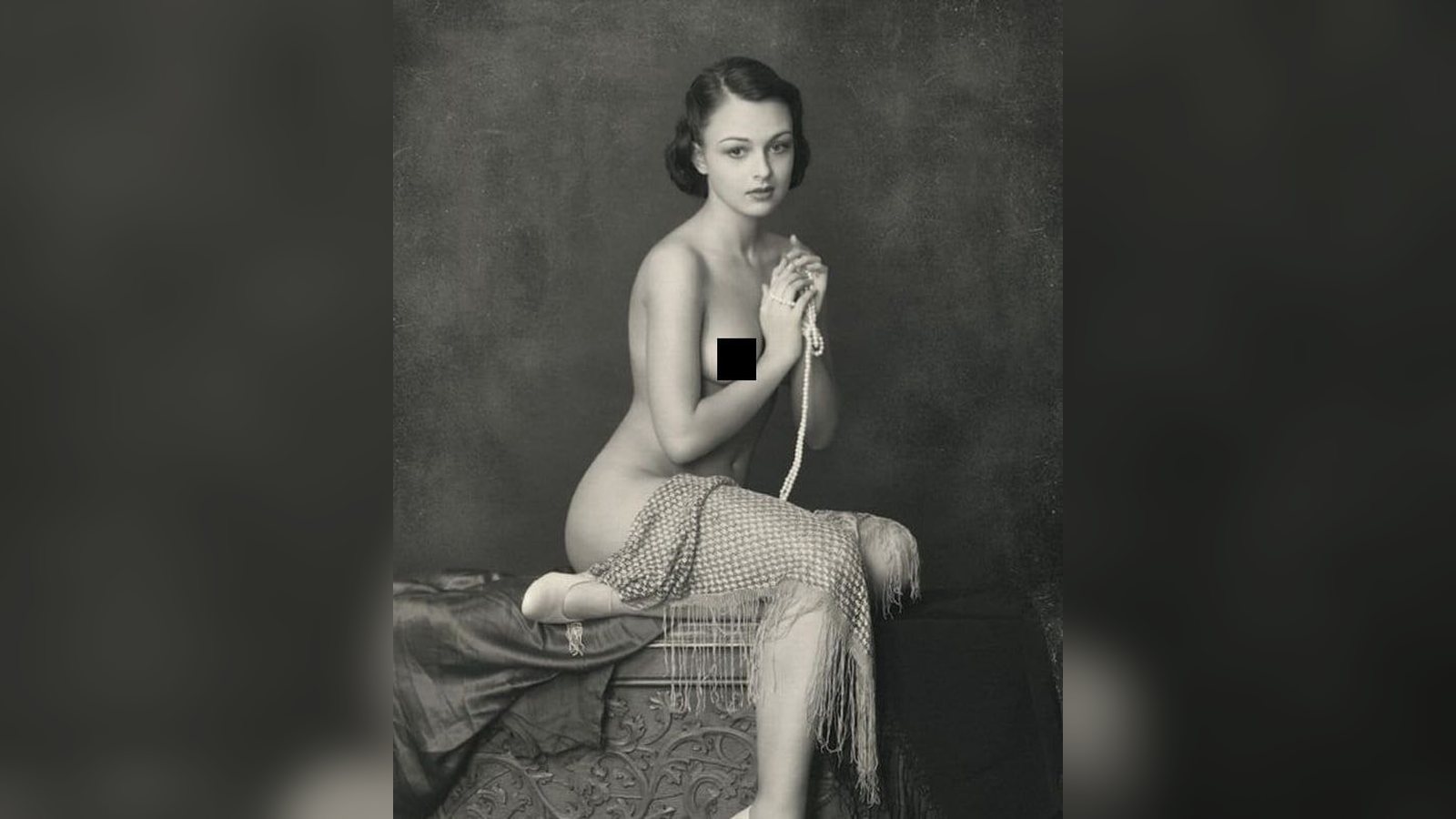
A woman posed in the delicate light of a late nineteenth-century glass-roofed atelier looks away from the lens, her posture balanced between classical sculpture and the intimate naturalism of the emerging Belle Époque. In recent digital circulation, this image has resurfaced accompanied by a sweeping assertion: that a French photographer captured it in 1897 solely to demonstrate the definitive beauty of French women to the world. Yet beneath the romantic patina of that modern social media caption lies a richer, more complex history of art, commerce, and visual mythmaking at the twilight of the nineteenth century.
What the photograph shows
In the frame, the subject is rendered in the distinctive tonal palette of late Victorian gelatin silver or albumen printing. Every element of the composition is calculated. The soft daylight filtering through the studio glass illuminates the gentle curve of her neck, the intricate swept-up Gibson-girl-style coiffure popular in the late 1890s, and the tailored drapery of her dress. Her expression is neither stiffly formal nor openly candid; it maintains the serene detachment demanded by fine-art salon photography of the era.
Unlike the rigid, neck-clamped portraits of the early daguerreotype period, the woman’s posture suggests fluid grace. Her gaze does not confront the camera directly, inviting the viewer to contemplate her as an archetype rather than an individual client who simply paid for a family carte-de-visite. The plain studio backdrop and gentle vignetting concentrate all visual attention on the texture of her hair, the symmetry of her profile, and the elegance of her silhouette.
The moment behind the image and the viral legend
The viral narrative claiming the image was commissioned or conceived in 1897 as a national showcase of French beauty simplifies the realities of late nineteenth-century portraiture. In reality, photographers of the era did not embark on abstract missions to prove national beauty in a vacuum; they operated within a fiercely competitive commercial ecosystem. By 1897, Paris was the undisputed capital of the international postcard, cabinet card, and theatrical souvenir industry.
Photographers worked under tight schedules, balancing natural skylights with emerging magnesium flash powder or electric arc lamps. Models—frequently chorus girls, stage performers from the Bouffes-Parisiens or the Folies Bergère, or professional studio sitters—were carefully coached in gestures derived from classical painting and contemporary fashion plates. What modern internet audiences read as a pure, spontaneous tribute to national beauty was, in its original moment, a masterclass in calculated studio marketing designed to sell prints across Europe and North America.
Photographer, studio culture, and provenance
While the exact attribution of the viral frame is frequently omitted in internet reposts, the visual grammar points directly to the prominent Parisian ateliers of the late 1890s. Renowned photographic houses like Studio Reutlinger on the Boulevard des Capucines, Paul Nadar’s atelier, or later independent portraitists like Jean Agélou perfected this exact visual vocabulary. Reutlinger, in particular, built an international empire by photographing stage luminaries such as Cléo de Mérode and Lina Cavalieri, retouched with delicate shading to produce postcard prints that circulated by the millions.
These images survived because they were mass-produced as collectibles or preserved in the legal deposit collections of the Bibliothèque nationale de France. Stamped onto heavy cardboard mounts known as cabinet cards, they were sold in stationers and kiosks along the grand boulevards. Over the subsequent decades, as private family albums were dispersed into flea markets and later digitized by antique collectors, many such prints lost their original model names and studio stamps, becoming anonymous archetypes in the digital age.
Historical context: The myth of ‘La Parisienne’
The year 1897 was a pivotal moment in French cultural and political history. France was navigating the technological marvels of the pre-World War I era, but it was also a society undergoing deep social contestation. In December 1897, journalist Marguerite Durand founded La Fronde in Paris, the world’s first major daily newspaper operated and produced entirely by women, demanding civil rights, labor protections, and equal recognition.
The photographic obsession with the graceful, compliant, decorative woman—the mythical Parisienne—functioned in parallel with these real-world social changes. While magazines and postcards celebrated women as passive embodiments of aesthetic charm, French women were increasingly entering universities, literary salons, and the workforce. The 1897 portrait thus stands at an intersection of visual pleasure and cultural tension: an idealized, quiet reflection of feminine refinement created just as the modern woman was claiming her public voice.
Why it still resonates
The persistent viral fascination with this 1897 portrait reveals modern culture’s yearning for unvarnished, pre-digital elegance. In an era dominated by instantaneous algorithmic filters, the soft, organic grain of a nineteenth-century glass plate negative possesses an arresting authenticity. The portrait endures not because it proves any national claim about French beauty, but because it captures the zenith of nineteenth-century photographic craft—a moment when glass, sunlight, and careful composition turned a fleeting studio session into a timeless piece of visual art.