


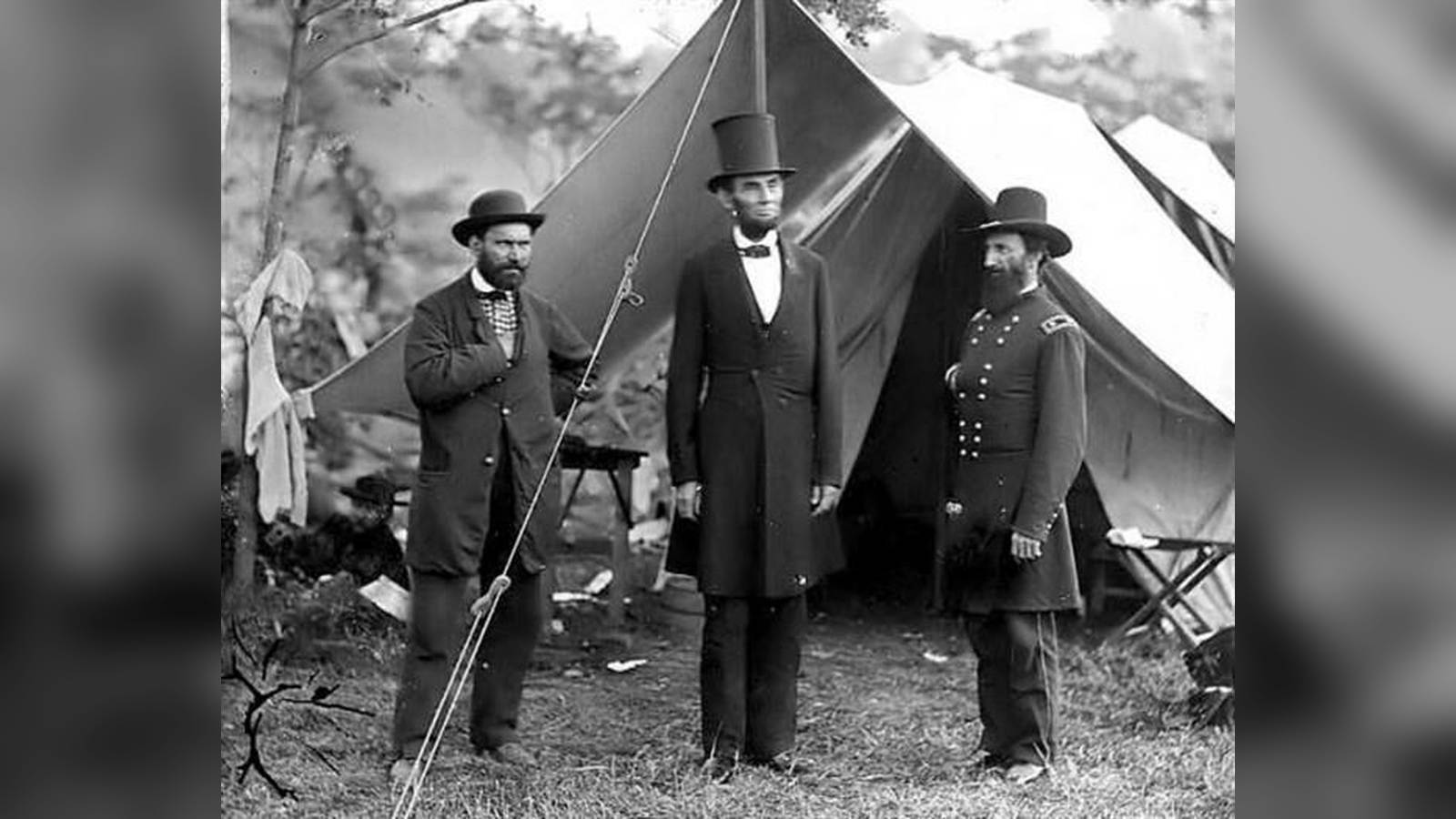
This iconic photograph captures President Abraham Lincoln standing on the scarred earth of the Antietam battlefield in early October 1862, just weeks after the conflict that claimed more lives in a single day than any other in American history. The image serves as a haunting witness to the weight of executive responsibility during the Civil War, posing a fundamental question for history: how does a leader reconcile the cold, strategic necessity of total war with the staggering, visceral toll of its violence? In the frame, the president appears not as a triumphant commander, but as a man burdened by the grim reality of the carnage he was tasked with overseeing.
What the photograph shows
In the photograph, President Lincoln stands in a landscape that had only recently been a site of unimaginable slaughter. He is dressed in a somber, dark frock coat and a tall top hat, his gaunt, angular frame casting a long, thin shadow across the Maryland countryside. The terrain, though quiet at the moment of the shutter release, was the site of the September 17, 1862, battle that resulted in over 20,000 casualties. The stillness of the photograph contrasts sharply with the frantic, violent activity that had defined the location only a few weeks prior. His posture is stiff, perhaps due to the long exposure times required by the wet-plate collodion process of the era, yet his expression conveys a profound, weary introspection that seems to transcend the technical limitations of the camera. The background, largely obscured by the depth of field, hints at the vast, desolate space where soldiers had fought, bled, and died.
The moment behind the image
The photograph was taken by Alexander Gardner on October 2, 1862. Lincoln had traveled to the Antietam battlefield to confer with General George B. McClellan, the commander of the Army of the Potomac. The president’s visit was marked by deep political and military frustration; he was profoundly dissatisfied with McClellan’s reluctance to pursue the retreating Confederate forces after the Union’s tactical victory at Antietam. This visit solidified Lincoln’s resolve to replace the general, an act he would carry out in November 1862. The atmosphere in the camp was one of strained diplomacy and heavy reflection as the president confronted the physical reality of the war he was tasked with winning. By walking the ground where thousands had perished, Lincoln was effectively bridging the gap between the abstract policy-making of the White House and the human cost of his administration’s decisions.
Photographer and provenance
Alexander Gardner, a Scottish immigrant who originally worked for Mathew Brady, was the man behind the lens. Gardner’s work is noted for its raw, unflinching documentation of the Civil War. Unlike many of his contemporaries who focused exclusively on studio portraits or posed military scenes, Gardner ventured into the field to capture the immediate aftermath of battles. This particular image is held by the National Archives and is widely recognized as one of the most significant visual records of Lincoln’s wartime leadership. Gardner later published his work in the ‘Photographic Sketch Book of the War,’ ensuring these moments were preserved for posterity. The provenance of the photo is well-documented, though it is important to note that many photos of this period were attributed to Brady’s gallery rather than the individual photographer, reflecting the studio-centric business model of 19th-century photography. Gardner’s own career eventually led him away from the battlefield and into the documentation of the American West, but his Civil War work remains his most enduring legacy.
Historical context
The Battle of Antietam was a pivotal turning point in the American Civil War. While it provided the strategic victory Lincoln needed to issue the preliminary Emancipation Proclamation, it also underscored the sheer scale of the death toll that the nation was beginning to accept as the new reality of the war. By visiting the field, Lincoln was not just inspecting troops; he was confronting the human cost of the Union’s survival. The photograph serves as a bridge between the political decisions made in Washington and the grim, tangible consequences faced by soldiers on the front lines. It captures a moment where the war ceased to be a series of dispatches and became a physical, unavoidable presence in the president’s life. The visual record of this visit, including this specific portrait, allowed the American public to see their leader in the context of the war’s devastation, humanizing the presidency in a way that had never been possible before the advent of photography.
Why it still matters
This image remains a powerful symbol of the burden of leadership. It stripped away the artifice of wartime propaganda, presenting a president who was visibly affected by the destruction he witnessed. For the modern viewer, the photograph serves as a reminder of the fragility of national unity and the profound, often tragic, choices that define historical turning points. It captures the exact moment when the leader of a nation looks upon the cost of his own policies, a moment of silence in the midst of a deafening historical storm. The photograph is not merely a document of a visit; it is a meditation on the cost of power and the indelible scars left upon a nation by its most violent conflicts.