


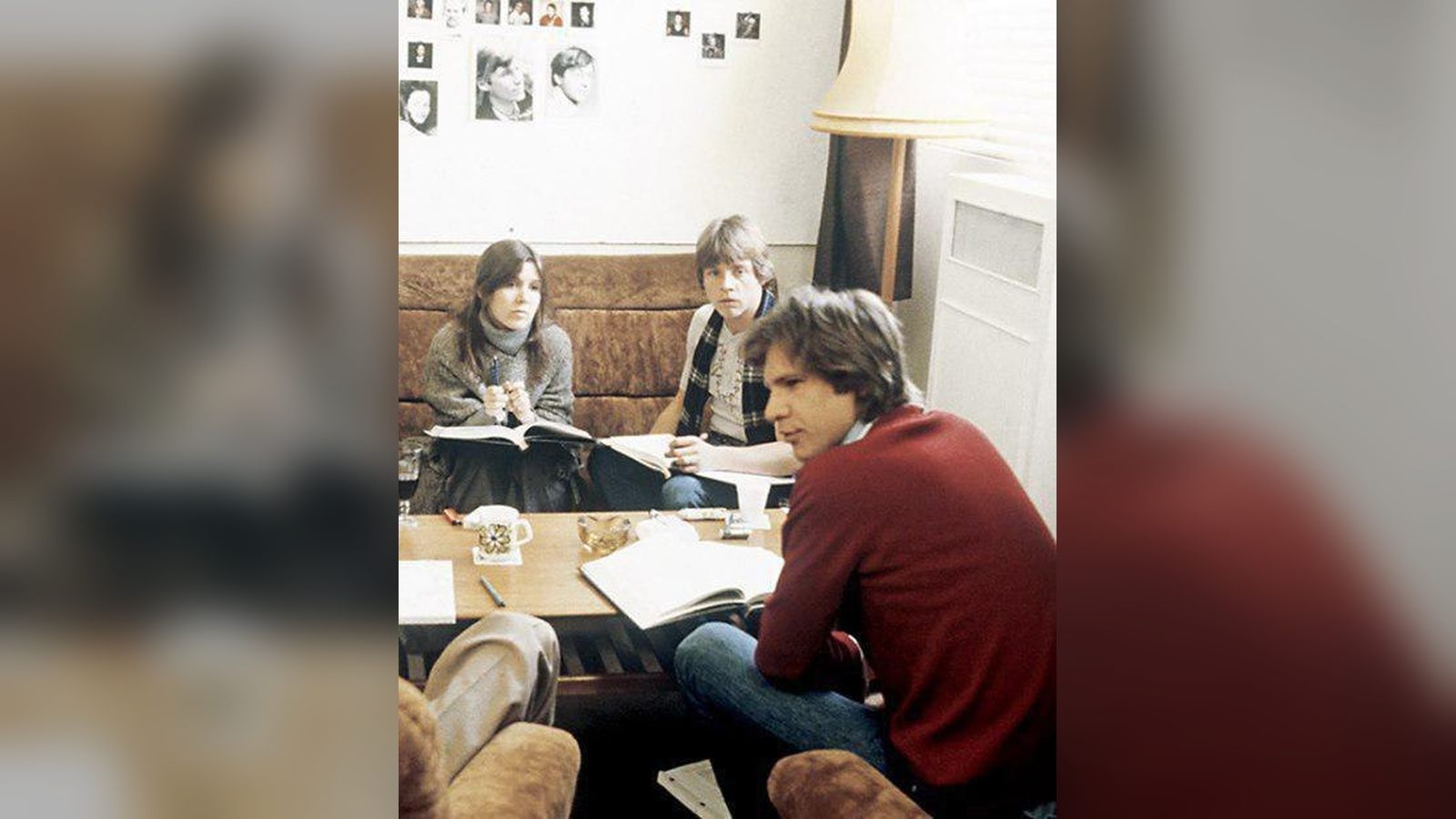
In this candid 1979 photograph from the production and promotional period of Star Wars: Episode V – The Empire Strikes Back, Carrie Fisher, Mark Hamill, and Harrison Ford stand together in an unscripted moment of quiet ease. Stripped of Princess Leia’s royal gowns, Luke Skywalker’s hero tunic, and Han Solo’s iconic holster, the three young actors share a warm, relaxed connection that feels entirely removed from the galactic stakes unfolding on screen. Taken at a pivotal turning point when the runaway success of the original 1977 Star Wars had catapulted them into global household names, the photograph captures a rare instance of raw human camaraderie during one of the most demanding film productions in Hollywood history. How did a brief, off-camera pause between three rising performers come to encapsulate the emotional spine of cinema’s greatest sci-fi saga?
What the photograph shows
The photograph centers on the magnetic chemistry between Fisher, Hamill, and Ford, arranged in a tight, natural group that reveals their genuine off-screen familiarity. Carrie Fisher occupies the middle of the frame, her posture relaxed and her radiant smile reflecting the quick-witted, generous spirit her co-stars frequently praised in interviews. To her left, Mark Hamill leans in with a boyish, open expression, his casual demeanor contrasting sharply with the burdened Jedi-in-training persona he was developing for the second film. Harrison Ford stands beside them, projecting a quiet, effortlessly charismatic composure, wearing casual late-1970s attire rather than his character’s rugged Corellian vest. The lighting is soft and unstudied, free from the high-contrast theatrical illumination used on the set, casting a warm tone over their faces and highlighting the unvarnished reality of three young friends taking a breath together away from the cameras.
The moment behind the image
The shutter clicked in 1979 amidst an intensely physical and high-stakes production calendar for The Empire Strikes Back. Principal photography had begun under harsh conditions in the sub-zero blizzards of Finse, Norway, before transitioning to the cavernous soundstages of Elstree Studios in Hertfordshire, England. Directed by Irvin Kershner, the film required rigorous emotional performances, intricate wirework for lightsaber duels, and complex interaction with groundbreaking mechanical effects like the Yoda puppet created by Stuart Freeborn and operated by Frank Oz. Alongside the grueling shooting schedule, the trio was frequently called upon for studio photo calls, media interviews, and early promotional tours across North America and Europe. Caught in between tight scene setups and publicity obligations, this photograph captures a fleeting interlude where the three actors could drop the immense burden of expectations and simply enjoy each other’s company.
Photographer and provenance
The image originated as part of the official unit photography and unit publicity documentation commissioned by Lucasfilm Ltd. during 1979. Set photographers and publicity officers were routinely stationed on set and at promotional appearances to generate press materials, fan club mailings, and magazine features for outlets like PreVIEW and Starlog. While individual unit photographers on 1970s blockbusters were rarely credited publicly in syndicate press releases—their work usually stamped under general studio or distributor copyright—the photograph was systematically cataloged within the Lucasfilm photographic archive. Over the following decades, as the image was distributed to press syndicates and later digitized for retrospective retrospectives, it transformed from a routine publicity asset into an revered historical document of classic cinema.
Historical context
When this photo was taken in 1979, the stakes for The Empire Strikes Back could not have been higher. Creator George Lucas had taken the extraordinary financial risk of self-financing the sequel using personal loans and profits from the 1977 original, aiming to preserve complete creative independence from major Hollywood studios. Furthermore, late-1970s Hollywood was skeptical of sequels, which were widely regarded as cheap cash-ins that rarely matched the quality of their predecessors. To succeed, the movie needed to deepen its characters and test their relationships in darker, more mature ways. The authentic, personal connection between Fisher, Hamill, and Ford served as the anchor for the entire project; without their genuine rapport, the emotional weight of Han and Leia’s romance or Luke’s agonizing internal journey would have faltered.
Why it still matters
More than four decades after it was taken, this candid snapshot remains a beloved artifact for generations of moviegoers worldwide. Created long before the advent of digital red carpets, social media branding, and carefully scripted talent appearances, the image records an era of movie stardom defined by spontaneity and vulnerability. Following Carrie Fisher’s untimely death in December 2016, pictures like this have acquired a deep, nostalgic resonance, serving as poignant reminders of the youth, affection, and creative energy that birthed a cultural phenomenon. The frame continues to remind fans that behind the galactic battles, groundbreaking special effects, and iconic villains, the true magic of Star Wars lived in the human heart of its central trio.