


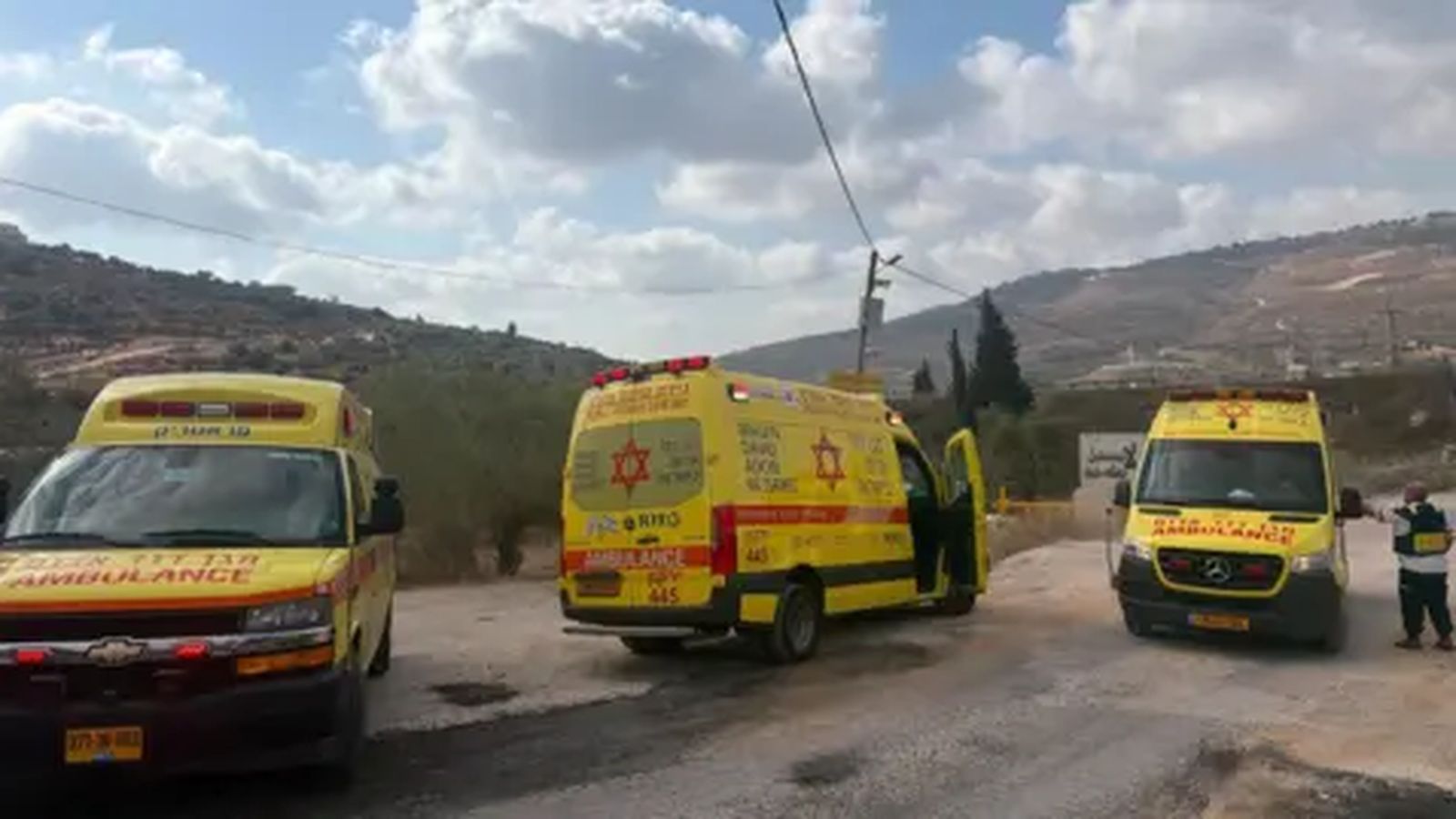
A highly volatile security crisis has engulfed the northern West Bank following a deadly clash in the Palestinian village of Tell, southwest of Nablus, which left four Palestinians and two Israelis dead. The incident, which occurred on Friday, July 24, 2026, has triggered a massive overnight military sweep by the Israel Defense Forces (IDF), the sealing of major regional transport arteries, and a wave of retaliatory violence by Israeli settlers across multiple Palestinian communities.
The Disputed Catalyst in Tell
According to reports from the BBC, Haaretz, and PBS Newshour, the initial confrontation in Tell—a village designated as Area B under the 1993 Oslo Accords—remains subject to starkly conflicting narratives. Palestinian eyewitnesses, including local resident Ahmed Zeidan, stated that the violence began early in the morning when approximately 30 armed Israeli settlers from nearby outposts entered the village and began attacking Palestinian homes. Local residents rushed to confront the group, leading to hand-to-hand clashes before Israeli military personnel arrived on the scene.
Conversely, the IDF maintained that its forces responded to an emergency report that uncoordinated Israeli civilian hikers had been attacked by Palestinians. According to the military’s statement, a security guard from a nearby unauthorized settler outpost arrived at the scene to assist the hikers. The IDF alleges that a Palestinian resident snatched the guard’s weapon and shot him dead. A second Israeli casualty, identified as an IDF soldier, was also killed during the subsequent operational response, though the exact circumstances of his death remain under investigation.
Visual evidence circulating on social media and partially verified by Israeli media outlets has complicated the official narratives. One video shows a physical altercation involving Palestinians, Israeli soldiers, and armed Israelis in civilian clothing, during which civilians—including children—look on as the armed Israelis push and kick Palestinian residents. A second video captured from a different angle shows two Palestinian men attempting to disarm the Israelis, with one successfully grabbing a weapon before shots are fired. Crucially, a third video confirmed by the military shows IDF soldiers firing repeatedly at a group of Palestinians who were already lying on the ground in a field. The IDF confirmed that the man who snatched the weapon was among those killed but did not provide an explanation for the deaths of the other three Palestinians, who were all members of the same family.
Massive IDF Military Sweep and Regional Lockdowns
In the immediate aftermath of the clash, the IDF declared its intention to execute “extensive counterterrorism operational activity in the sector.” Overnight, Israeli forces launched a coordinated wave of raids targeting at least 10 Palestinian towns and villages across the West Bank. In Tell, soldiers searched dozens of homes, including those belonging to the families of the deceased Palestinians, resulting in the detention of more than 20 residents.
The military operations quickly expanded beyond Tell. Significant forces entered the Jenin Governorate, targeting a residential compound near the Arab American University housing displaced persons from the Jenin Refugee Camp. Additional incursions were reported in Tulkarm, Qalqilya, the town of Azzun, Qaryut—where soldiers reportedly deployed tear gas against residential structures—and the Aqabat Jaber refugee camp in Jericho. In East Jerusalem, raids were conducted in the Kafr Aqab neighborhood, located behind the separation wall. Furthermore, IDF forces raided a hospital in Nablus, arresting two wounded Palestinians who were undergoing treatment for injuries allegedly sustained during the Tell shootout.
To restrict movement and prevent further mobilization, the IDF established checkpoints and completely sealed all entrances to Nablus and its surrounding villages, a measure confirmed by the advocacy group Physicians for Human Rights Israel. In response to the rapidly deteriorating security environment, the U.S. Embassy in Jerusalem issued an emergency security alert, strictly limiting personal travel for U.S. government personnel and their families within the West Bank.
Retaliatory Settler Violence
The deaths of the two Israelis triggered immediate, coordinated retaliatory attacks by settlers against surrounding Palestinian villages, often referred to as “price tag” actions. According to the Palestinian Red Crescent Society (PRCS) and local municipal officials, the violence spread rapidly on Friday evening.
In the town of Surra, west of Nablus, Mayor Naaman Abdullah reported that dozens of settlers assaulted residents, completely or partially burned six homes, torched five vehicles, and set fire to agricultural lands. PRCS ambulance crews transported several injured residents to local hospitals. Similar incursions occurred in Urif, which was raided twice within a matter of hours, resulting in arson attacks on residential properties. In Khirbet Imreiha, near Ya’bad, settlers reportedly threw stones at homes and used pepper spray against residents, causing multiple injuries.
Political Fallout and Rhetorical Escalation
The escalation has intensified political divisions within Israel and drawn sharp condemnation from Palestinian authorities. Israeli Prime Minister Benjamin Netanyahu convened an emergency meeting with senior security officials, vowing to act “with full force against the terrorists and those who orchestrate and sponsor them.”
However, statements from far-right ministers within Netanyahu’s coalition have drawn widespread alarm. National Security Minister Itamar Ben-Gvir publicly declared that the villages of “the murderers” must be treated in the same manner as the Gaza Strip, asserting, “For every Jew murdered, the enemy must suffer the loss of land and homes.” Finance Minister Bezalel Smotrich echoed these sentiments, arguing that the villages of Tell, Iraq Burin, and Beit Furik “need to look exactly like the refugee camps in Nablus and Tulkarm,” referring to the extensive demolition campaigns carried out by the military in those areas. Smotrich explicitly called for the evacuation of Palestinian populations from these villages to facilitate the clearing of “terrorist infrastructure.”
These remarks were met with fierce criticism from opposition figures and human rights organizations. Yair Golan, leader of Israel’s Democrats Party and a former IDF major general, characterized the government’s rhetoric as “a clear intent to set the area ablaze.” Yuli Novak, executive director of the Israeli human rights group B’Tselem, warned that millions of Palestinians are now “completely exposed to further attacks, with no one protecting them,” as political leaders openly incite revenge.
The Palestinian Foreign Ministry issued a formal statement condemning what it termed a “massacre” in Tell, attributing the surge in violence directly to the “protection, political backing, and complete impunity granted by the Israeli government and occupation forces” to settler groups.