
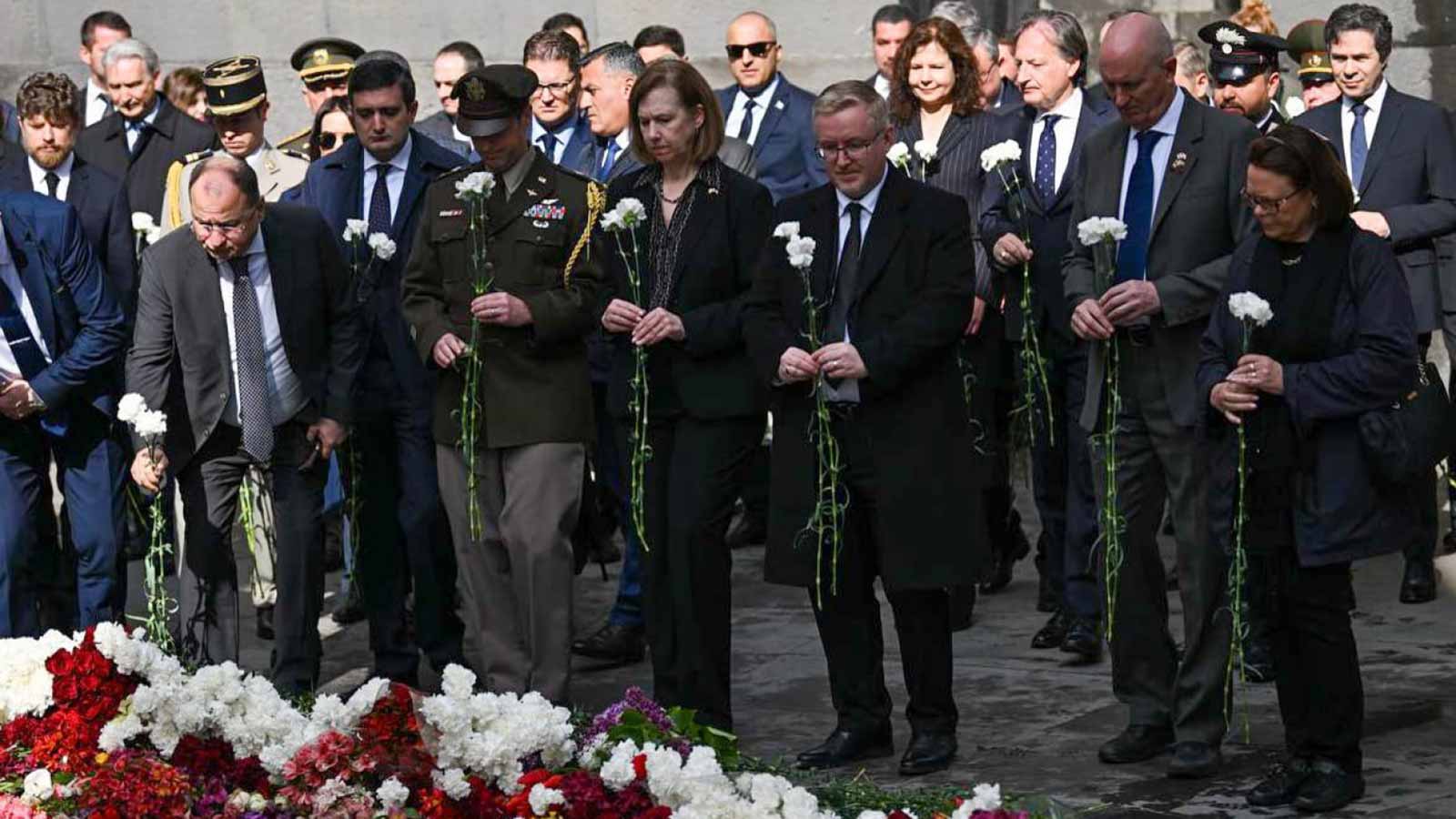
- Foreign diplomats in Armenia, including France, US and Russia’s Ambassadors, paid tribute at Tsitsernakaberd on April 24, 2025.
- They laid flowers at the Eternal Flame to commemorate the victims of the 1915 Armenian Genocide.
- The commemoration marked the 110th anniversary of the Genocide.
- Statements from the Polish and Lithuanian Embassies and the Czech Ambassador referenced their countries’ recognition and commitment to prevention.
- Poland’s Parliament recognized the Genocide in 2005, and the Czech Parliament recognized it in 2017.
Foreign Diplomats Honor Armenian Genocide Victims at Tsitsernakaberd on 110th Anniversary in Yerevan – 2025
On April 24, 2025, the day marked as the 110th anniversary of the Armenian Genocide, diplomatic representatives from various countries accredited in the Republic of Armenia gathered in Yerevan to participate in acts of remembrance. These diplomats visited the Tsitsernakaberd Armenian Genocide Memorial Complex to pay their respects to the memory of the victims of the atrocity that commenced in 1915 in the Ottoman Empire. Their presence and gestures underscored the international dimension of commemorating this historical crime against humanity.
Tribute Paid at the Eternal Flame at Tsitsernakaberd
A central point of the commemorative activities at Tsitsernakaberd is the Eternal Flame, located within the memorial complex. Foreign diplomats, including the Ambassador of the Russian Federation to Armenia, Sergey Kopirkin, and representatives from other countries, laid flowers at this symbolic flame. The act of laying flowers at the Eternal Flame is a traditional and solemn gesture observed annually on April 24. It serves as a tangible way for individuals and official representatives to demonstrate their remembrance and reverence for the victims.
The Tsitsernakaberd complex itself is a site dedicated to the memory of those who perished during the Armenian Genocide. Visiting this memorial on the anniversary is a significant act of recognition and solidarity with the Armenian people as they mourn their losses and reflect on the historical events of 1915. The participation of foreign diplomatic corps highlights the global importance of acknowledging and remembering such widespread human tragedies.
Statements from Diplomatic Missions and Ambassadors
In conjunction with their presence at the memorial or through official communication channels, several diplomatic missions and ambassadors in Armenia conveyed messages related to the commemoration. These statements provided insights into their respective countries’ positions on the Armenian Genocide and the significance of remembering the victims. The content of these messages varied, with some referencing official recognition by their governments or parliaments, while others focused on the importance of remembrance and prevention of future atrocities.
Poland: Referencing 2005 Parliamentary Recognition
The Embassy of the Republic of Poland in Armenia utilized its Facebook page to communicate its message on the 110th anniversary. The Embassy’s post specifically referenced a significant historical event related to Poland’s stance on the Armenian Genocide: the recognition of the atrocity by the Polish Parliament, the Sejm. According to the Embassy’s post, the Sejm adopted a decision recognizing the Armenian Genocide on April 19, 2005. The Embassy included a direct quote from this parliamentary decision in its message. The quote stated, “The Sejm of the Republic of Poland pays tribute to the memory of the victims of the genocide committed against the Armenian population in Turkey during World War I. Honoring the memory of the victims of that atrocity and condemning the crime is a moral obligation of all mankind, states, and people of good will.” By sharing this quote, the Polish Embassy reiterated its country’s official position and the moral reasoning behind its recognition.
Czech Republic: Ambassador’s Visit and 2017 Recognition Date
His Excellency Petr Pirunčík, the Ambassador Extraordinary and Plenipotentiary of the Czech Republic to Armenia, was among the foreign diplomats who visited the Tsitsernakaberd Memorial Complex. Ambassador Pirunčík documented his visit and shared his reflections on his personal Facebook page, including a photograph taken at the memorial site. In his public post, the Czech Ambassador explicitly referenced the date of the commemoration, stating, “Today, April 24, we commemorate the 110th anniversary of the victims of the Armenian Genocide.” Furthermore, Ambassador Pirunčík highlighted his country’s official recognition by providing the specific date of this act: “8 years ago, on April 25, 2017, the Parliament of the Czech Republic recognized the Armenian Genocide.” His presence at Tsitsernakaberd and his clear reference to the date of the Czech parliamentary recognition underscored the Czech Republic’s official acknowledgment and its participation in the global commemoration.
Russia: Expression of Shared Mourning
The Embassy of the Russian Federation in Armenia also conveyed a message concerning the 110th anniversary of the Armenian Genocide. In a statement distributed through the Embassy’s social media networks, a message of solidarity and shared grief was expressed. The statement from the Russian Embassy noted, “We mourn together with the Armenian people on the occasion of the day of remembrance of the victims of the Armenian Genocide in the Ottoman Empire.” This direct expression of mourning together with the Armenian people highlights Russia’s position on the historical event and its empathy with the descendants of the victims. The participation of the Russian Ambassador Sergey Kopirkin in the flower-laying ceremony at the Tsitsernakaberd Memorial Complex further solidified this message of shared remembrance and grief on behalf of the Russian Federation.
Lithuania: Emphasis on Prevention of Recurrence
Ambassador Andrius Pulokas, the Ambassador of the Republic of Lithuania to Armenia, was also present at Tsitsernakaberd on April 24 to pay tribute to the memory of the Armenian Genocide victims. A message from the Embassy of Lithuania in Armenia underscored a crucial aspect of commemorating such atrocities: the commitment to preventing them from happening again. The Embassy’s message stated, “By honoring the victims, we remain committed to preventing the recurrence of such atrocities.” This statement links the act of historical remembrance directly to the forward-looking imperative of preventing genocide and other crimes against humanity, emphasizing the educational and cautionary value of acknowledging the past.
Context of the 110th Anniversary and Annual Commemoration
The year 2025 marks the 110th anniversary of the Armenian Genocide, a somber milestone for the Armenian people worldwide. The global Armenian diaspora, spread across numerous countries, observes this anniversary with various events aimed at remembrance, education, and advocacy for continued recognition and justice. In Yerevan, Armenia, the annual commemoration on April 24 is a central event. It traditionally involves a large-scale mourning procession, where hundreds of thousands of Armenians silently walk to the Tsitsernakaberd Memorial Complex. Participants lay flowers at the Eternal Flame and the Genocide Memorial Wall, paying tribute to the memory of the approximately 1.5 million victims who perished during the Genocide. The participation of foreign diplomats in this deeply significant national observance highlights the increasing international awareness and acknowledgment of the Armenian Genocide as a historical fact.
Significance of International Diplomatic Participation
The presence of foreign diplomats at the Tsitsernakaberd Memorial Complex on April 24 holds symbolic and substantive significance. Their participation demonstrates their respective countries’ recognition of the importance of this day for the Armenian people and their willingness to show solidarity. In cases where countries have officially recognized the Armenian Genocide, the visit serves as a reaffirmation of that stance. For countries that have not yet done so, the visit can be seen as a gesture of humanitarian concern and remembrance. The collective presence of diplomats from various nations underscores the universal nature of the crime of genocide and the shared human responsibility to remember and condemn such atrocities.
Commitment to Remembrance and Prevention: A Shared Global Responsibility
The statements issued by the Embassies of Poland, Lithuania, and the Czech Ambassador, among potentially others, reflect a shared commitment that extends beyond mere historical acknowledgment. The Polish Sejm’s quote speaks of a “moral obligation” for all humanity and states. The Lithuanian Embassy explicitly links honoring victims to preventing recurrence. The Czech Ambassador’s visit on the day following his country’s recognition anniversary reinforces the ongoing nature of this commitment. The Russian Embassy’s expression of mourning together highlights a sense of shared humanity in the face of immense loss. These messages collectively underscore the understanding that remembering past genocides is not just about looking backward, but also about informing present and future efforts to prevent similar crimes, promoting human rights, and fostering a global culture of peace and mutual respect.
A Day of Global Remembrance in Yerevan
As the world’s Armenian community marked the 110th anniversary of the Armenian Genocide on April 24, 2025, the Tsitsernakaberd Memorial Complex in Yerevan became a focal point for international remembrance. Foreign diplomats stationed in Armenia, including the Ambassadors of Russia, Lithuania, and the Czech Republic, along with representatives from other nations, paid their respects by laying flowers at the Eternal Flame. Statements from their respective embassies and ambassadors reiterated their countries’ positions, with Poland and the Czech Republic specifically referencing their parliamentary acts of recognition in 2005 and 2017, respectively. The Lithuanian Embassy emphasized the commitment to preventing the recurrence of such atrocities, while the Russian Embassy expressed shared mourning. The presence and messages of these diplomats underscored the international recognition of the Armenian Genocide and the collective global responsibility to remember the victims, learn from history, and work towards a future where such crimes are never repeated.