


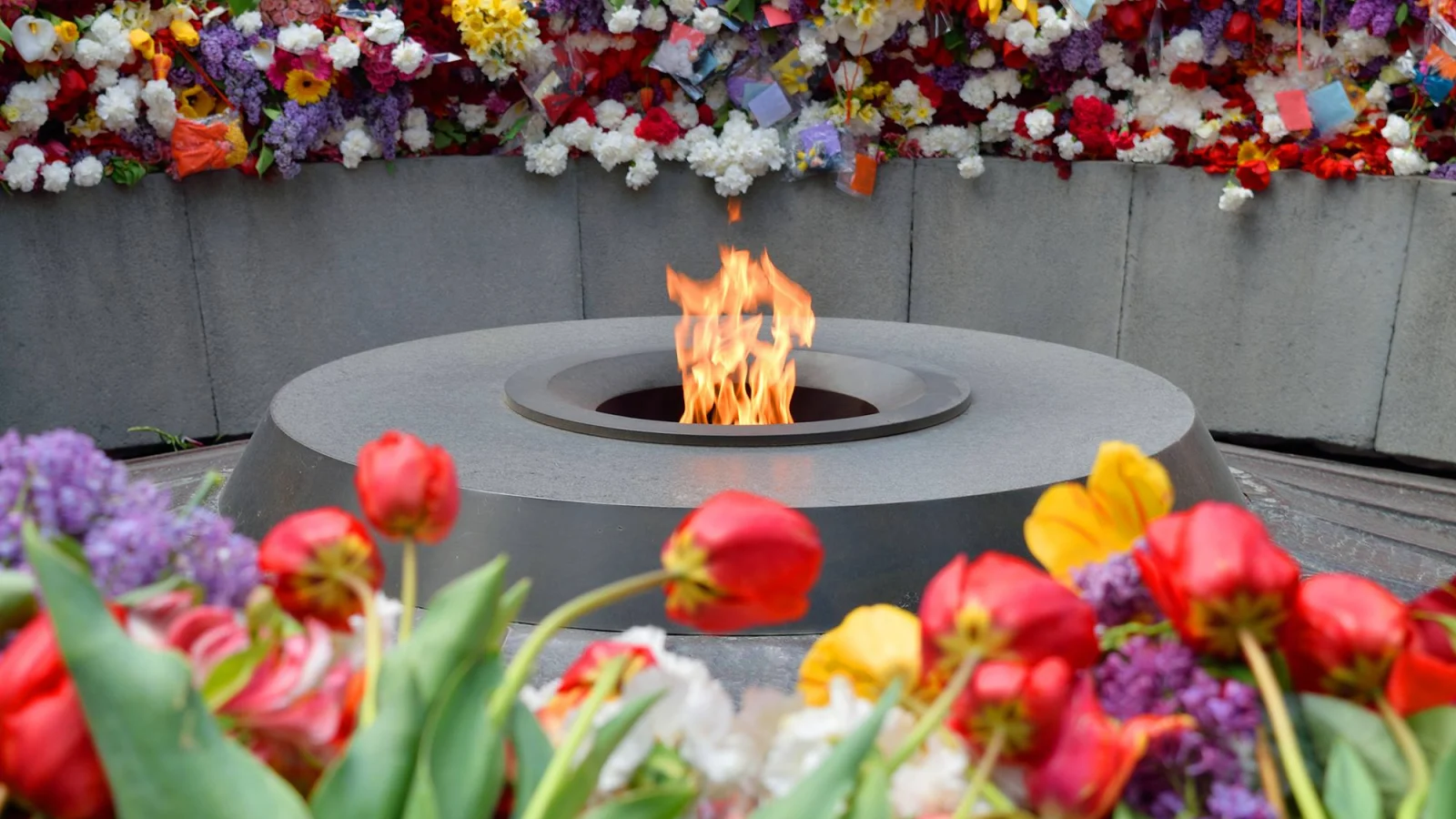
- Armenia’s political elite, led by Prime Minister Nikol Pashinyan, visited Tsitsernakaberd on April 24, 2025, for the Armenian Genocide 110th anniversary commemoration.
- His Holiness Garegin II, Catholicos of All Armenians, also visited the memorial and held a service.
- Messages from the HRD, MFA, PM, and NA Speaker addressed the Genocide’s historical facts, remembrance, and importance of statehood.
- Official statements referenced the 1.5 million victims, atrocities, and destruction of cultural heritage.
- Emphasis was placed on genocide prevention, international recognition efforts (including UN initiatives), and overcoming the tragedy through a secure state.
Armenia’s State and Church Leadership Commemorate 110th Anniversary of Armenian Genocide at Tsitsernakaberd – 2025
On April 24, 2025, the Republic of Armenia marked the 110th anniversary of the Armenian Genocide. On this solemn day of national remembrance, the country’s political leadership, headed by Prime Minister Nikol Pashinyan, visited the Tsitsernakaberd Armenian Genocide Memorial Complex in Yerevan to pay tribute to the victims. The visit and accompanying messages from key state and religious figures underscored the national significance of the day and the country’s ongoing focus on remembrance, justice, and prevention.
Visit of Political Leadership to Tsitsernakaberd Memorial
The Armenian political elite arrived at the Tsitsernakaberd Memorial Complex to participate in the commemorative events. Prime Minister Nikol Pashinyan led the delegation. He was accompanied by the Speaker of the National Assembly, Alen Simonyan, and the President of the Republic of Armenia, Vahagn Khachaturyan. The visit included the full complement of government members, demonstrating a united approach by the executive and legislative branches in commemorating the anniversary. Their presence at the memorial complex, a central site of remembrance for the Armenian Genocide, is an annual tradition that highlights the state’s commitment to honoring the memory of the victims and acknowledging the historical events of 1915.
Catholicos Garegin II Pays Tribute and Holds Service
Alongside the state leadership, the spiritual head of the Armenian Apostolic Church, His Holiness Garegin II, Supreme Patriarch and Catholicos of All Armenians, also visited the Tsitsernakaberd Memorial Complex. He was accompanied by brethren from the Mother See of Holy Etchmiadzin. The visit of the Catholicos and clergy added a spiritual dimension to the day’s commemorations. At the memorial, near the Eternal Flame, His Holiness Garegin II presided over an intercessory service dedicated to the holy martyrs of the Armenian Genocide. This religious service is a traditional act of prayer and remembrance for the souls of those who perished.
Human Rights Defender Highlights Unresolved Rights and Historical Facts
On the occasion of the 110th anniversary, the Human Rights Defender (HRD) of the Republic of Armenia, Anahit Manasyan, issued a message. Her message commenced by noting the global acknowledgment of the historical event, stating, “Today the civilized world commemorates the memory of the holy martyrs of the first genocide of the 20th century, the Great Crime.” HRD Manasyan recounted the fate of Armenians living in Ottoman Turkey at the beginning of the last century, who she stated were subjected to “organized mass atrocities: brutal murders, forced displacement, and inhumane torture.” Her message also drew attention to the continued impact of these events on individuals, emphasizing that despite “continuously improving mechanisms for the protection of human rights,” the rights of those “forcibly displaced from their native homes and subjected to inhumane torture have not been restored to this day.”
MFA Statement Underscores Loss and the Fight Against Genocide
The Ministry of Foreign Affairs (MFA) of the Republic of Armenia also released a statement for the 110th anniversary. The MFA’s message paid tribute to the victims, stating, “Today, on the 110th anniversary of the Armenian Genocide, we pay tribute to and commemorate the memory of 1.5 million Armenians martyred as a result of the genocide.” The statement detailed aspects of the atrocity, noting that in the last period of the Ottoman Empire’s existence, “a significant portion of the Armenian people, including children, women, and elderly people, were annihilated based on their national affiliation.” The MFA highlighted not only the human loss but also the cultural destruction and material appropriation, stating that their material property was appropriated and “a significant part of their rich historical and cultural heritage, which spans thousands of years, was destroyed.”
The MFA statement connected the historical event to international legal efforts, asserting that the “understanding of the imperative to prevent such atrocities as the Armenian Genocide led to the necessity of legally defining the crime of Genocide, which was manifested in the adoption of the 1948 UN Convention on the Prevention and Punishment of the Crime of Genocide.” However, the Ministry lamented that the Great Crime “sadly not only did not remain the last atrocity against humanity in the 20th century, but we continue to witness new mass crimes based on hatred, racial and ethnic intolerance also in the 21st century.” The MFA emphasized Armenia’s proactive role in the global fight against genocide, stating that Armenia “continues to be actively involved in initiatives aimed at early detection, quick response, prevention, and exclusion of such crimes.” The statement referenced Armenia’s efforts leading to the designation of December 9 as the UN International Day of Commemoration and Dignity of the Victims of the Crime of Genocide and of the Prevention of this Crime in 2015. It also highlighted the consensus adoption of Armenia’s “Prevention of Genocide” resolution at the 55th session of the UN Human Rights Council in April 2024. According to the MFA, all these efforts are aimed at ensuring that the slogan “never again” is transformed into reality. The statement concluded by affirming Armenia’s forward-looking perspective, stating, “The Republic of Armenia today remembers the past and looks to the future, striving to build an environment for future generations free from discrimination and violence, based on tolerance, respect, the protection of human rights, and the values of peace.”
[Source: Provided reports from Armenian Officials and Institutions]
Prime Minister Pashinyan’s Message on Overcoming Tragedy Through Statehood
Prime Minister Nikol Pashinyan delivered a message on the occasion of the 110th anniversary of the Armenian Genocide, focusing on the theme of overcoming the historical tragedy through the strengthening of Armenian statehood. He began by commemorating the innocent victims of the “Great Crime, the Armenian Genocide, who fell victim to the massacres and mass displacements that escalated from 1915.” The Prime Minister described these events during the final period of the Ottoman Empire’s existence as having left “a deep mark on the soul and consciousness of every Armenian,” noting that for many citizens of Armenia, the genocide is “not only a national but also a family, personal tragedy.” He framed overcoming this tragedy as a “key issue in our national agenda for more than a century.”
Prime Minister Pashinyan articulated his view on the means of overcoming this tragedy, stating that his reflections lead to the conclusion that “a developed, sovereign, secure, that is, a Republic of Armenia with delimited and demarcated borders, is the means of overcoming the tragedy of the Great Crime, the pledge of our loyalty to all the sacrifices and victims of our people.” He listed the components he believes are essential for keeping the memory of the victims alive and overcoming the tragedy: “State and state interests, the Republic of Armenia with internationally recognized territory, regulated relations with neighbors, open borders, peace, work, welfare, a free and protected citizen.” These elements, he argued, represent the path forward. Prime Minister Pashinyan characterized following this path not as a matter of optimism or pessimism, but as a “mission to ensure the perpetual existence of the Republic of Armenia, our homeland-state.” He expressed the belief that after enduring cruel trials and tragedies, the Armenian people have “earned this opportunity,” and this opportunity “must not be missed.” He concluded his message by stating his conviction that “we, the people and the governing team they elected, will not miss this opportunity for the sake of our martyrs and for the sake of our future generations,” followed by the phrases “Glory to the martyrs and long live the Republic of Armenia.”
National Assembly Speaker Simonyan’s Message on Memory and Future
The Speaker of the National Assembly, Alen Simonyan, also issued a message on the 110th anniversary of the Armenian Genocide. He described April 24 as “one of our nation’s heavy and sad days of national memory.” Speaker Simonyan paid tribute to the victims, stating, “On this day, we commemorate the memory of one and a half million innocent Armenians who became victims of genocide simply for being Armenian.” He characterized the Armenian Genocide as a “deep wound of history that resonates with the voice of justice today.” Speaker Simonyan emphasized the commitment to building a strong future for Armenia, stating, “Our commitment is to build a united, strong, and peaceful Armenia, based on the lessons of the past and aimed at a stable future.” He articulated a perspective on the role of memory, stating, “We do not forget what happened, but we do not want memory to become only a source of pain and mourning; it should make us more determined and far-sighted in our future steps.” His message concluded with a reaffirmation of commitment, stating, “We bow before the memory of all martyrs and reaffirm our commitment to protect our statehood, value peace, and ensure a dignified future for our generations,” followed by the phrase “Eternal glory to the innocent victims.”
Context of the 110th Anniversary and Annual Commemoration Tradition
The commemoration on April 24, 2025, falls on the 110th anniversary of the Armenian Genocide, a date deeply embedded in the historical memory of the Armenian people. The date marks the mass arrests and deportations of Armenian intellectuals and community leaders from Constantinople in 1915, which are widely considered the start of the Genocide. Every year on this day, Armenians around the world participate in various commemorative events. In Yerevan, the capital of Armenia, a major component of the annual observance is the traditional mourning procession to the Tsitsernakaberd Memorial Complex. Hundreds of thousands of citizens silently walk to the memorial throughout the day to lay flowers at the Eternal Flame and the memorial wall, paying their respects to the nearly 1.5 million victims of the Genocide. This annual tradition provides a collective space for remembrance and reaffirmation of the demand for justice and recognition.
Conclusion: National Unity in Remembrance and Commitment to the Future
On the 110th anniversary of the Armenian Genocide, Armenia’s state and church leadership demonstrated national unity in commemorating the victims at the Tsitsernakaberd Memorial Complex. The visit of the Prime Minister, President, Speaker of the National Assembly, and government members, alongside the Catholicos of All Armenians, highlighted the profound national significance of the day. The messages delivered by the Human Rights Defender, the Ministry of Foreign Affairs, the Prime Minister, and the National Assembly Speaker collectively conveyed a multifaceted approach to remembrance, emphasizing the historical facts, the fight for international recognition and prevention of genocide, and the crucial role of a strong, sovereign Armenian state in overcoming the enduring consequences of the tragedy and securing a peaceful future for future generations. These statements, rooted in the memory of the 1.5 million victims and the atrocities of 1915, articulate a path forward that balances remembrance of the past with a determined commitment to building a secure and prosperous future for the Republic of Armenia.