
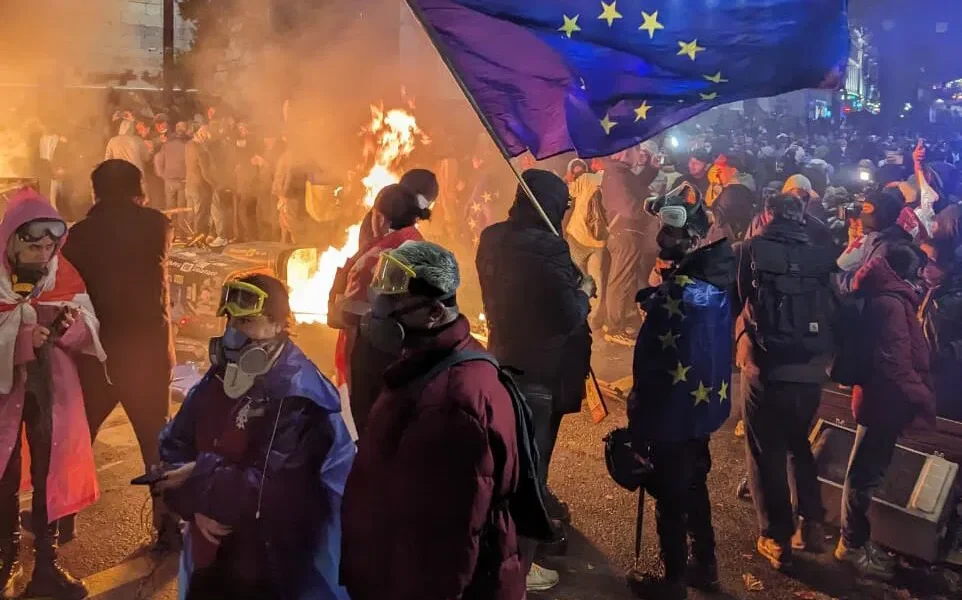
The Georgian Dream (GD) party’s decision to suspend EU accession negotiations until 2028 has ignited a political storm across Georgia. Announced by Prime Minister Irakli Kobakhidze, the decision has led to widespread protests, accusations of democratic backsliding, and condemnation from local and international voices. Critics argue that the move undermines Georgia’s constitutional commitment to European integration and isolates the country from its Western allies.
The GD’s announcement comes amidst accusations of vote-rigging in the October 26 parliamentary elections, which opposition parties and President Salome Zurabishvili have rejected. Citizens in cities such as Tbilisi, Batumi, Kutaisi, and Zugdidi have taken to the streets, demanding the reversal of the government’s decision and the restoration of Georgia’s pro-European path.
On November 29, Rustaveli Avenue in Tbilisi was closed to traffic as demonstrators gathered in front of the Parliament. Police have mobilized heavily in the area, using tear gas, pepper spray, and water cannons against protesters, some of whom have been injured.
Several universities, including Free University and Agrarian University, have temporarily suspended classes in solidarity with the protesters. Students from Tbilisi State University have organized marches, condemning the GD’s decision as a betrayal of Georgia’s European aspirations.
Reports of police targeting journalists have emerged, with at least 20 cases of physical and verbal assaults recorded during the protests. Transparency International Georgia has called on law enforcement to cease violent measures against peaceful demonstrators.
President Zurabishvili has described the decision as a “constitutional coup” and has called on citizens, civil servants, and the military to support the people’s demand for a European future. She criticized the Georgian Dream for steering the country away from its democratic path and warned of the existential threat posed by Russian influence.
The EU, alongside officials from Germany, Sweden, Lithuania, and the U.S. Helsinki Commission, has expressed disappointment in Georgia’s decision. EU Ambassador Paweł Herczyński called the move “heartbreaking,” emphasizing its potential to derail Georgia’s aspirations for integration into the European family.
Professors from Tbilisi State University and employees of the State Services Development Agency have condemned the GD’s decision, stressing its negative impact on education, international cooperation, and the nation’s strategic interests.
The suspension of EU accession talks marks a turning point in Georgia’s foreign policy, raising concerns about the country’s democratic trajectory and its place in the global order. As protests continue and international scrutiny intensifies, Georgia’s leadership faces mounting pressure to reconsider its stance.