

Quick Read
- Henry Winkler described Robin Williams’ imagination as a ‘Mount Vesuvius’ during his ‘Happy Days’ debut.
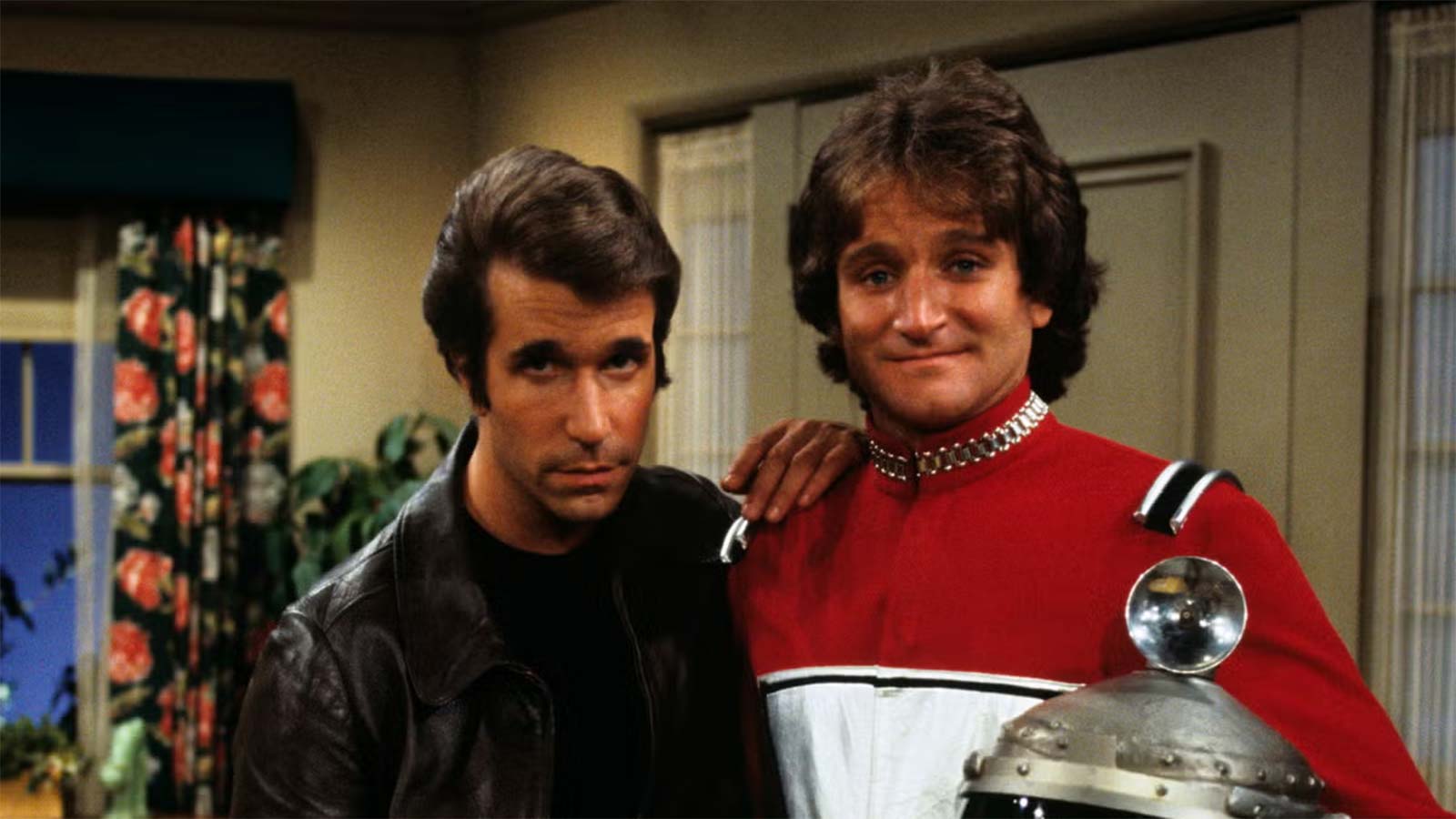
- Williams made his screen debut as Mork the alien in the fifth season of ‘Happy Days.’
- Williams’ improvisational skills led to scripts being shortened, with writers leaving space for his spontaneous lines.
- The cast and audience immediately recognized Williams’ talent, prompting the creation of ‘Mork & Mindy.’
Robin Williams’ First Screen Debut: A Star is Born on ‘Happy Days’
When Henry Winkler, the iconic Fonzie of ‘Happy Days,’ sat down at FanExpo San Francisco in late 2025, the conversation inevitably turned to one of the most electrifying guest appearances in television history. Winkler, now 80, reminisced about the moment Robin Williams walked onto the set in the show’s fifth season—an unassuming newcomer who would soon leave an indelible mark not only on the cast but on the future of comedy itself.
Williams’ role as Mork, the quirky alien from Ork, wasn’t just a guest spot; it was his screen debut. According to Winkler, Williams arrived quietly, blending in among the regulars. But once the script landed in his hands, everything changed. Instead of responding to Winkler’s playful challenge in character as Fonzie, Williams broke into song and dance from ‘West Side Story,’ instantly revealing the boundless energy and unpredictability that would define his career.
“Stay out of his way,” Winkler advised himself, realizing that Williams’ imagination was like a “Mount Vesuvius”—uncontainable, erupting with ideas. From the very first scene, it was clear Williams operated on a different frequency. The writers quickly learned to adapt: ‘Mork & Mindy’ scripts were famously shorter, often leaving gaps with the note, “Robin will say something here,” trusting his improvisational magic to fill the space. Winkler recalled, “Our scripts were 54 pages long. His, on his set, they were 30 pages long.”
The Birth of ‘Mork & Mindy’: Improvisation Becomes Legend
Williams’ improvisational style was so unique that the cast and crew had to change their approach. Garry Marshall, the creator of ‘Happy Days,’ described Williams as “all over the place and improvising some,” and emphasized how the main cast gave guest stars room to shine. The result? At the end of Williams’ debut episode, the live audience—300 strong—rose to their feet in a rare standing ovation. It was a moment that made Marshall instantly realize Williams was ready for his own show.
Thus, ‘Mork & Mindy’ was born. Williams’ portrayal of Mork captivated viewers, and he returned to ‘Happy Days’ for another episode, but it was clear his trajectory was set. The writers of ‘Mork & Mindy’ embraced his unpredictability, crafting scripts that left room for spontaneous brilliance. Winkler and his colleagues learned to expect the unexpected, and Williams delivered—every single time.
Williams’ Legacy: Impact on Cast, Crew, and Beyond
Williams’ approach didn’t just affect his own work; it changed how others operated. Directors, like Chris Columbus of ‘Mrs. Doubtfire,’ had to invent new ways to capture Williams’ performances, sometimes rolling “almost 2 million feet of film” to make sure every improvisational gem was recorded. Columbus used four cameras at once, not just to follow Williams but to catch his costars’ spontaneous reactions to his unpredictability.
Other actors and writers who worked with Williams recall similar experiences. Sonia Manzano, famed for her decades on ‘Sesame Street,’ shared with People how Williams could take a script and transform it: “He actually used two words that I actually wrote,” she joked, marveling at how he could make even the smallest part his own.
Williams’ improvisational skill was not only legendary but contagious—his presence elevated the energy on set and challenged everyone to bring their best, knowing they might be swept up in a whirlwind of creativity at any moment.
Why Winkler’s Story Resonates: Lessons from a Comedy Volcano
Winkler’s recollection isn’t just nostalgia; it’s a reminder of what happens when true creativity is given space to flourish. Williams, as Winkler described, was not simply a performer—he was a force of nature. The cast and crew learned to “stay out of his way,” not out of fear, but out of respect for a talent that could not be contained by convention.
Those who witnessed Williams’ debut remember a singular moment in television when the ordinary was transformed into something extraordinary. The standing ovation wasn’t just for a performance—it was for a phenomenon. Williams’ improvisational gifts would go on to touch countless lives, on and off screen, leaving a legacy of laughter and inspiration.
In the years since, Winkler and others have continued to celebrate Williams’ genius. Stories of his spontaneous acts of kindness, his creative generosity, and his relentless energy serve as both inspiration and benchmark for future generations. As Winkler put it, working with Williams meant learning new rules—ones that still apply to anyone seeking to push the boundaries of what’s possible in entertainment.
Robin Williams’ debut on ‘Happy Days’ wasn’t just a star’s arrival—it was the eruption of a “Mount Vesuvius of imagination” that changed the landscape of television comedy, forever.
Winkler’s tribute to Williams is a testament to the transformative power of creative freedom. Williams’ improvisational genius not only reshaped ‘Happy Days’ and spawned ‘Mork & Mindy,’ but it also set a new standard for what television could be when artists are trusted to unleash their true potential.