


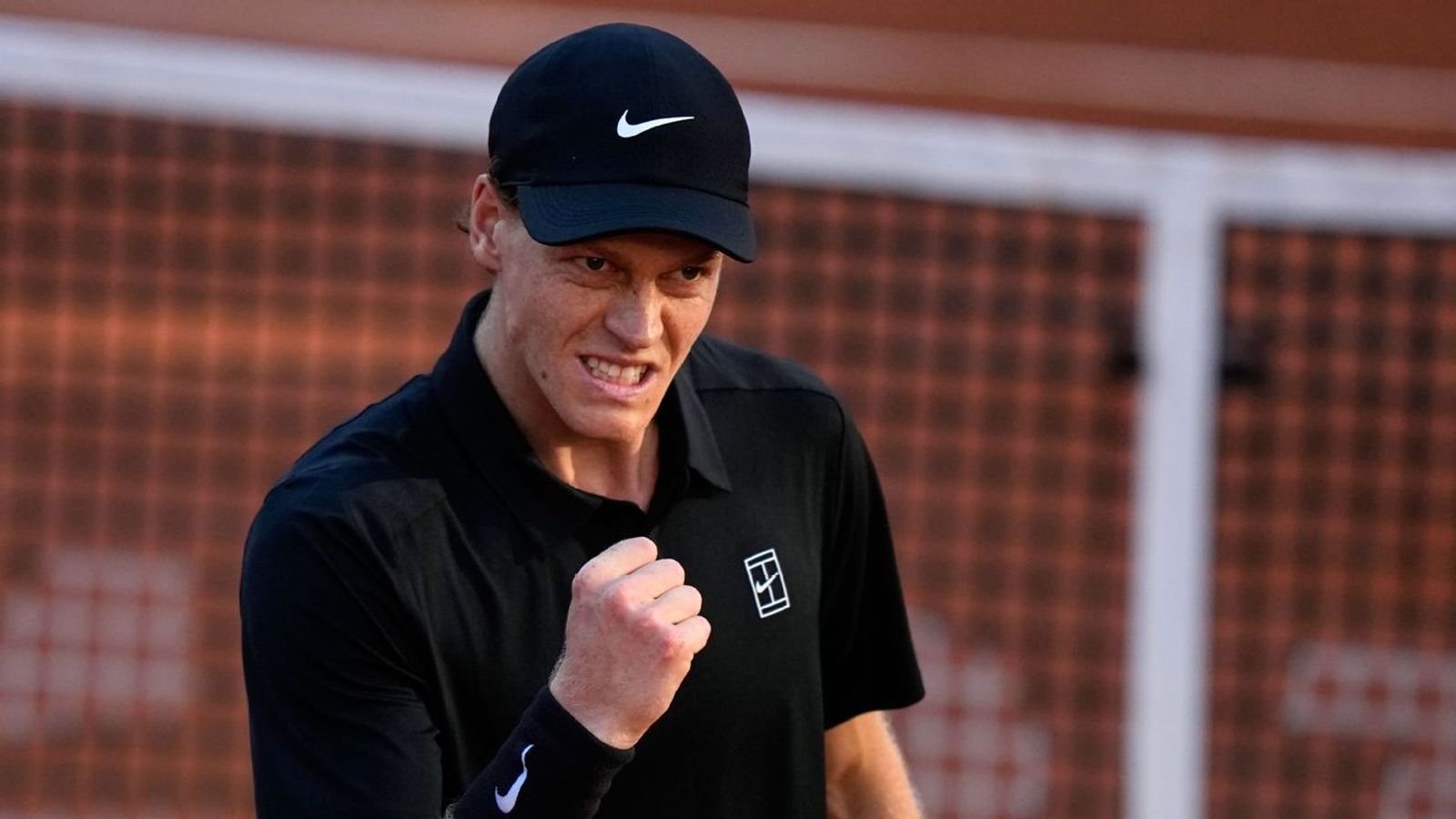
The Coronation at Foro Italico
In a performance that solidified his standing as the preeminent force in professional tennis, Jannik Sinner defeated Casper Ruud 6-4, 6-4 on Sunday to capture his first Italian Open title. The victory carries profound institutional weight, as Sinner becomes only the second man in the history of the ATP Tour to complete the career ‘Golden Masters’—winning all nine active ATP Masters 1000 tournaments. This achievement places the 24-year-old Italian in the exclusive company of Novak Djokovic, who previously stood alone in this statistical pantheon. The significance of the moment was amplified by its location; Sinner is the first Italian man to lift the trophy in Rome since Adriano Panatta in 1976, ending a half-century drought for the host nation.
Tactical Mastery and Technical Precision
The final against Ruud, a seasoned clay-court specialist, served as a microcosm of Sinner’s current technical evolution. Despite an early 2-0 deficit in the opening set, where Ruud utilized heavy baseline returns to pressure the Italian, Sinner demonstrated the psychological resilience that has become his trademark. He adjusted his positioning, neutralizing Ruud’s topspin with aggressive flat hitting and well-timed drop shots. The match swung decisively at 4-4 in the first set, when Sinner broke Ruud’s serve with a series of relentless forehand winners, eventually closing the set at 6-4. The second set followed a similar trajectory of controlled aggression, culminating in a spectacular forehand overhead winner that sent the capacity crowd at Stadio Centrale into a frenzy.
Statistical Milestones and Global Implications
The metrics surrounding Sinner’s current run are nothing short of historic. His victory in Rome marks his 29th consecutive win, a streak dating back to early March. Furthermore, he has now secured 34 consecutive match wins at the Masters 1000 level, the longest such streak in the history of the tour. By sweeping the three clay-court Masters events this season (Monte-Carlo, Madrid, and Rome), he joins Rafael Nadal (2010) as the only player to achieve this feat. Perhaps most impressively, Sinner reached the career Golden Masters at age 24, significantly younger than Djokovic, who was 31 when he completed the set in 2018. This rapid accumulation of elite titles suggests a standard of consistency across surfaces that challenges the traditional narratives of court specialization.
Institutional Impact and the Italian Renaissance
The event was attended by Italian President Sergio Mattarella, highlighting the national importance of Sinner’s ascent. The ‘Sinner effect’ has catalyzed a broader resurgence in Italian tennis, exemplified by Simone Bolelli and Andrea Vavassori’s victory in the men’s doubles—the first homegrown doubles title in Rome in 66 years. The atmosphere at the Foro Italico, characterized by soccer-style chanting and a sea of orange-clad supporters, reflects Sinner’s status as Italy’s most popular athlete. Beyond the cultural impact, the institutional support from the Italian Tennis Federation has created a pipeline of talent that Ruud himself acknowledged during the trophy ceremony, noting that Italy currently boasts a depth of talent that is ‘taking tennis by storm.’
The Path to Roland-Garros
As the tour shifts to Paris for the French Open, Sinner enters as the overwhelming favorite, with betting markets placing him at -275. With Carlos Alcaraz sidelined by a wrist injury and Novak Djokovic navigating a transitional phase, Sinner has a clear path to becoming the seventh man in the Open Era to complete the career Grand Slam. A victory at Roland-Garros would also grant him the ‘Djokémon’—a colloquial term for holding every major title in tennis, including all four Slams, all nine Masters, and the ATP Finals. Given his current form and 17-0 record on clay this year, the prospect of Sinner rewriting the record books in Paris appears increasingly likely.
The ascent of Jannik Sinner represents more than a mere change in the ATP rankings; it signals a fundamental shift in the sport’s competitive architecture. By achieving the career Golden Masters at just 24—seven years younger than Novak Djokovic—Sinner has demonstrated a level of multi-surface proficiency that was previously thought to be the exclusive domain of the ‘Big Three.’ His ability to combine raw baseline power with the tactical nuance required for clay-court success suggests that the transition from the era of legendary veterans to the new generation is not only complete but has produced a protagonist capable of unprecedented statistical consistency. As the tour moves toward Roland-Garros, Sinner’s dominance poses a profound challenge to his peers, establishing a new benchmark for excellence that balances national expectation with global institutional authority.