


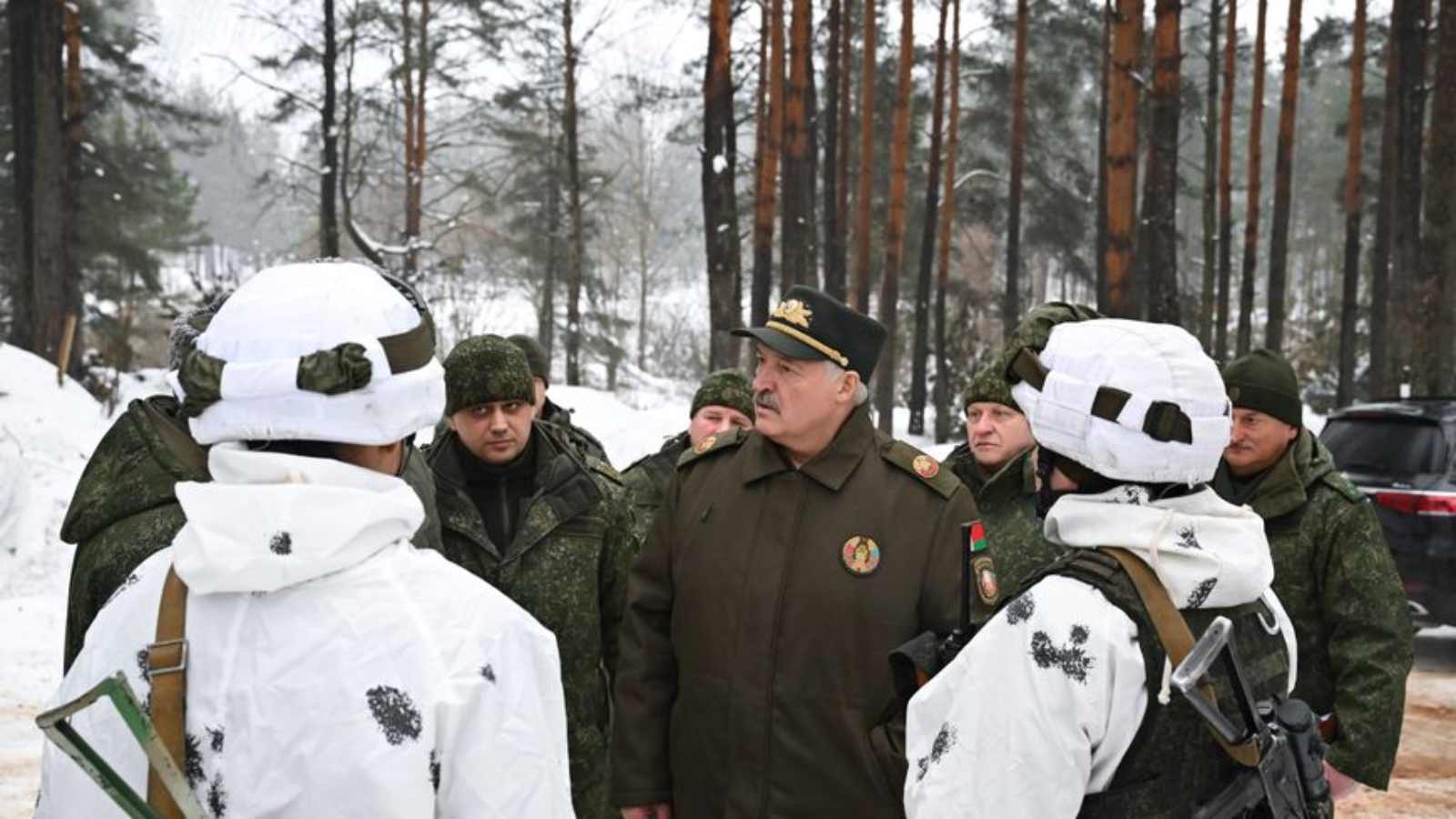
MINSK (Azat TV) – Belarusian President Aleksandr Lukashenko has declared that the country must operate under a permanent state of military readiness, warning his high-ranking commanders that the era of peacetime normalcy has ended. The announcement followed a meeting on March 30, where the president reviewed the results of a comprehensive, surprise inspection of the Armed Forces that had been underway since mid-January 2026.
A Shift to Wartime Operational Doctrine
Lukashenko characterized the recent maneuvers as the largest of their kind in the history of independent Belarus, noting that the objective was to simulate wartime conditions without allowing for traditional administrative buffers. By bypassing standard Defense Ministry channels and placing units on sudden combat alert, the President claimed the inspection provided an unvarnished look at the military’s actual capabilities. “There can be no peacetime. We are preparing for war,” Lukashenko stated, emphasizing that the expenditure of state funds is only justified if the army remains a credible deterrent against external threats.
Internal Oversight and Counterintelligence Mobilization
To ensure the accuracy of the inspection, the President mobilized the State Security Committee (KGB), the Prosecutor’s Office, and the State Control Committee to monitor for false reporting. Lukashenko acknowledged that “corporate solidarity” within military ranks often masks systemic failures, prompting him to demand direct, unmediated information from counterintelligence agencies. The inspection focused heavily on the readiness of the Western and Northwestern Operational Commands, as well as special operations and air defense units, amid a deteriorating geopolitical climate along the country’s borders.
Heightened Regional Tensions and Political Fallout
The conclusion of these drills coincides with a period of intense regional friction. On April 1, a Belarusian court sentenced Lithuanian national Myroslav Trotsky to 15 years in prison on espionage charges, a move that prompted the Lithuanian government to issue renewed warnings regarding the risks of travel to Belarus. Meanwhile, the political opposition, led by Sviatlana Tsikhanouskaya, has criticized the regime’s alignment with Moscow, particularly as the country marks the anniversary of the Union State of Belarus and Russia. These developments underscore a broader trend of isolation and militarization as Belarusian authorities continue to prioritize internal security and military consolidation over diplomatic engagement.
The intensification of these military exercises, coupled with the explicit rejection of ‘peacetime’ as a viable status, suggests that the Belarusian leadership is attempting to institutionalize a state of permanent mobilization to deter perceived external threats while simultaneously suppressing internal dissent.