


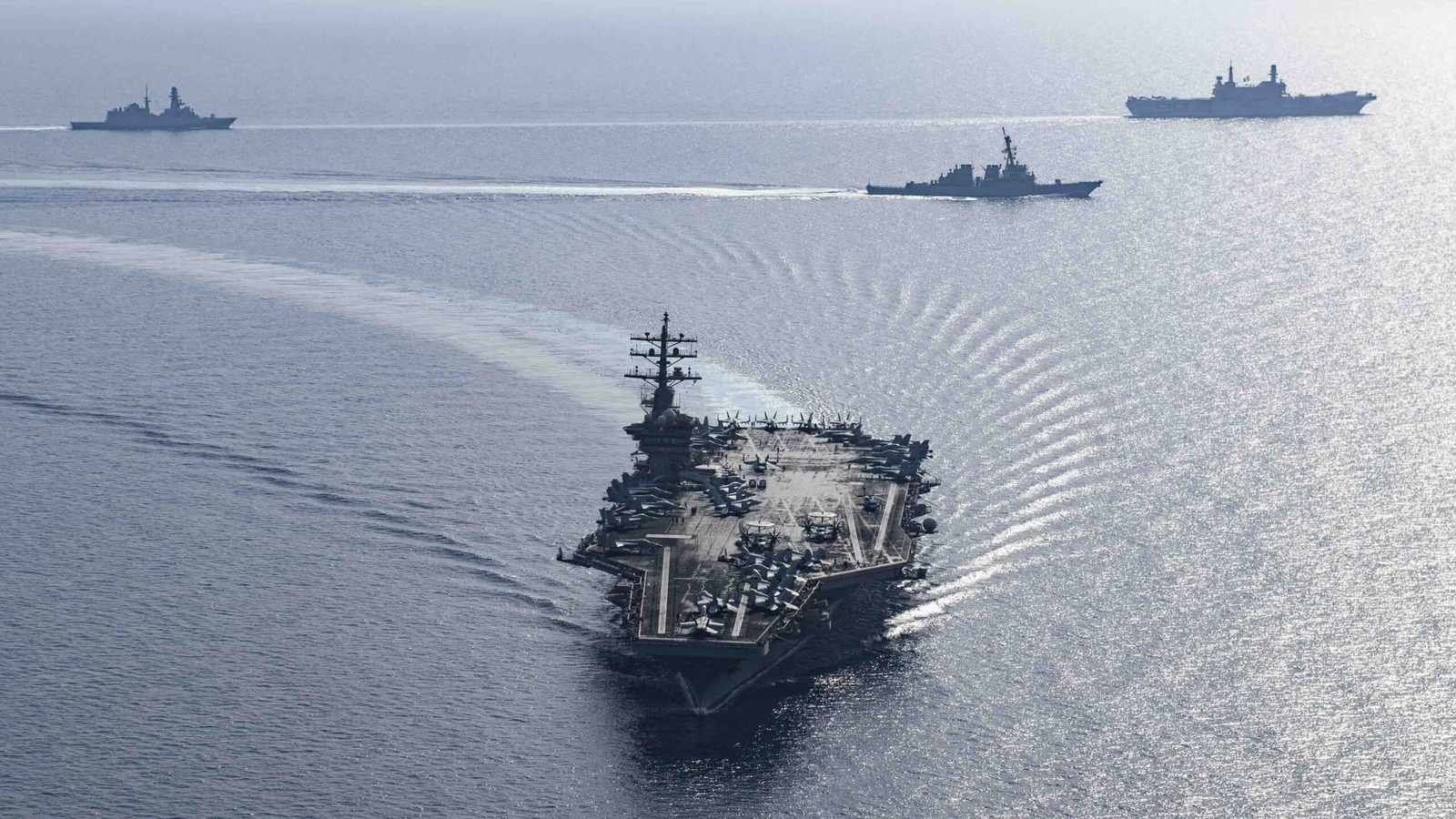
The U.S. military is relocating the aircraft carrier USS George Washington out of the South China Sea to the Middle East, relieving the USS Abraham Lincoln after an extended operational deployment. The redeployment highlights growing tensions in the Middle East and the operational trade-offs confronting the Pentagon as it prioritizes naval readiness in multiple threat theaters.
Naval Rotation and Deployment Pressures
The USS Abraham Lincoln departed San Diego on November 21, 2025, entering a deployment that surpassed the standard six-month timeframe. The mission became the longest continuous U.S. naval deployment since the Cold War, generating widespread discussion regarding fleet sustainment and crew welfare. Family members and naval personnel raised concerns over mental health strains and logistical bottlenecks during the prolonged period at sea.
Responding to reports of onboard strain, Acting Navy Secretary Hung Cao traveled to the carrier to conduct a direct assessment and assure crew members of their scheduled return. Former Chairman of the Joint Chiefs of Staff retired Adm. Mike Mullen noted that extended carrier deployments historically risk wearing down crews and equipment, emphasizing the structural need for timely rotations. Mullen added that U.S. Central Command Chief Adm. Brad Cooper confirmed shipboard support services had been reinforced and crew morale had significantly improved once the return timeline was formalized.
Political Scrutiny in Washington
The deployment extension drew swift reactions on Capitol Hill. Democratic Senator Ruben Gallego of Arizona criticized the administration’s strategic planning regarding naval commitments, citing testimony from military families and calling for a congressional investigation into deployment scheduling and crew support systems. Gallego argued that long deployments without clear rotation schedules put unacceptable strain on service members.
In contrast, executive officials defended the operational timeline. Defense Secretary Pete Hegseth stated that public reports mischaracterized the situation on board, maintaining that operational requirements dictated the carrier’s presence. President Donald Trump pushed back against criticism regarding deployment length, asserting that operational imperatives in the Middle East took precedence.
Indo-Pacific Strategic Balance
The movement of the USS George Washington leaves the Western Pacific without a U.S. aircraft carrier strike group, raising strategic questions among regional allies. The departure coincides with recent Chinese naval maneuvers in proximity to the Philippines and Japan, two central U.S. treaty allies in the region. Defense analysts from the Hudson Institute noted that the temporary absence of carrier firepower could be leveraged by Beijing to project diplomatic influence and question the long-term durability of American security guarantees in the South China Sea.
Addressing these concerns, Adm. Frank Bradley, head of U.S. Special Operations Command, traveled to Manila to reaffirm commitment to the Philippines. Bradley emphasized that global force projection capabilities allow the U.S. military to respond to contingencies worldwide, assuring regional partners that naval forces will reorient toward the Pacific once operational demands in the Middle East stabilize. However, defense experts warn that high operational tempo across two theaters risks creating shipyard maintenance backlogs, potentially impacting overall carrier availability in coming years.