


3I/ATLAS: The Third Interstellar Object Stirs the Scientific Pot
When the third confirmed interstellar object, 3I/ATLAS, glided into our solar system, it did more than just traverse millions of miles of empty space—it landed squarely in the heart of a scientific debate. Unlike its predecessors, 1I/‘Oumuamua and 2I/Borisov, 3I/ATLAS has become a lightning rod for questions about bias, expertise, and the openness of the astronomical community to the unknown. Reuters and the European Space Agency have documented its journey, but the real story is unfolding in research circles.
Avi Loeb Challenges the Status Quo
Harvard astrophysicist Avi Loeb has never shied away from controversy, and his latest salvo targets what he calls the “arrogance of expertise” surrounding 3I/ATLAS. In a December 2025 blog post, Loeb criticizes both NASA and fellow researchers for brushing aside the comet’s anomalies, despite the fact that $90 million was spent investigating sterile neutrinos—an ultimately fruitless pursuit. “Testing potential explanations of anomalies,” Loeb insists, “is at the foundation of scientific frontiers.”
So what makes 3I/ATLAS so peculiar? Loeb lists thirteen anomalies, the most striking of which is the so-called “anti-tail.” After poring over Hubble Space Telescope images taken before and after the comet’s closest approach to the Sun, Loeb notes that the anti-tail’s physics remain unresolved. Unlike typical comets, where the tail is swept away from the Sun by solar radiation and wind, 3I/ATLAS displays a sunward jet—defying conventional wisdom. “The anti-tail must therefore contain something else,” Loeb argues, inviting the scientific community to step beyond its comfort zone.
The Visual Journey: From Mars to Earth
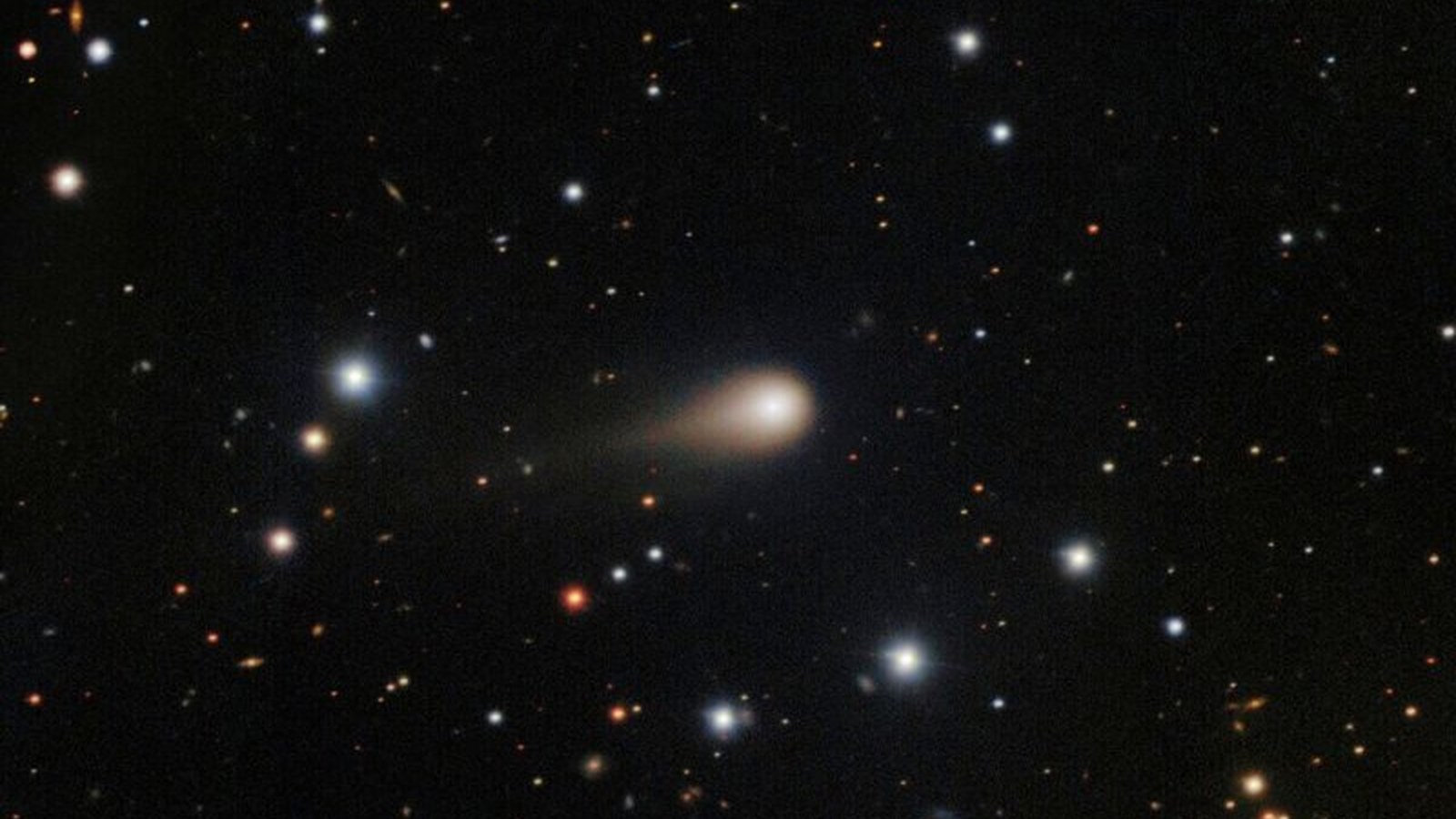
While debate rages in the theoretical realm, telescopes and spacecraft have been busy capturing 3I/ATLAS’s journey. In October, the European Space Agency’s ExoMars Trace Gas Orbiter, circling Mars, snapped images of the comet as it passed just 18.6 million miles away. NASA’s Lucy spacecraft also caught the comet in a series of stacked images, tracking its approach to Mars.
Later, NASA’s Hubble Space Telescope reobserved 3I/ATLAS, this time when it was about 178 million miles from Earth. The result: a luminous point of light against a backdrop of streaking stars, a visual testament to its alien origin. NASA released these images with plans for further study as 3I/ATLAS continues its outbound journey.
Other missions joined the chase: the sun-watching PUNCH satellites, the Solar and Heliospheric Observatory, and the Perseverance Rover on Mars all contributed data. SPHEREx observations revealed that the comet’s coma—its hazy cloud of gas and dust—was rich in ice water and carbon dioxide, resembling comets born within our own solar system. Yet, this similarity is just one layer in a puzzle that grows stranger the deeper scientists look.
Anomalies or Alien Technology? The Boundaries of Possibility
If you ask Loeb, the anomalies of 3I/ATLAS deserve more than a passing glance. He recalls how another scientist, Chris Lintott, dismissed his speculative sentence about possible technological origins as “nonsense on stilts”—a phrase that stings in a field built on curiosity. Loeb’s original line pondered whether the comet’s trajectory and size could hint at technological design, given the limited interstellar reservoir of rocky materials.
For Loeb, the pushback against such ideas is a symptom of a deeper problem. He points out that failed sterile neutrino studies were never met with such skepticism, yet any mention of “alien technology” triggers a backlash. It’s not about proving extraterrestrial intelligence, he argues, but about remaining open to unlikely explanations when faced with unexplained phenomena. “There are no experts in interstellar objects,” Loeb notes—after all, humanity has only seen three so far.
What’s Next for 3I/ATLAS?
As 3I/ATLAS speeds out of the solar system, the data continues to pour in. NASA has announced plans for further observations, hoping to decode the nature of the anti-tail and other oddities. Meanwhile, the debate over interpretation remains unresolved, a mirror of larger questions about how science should confront the unknown.
Is 3I/ATLAS just an icy rock, shaped by forces we don’t fully understand? Or could it be evidence of something more? For now, the comet is a test case—not just for our instruments, but for our willingness to challenge the boundaries of expertise and the inertia of dogma.
The Broader Implications: Bias and the Frontiers of Knowledge
The story of 3I/ATLAS is not just about one comet. It’s about how science moves forward. Loeb’s critique of bias and his call for open-mindedness may be uncomfortable, but it’s essential. When the history of interstellar exploration is written, it will not just be a catalog of discoveries, but a chronicle of the arguments and attitudes that shaped them.
From the halls of Harvard to the control rooms of NASA and ESA, 3I/ATLAS forces a reckoning: Are scientists ready to follow the data, wherever it leads? Or will the comfort of expertise—and the fear of ridicule—hold them back?
The saga of 3I/ATLAS reveals a simple truth: the edge of scientific discovery is rarely tidy. Anomalies are not just obstacles; they are invitations to rethink what we know. Whether 3I/ATLAS is a cosmic oddity or something more, its passage reminds us that progress in science demands courage—not just in observation, but in interpretation. The real frontier is not in the stars, but in our willingness to ask the uncomfortable questions.