


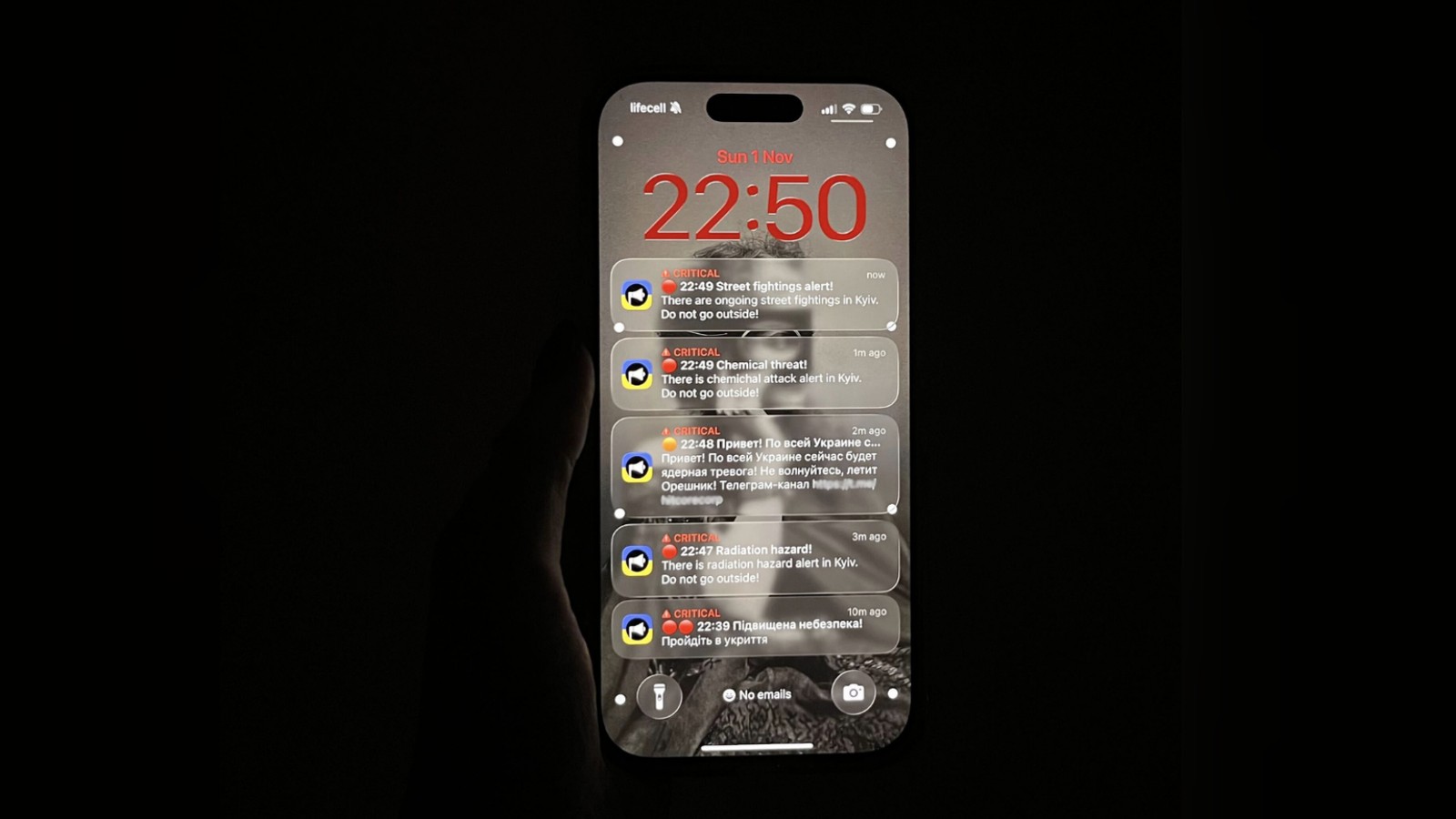
Official emergency air alert smartphone applications in both Ukraine and Russia suffered cyberattacks on Sunday night, November 1, 2026, triggering a wave of false notifications warning of nuclear, chemical, and tactical attacks, as reported by the BBC. The unauthorized alerts in Ukraine began at approximately 22:47 local time, deploying red-level air raid warnings nationwide before delivering subsequent fabricated messages concerning radiation threats in Kyiv, chemical attacks, and active street fighting.
Authorities in Kyiv acted quickly to counteract potential panic. Ukraine’s air force posted a statement on Telegram noting that the application had been subjected to hostile interference, assuring citizens that there was no radiation threat and urging them to consult official channels. The Ukrainian government temporarily disabled the app for maintenance. Many citizens quickly identified the hoaxes due to informal phrasing and the use of Russian-language text in notifications, which contrasted sharply with standard official alerts.
Similar Breaches Target Russian Infrastructure
Hours after the Ukrainian breach, Russian authorities reported that a similar air raid alert application had also been targeted by a massive cyberattack. A purported screenshot of a fake alert shared on Telegram by Atesh, a partisan Ukrainian group operating inside Russian-held territory, warned users that nuclear warheads mounted on attack drones had been launched at all Russian regions. The notification included profanities and instructed residents to stock up on food and hide.
Russia’s emergencies ministry stated that the app’s full functionality would be restored by the end of Monday, November 2, 2026, emphasizing that the wider foundational alert infrastructure remained uncompromised. Asked about the incident, Kremlin spokesman Dmitry Peskov did not address the specific breach directly but noted that Russian government internet resources faced constant cyberattacks round the clock and pointed to the proliferation of AI technology as a contributing factor.
Security Stakes and Hacktivist Attribution
Cybersecurity experts speaking to the BBC noted that while both nations regularly carry out digital operations against each other, the informal language in Sunday’s hoax alerts pointed toward hacktivist groups rather than direct state-directed military commands. Herbert Lin, a senior research scholar for cyber policy and security at Stanford University, observed that while it marked the first such breach of an official Ukrainian information app, it likely would not be the last.
Oleksander Merezhko, chair of the foreign affairs committee in the Ukrainian parliament, told the BBC that the psychological impact was mitigated because Ukrainians were accustomed to continuous alerts and immediately spotted linguistic anomalies. The digital disruptions also coincided with the conclusion of a localized six-day humanitarian ceasefire in Ukraine’s frontline Kherson region, which had been brokered in part by US First Lady Melania Trump to evacuate civilians from Oleshky.
Vulnerability Analysis and Psychological Warfare Dynamics
The simultaneous compromise of civil defense applications in nations locked in a prolonged military conflict underscores a deepening vulnerability in modern digital infrastructure. Civil defense applications, designed to provide life-saving warnings during conventional aerial bombardments, have increasingly become vectors for psychological warfare. Analysts reviewing the timeline noted that the sequencing of the breaches—with Russia’s systems hit only hours after Ukraine’s recovery—suggests either a coordinated multi-actor campaign or a calculated tit-for-tat retaliation strategy executed by capable adversarial networks.
In Ukraine, the app involved was developed collaboratively through the Ministry of Digital Transformation alongside security technology firm Ajax Systems. While the platform utilizes high-level encryption protocols, the compromise bypassed API or notification routing mechanisms to inject fabricated payloads directly onto user screens. According to regional reports from the Kyiv Independent, the intrusion extended beyond software notifications in certain areas, with localized loudspeakers and public warning sirens occasionally echoing the false emergency parameters.
In response to the fast-moving crisis, regional governors across Ukraine immediately mobilized local communication channels to counter the misinformation campaign. Ivano-Frankivsk Oblast Governor Svitlana Onyshchuk and Vinnytsia Oblast Governor Natalia Zabolotna issued prompt statements clarifying that the physical situation across their respective regions remained calm, while explicitly warning citizens against clicking malicious phishing links potentially embedded within the fraudulent app alerts. Concurrently, municipal authorities in Kyiv directed residents toward alternative digital tools such as the ‘Kyiv Digital’ platform to maintain continuous situational awareness.
Contextualizing the Nuclear and Radiological Anxiety
The choice of nuclear and chemical threats as the primary vectors for panic was strategically tailored to exploit existing geopolitical anxieties. Ukraine remains particularly sensitive to radiological hazards given its complex nuclear history, including the 1986 disaster at the Chornobyl power plant, alongside ongoing military friction surrounding the Russian-controlled Zaporizhzhia Nuclear Power Plant in Enerhodar. Just days prior to the cyberattacks, the International Atomic Energy Agency issued urgent pleas for military restraint following the death of a plant welder in a localized drone strike.
Despite the severity of the simulated warnings—which referenced advanced tactical munitions such as hypersonic missiles—the population’s reaction exposed a high degree of emotional hardening. Having endured years of continuous air raids, blackouts, and infrastructural targeting since the escalation of hostilities in February 2022, civil resilience blunted the intended destabilizing effect. Rather than triggering mass evacuations or societal panic, the false alarms frequently elicited skepticism, analytical scrutiny, and dark humor across social media networks, highlighting a widening gap between the disruptive potential of cyber-enabled psychological operations and their actual behavioral impact on war-weary civilian populations.