


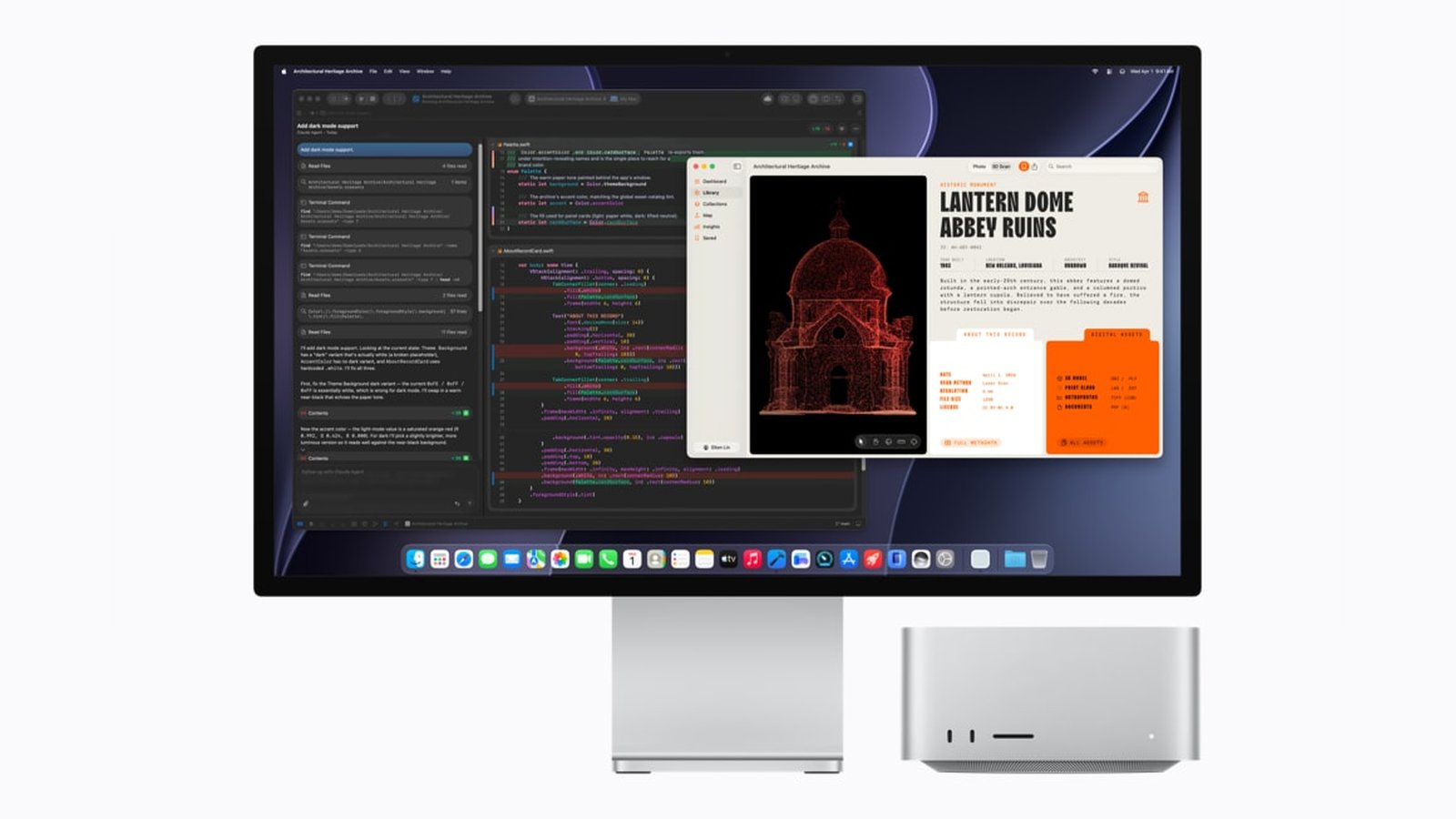
CUPERTINO (Azat TV) – Apple officially expanded its high-performance desktop portfolio on August 25, 2026, announcing the redesigned Mac Studio powered by its newly architected M5 Max and flagship M5 Ultra processors. The launch establishes hardware-level artificial intelligence acceleration and local large language model (LLM) execution as the centerpiece of Apple’s professional hardware strategy, positioning the compact workstation directly against cloud-dependent AI processing and traditional server-class workstations.
The announcement underscores a broader strategic pivot by the Cupertino tech giant toward zero-latency, privacy-centric on-device AI compute. According to official disclosures and statements by Johny Srouji, Apple’s chief hardware officer, the M5 Ultra chip integrates dedicated Neural Accelerators directly into every GPU core, coupled with an unprecedented unified memory architecture reaching up to 512GB. By enabling multiple Mac Studio units to be physically linked through high-bandwidth clustering, Apple is directly targeting software developers, AI researchers, data scientists, and high-end video production houses that previously required enterprise cloud infrastructure to run frontier-class open-weight AI models.
Redefining Silicon for On-Device AI Workloads
At the core of the new Mac Studio line is Apple’s fifth-generation custom silicon, built around a specialized architecture designed to eliminate memory bandwidth bottlenecks in matrix multiplication and tensor calculations. The base M5 Max configuration features an 18-core CPU—comprising 6 super cores and 12 performance cores—paired with an up-to-40-core GPU and up to 128GB of unified memory operating at 614GB/s bandwidth. Apple reports that the M5 Max delivers up to 3.9 times faster AI performance than its predecessor, speeding up code compilation and prompt processing in applications like LM Studio and Blackmagic DaVinci Resolve Studio.
The flagship M5 Ultra doubles the scale, combining two M5 Max dies into a single package boasting an up-to-36-core CPU (12 super cores and 24 performance cores) and an up-to-80-core GPU. The M5 Ultra delivers up to 1.2TB/s of memory bandwidth and supports up to 512GB of unified memory—a 50 percent increase over previous silicon generations. Peak AI compute performance on the M5 Ultra reaches up to 4.3 times that of the M3 Ultra and 9.8 times that of the M1 Ultra, enabling researchers to load and run massive open-weight LLMs locally without cloud API subscription charges or token usage limits.
Desktop Hardware Clustering via Thunderbolt 5
A central technical breakthrough introduced with the new Mac Studio is native hardware-level clustering using Thunderbolt 5 connectivity and Remote Direct Memory Access (RDMA) protocol support. Rather than relying on network-attached server racks, organizations can connect up to four Mac Studio units via Thunderbolt 5 cables to create a pooled unified memory cluster. Apple’s internal benchmarks demonstrate that a four-unit Mac Studio cluster achieves up to 3 times faster AI inference speed compared to a standalone workstation, effectively transforming desktop units into high-density local compute nodes for enterprise research teams.
This multi-unit scaling is reinforced by the integration of Thunderbolt 5 controllers providing bidirectional bandwidth up to 120Gb/s. The enhanced bandwidth not only facilitates direct memory sharing across clustered machines but also expands external expansion options, allowing simultaneous connections to high-speed RAID arrays, PCIe chassis, and multiple ultra-high-resolution displays. The workstations also incorporate Apple’s custom-designed N1 wireless chip, bringing Wi-Fi 7 and Bluetooth 6 support to the Mac Studio platform for the first time.
Graphics Power, Media Engine, and System Connectivity
Beyond specialized AI processing, the M5 architecture advances professional graphics and post-production capabilities through third-generation hardware-accelerated ray tracing and upgraded media engines. The M5 Ultra features dual video encode and decode engines compared to the M5 Max, allowing filmmakers and visual effects studios to playback up to 33 concurrent streams of uncompressed 8K ProRes 422 video at 30 frames per second. In 3D rendering environments such as Maxon Redshift and Foundry Nuke, scene rendering and machine learning training show performance gains between 1.7x and 4.7x over previous-generation M3 Ultra and M1 Ultra hardware.
For professional video production environments, Apple introduced Genlock support over USB-C, allowing precise frame synchronization between external capture hardware—such as the iPhone 17 Pro—and studio monitoring setups. The M5 Ultra configuration supports driving up to eight external displays simultaneously, or up to four Studio Display XDR monitors operating at full 5K resolution with 120Hz refresh rates.
Software Ecosystem and Enterprise Frameworks
To leverage the hardware capabilities of the M5 series, Apple unveiled Core AI, a new developer framework built into the upcoming macOS 27 Golden Gate operating system. Core AI operates alongside Apple’s open-source MLX machine learning framework, providing an optimized execution layer that maps neural network workloads across the CPU, GPU, and onboard Neural Accelerators without requiring manual memory management across hardware boundaries. The operating system also deeply integrates Siri AI and systemwide Apple Intelligence features, leveraging local compute power for context-aware search, automated workflow creation in Shortcuts, and Visual Intelligence tools.
Pricing, Availability, and Environmental Metrics
Apple confirmed that pre-orders for the new Mac Studio opened on August 25, 2026, with initial retail availability and customer deliveries scheduled to begin on September 22. Configurations featuring the maximum 512GB unified memory option are set to ship in late October. Pricing for the Mac Studio with M5 Max starts at $2,499 (U.S.) for standard customers and $2,299 for education buyers. The M5 Ultra variant starts at $5,499 (U.S.) and $5,099 for education, with commercial leasing programs starting at $48.99 monthly for M5 Max and $110.10 monthly for M5 Ultra models.
On the environmental front, Apple stated that the new Mac Studio contains 35 percent recycled content overall, featuring a chassis manufactured from 100 percent recycled aluminum and 100 percent recycled rare earth elements in all magnets. Supply chain operations for the workstation are powered by 40 percent renewable energy, aligning with Apple’s stated corporate target of achieving full carbon neutrality across its product life cycles by 2030.