


What the photograph shows
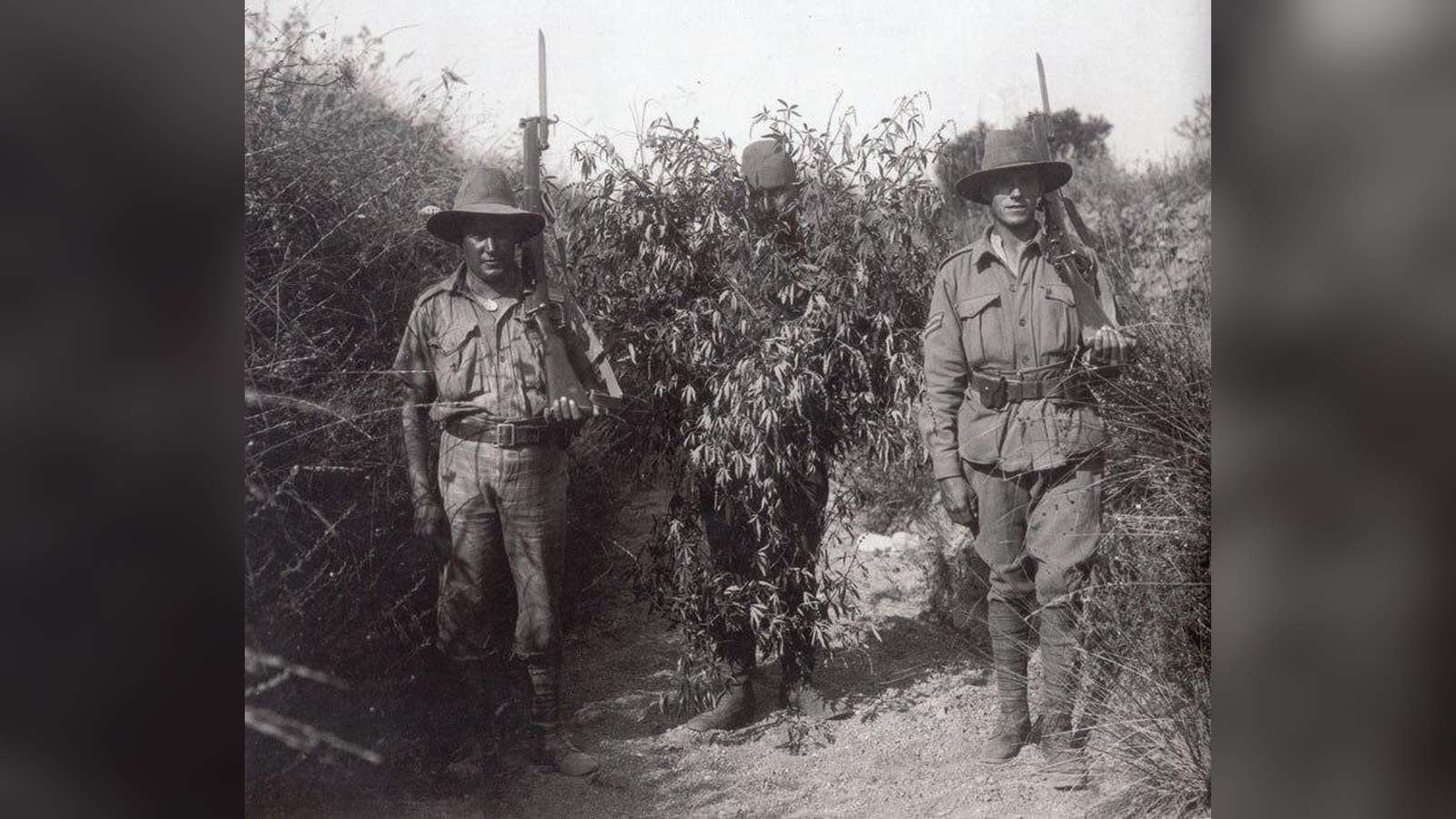
This remarkable archival photograph preserves a vivid and striking moment of frontline encounter during the First World War, focusing on the raw realities of tactical concealment and military capture. Positioned centrally in the frame, an Australian soldier stands erect and alert in his standard-issue uniform, maintaining strict vigilance over a prisoner of war. Beside him stands a captured Ottoman sniper, stripped of the elaborate organic concealment apparatus that had previously rendered him virtually invisible in the surrounding landscape. The sniper’s tactical disguise, meticulously crafted to mimic the indigenous flora of the theater—specifically the wild cannabis plants that flourished across parts of the Middle Eastern battlefields—is laid open for the camera, exposing the ingenious and desperate measures soldiers adopted to achieve concealment in open terrain. The sharp visual contrast between the regimented, manufactured clothing of the Allied captor and the makeshift, highly organic camouflage of the Ottoman prisoner encapsulates the high-stakes, deadly cat-and-mouse game that defined sniper operations. Every fold of the makeshift suit, the weary posture of the captive, and the watchful gaze of the guard contribute to a visual narrative of tension, survival, and the ultimate failure of even the most sophisticated field concealment. The viewer is immediately drawn to the textures of the foliage, the rough twine holding the makeshift ghillie suit together, and the stark emptiness of the background landscape, which accentuates the drama of the confrontation.
A closer visual inspection of the photograph reveals the intricate nature of the sniper’s field craft. The organic material used for the suit was not merely thrown together haphazardly; it was selected with an intimate understanding of the regional botany. In the arid and semi-arid valleys where imperial forces clashed, wild cannabis and hardy desert scrub offered exceptional textures and shades of green and brown that disrupted the human outline effectively against broken earth and low-lying vegetation. The captive sniper’s hands, visible and unbound for the moment of the photograph, show signs of exposure and exhaustion, telling a silent story of days spent lying prone under a blistering sun. The Australian guard, by contrast, embodies the institutional might of the imperial expeditionary force—his puttees neatly wound, his slouch hat angled against the glare, and his rifle held in a ready position that speaks of a soldier trained for constant vigilance. This visual tension between the individual artisan of camouflage and the disciplined representative of mechanized mass warfare forms the core emotional resonance of the archival frame, inviting contemplation on the vast disparity of resources coupled with the shared vulnerability of men on the firing line.
The moment behind the image
The shutter moment captured in this historical artifact was the culmination of hours or even days of extreme tension along the Middle Eastern or Gallipoli frontline, where the constant, silent menace of sniper fire claimed lives without warning. Snipers operating in the arid and semi-arid theaters of the First World War faced brutal environmental conditions, enduring scorching heat, biting cold, and total isolation while lying motionless for endless hours. To survive, these marksmen utilized every available feature of the local topography and vegetation, fashioning primitive ghillie suits from branches, brush, and native plants to break up their human silhouettes. The immediate moments leading up to this photograph involved an intense counter-sniper operation, where Allied infantrymen systematically hunted down a persistent threat, flushing the hidden marksman from his concealed vantage point. Following his detection, the Ottoman sniper was quickly disarmed, secured, and brought back behind friendly lines for interrogation and processing. This photograph immortalizes the fragile calm immediately following that capture, freezing the tense seconds when the invisible phantom of the battlefield was finally reduced to a captive human being standing exposed under the harsh sunlight.
Before the camera shutter clicked, the atmosphere would have been charged with adrenaline and residual danger. Counter-sniper missions were fraught with terror, as infantrymen moving through suspected zones never knew if another hidden marksman held them in crosshairs. When the Ottoman sniper was finally cornered—perhaps rooted out from a dry riverbed, an abandoned stone ruin, or a densely overgrown patch of agricultural land where cannabis grew wild—the confrontation likely ended not in a dramatic exchange of gunfire, but in a sudden, breathless surrender once escape routes were cut off. The act of photographing the prisoner alongside his camouflage was an instinctive impulse of documentation by troops who recognized the extraordinary nature of the disguise they had just overcome. In the aftermath, the prisoner would have been marched away from the immediate forward trenches to a divisional cage, where intelligence officers eagerly questioned captives about enemy dispositions, sighting ranges, and tactical methods employed by the Ottoman defense.
Photographer and provenance
The exact provenance and attribution of this specific photographic negative remain subject to the decentralized and chaotic nature of early twentieth-century military documentation. During the campaigns against the Ottoman Empire, visual records were produced by a mixture of official military photographers attached to imperial forces, intelligence personnel documenting tactical innovations, and enterprising front-line soldiers utilizing personal box cameras smuggled into the trenches. While official archives such as the Australian War Memorial hold extensive visual documentation of the Middle Eastern campaigns, images capturing intimate prisoner encounters like this one often circulated through private photograph albums before finding their way into institutional collections. The survival of this print offers modern historians a crucial window into the evolution of military field craft and counter-snipings long before camouflage was industrialized and standardized by national militaries. The uncertainty surrounding the exact photographer’s identity underscores the anonymous, collective documentation of a global conflict where thousands of individuals recorded fragments of history through their lenses.
Tracing the journey of such an image involves recognizing the dual currents of official war reporting and informal soldier photography. Official photographers, bound by censorship and the need to project morale, frequently captured staged or sanitized views of battlefields. Conversely, unofficial snapshots taken with pocket cameras—often developed in makeshift field darkrooms or sent home in letters—revealed the unvarnished realities of frontline existence, including the gritty details of prisoner capture and improvised tactical gear. Whether this photograph was taken by an official correspondent documenting enemy ingenuity for intelligence bulletins or by an Australian soldier eager to record a memorable trophy of war, it survived the decades because it captured a universally compelling narrative of human cleverness pitted against overwhelming force. Its preservation in modern archives serves as a testament to the enduring value of vernacular war photography in preserving details that official histories frequently overlooked.
Historical context
The First World War is frequently remembered through the muddy, industrialized attrition of the Western Front, yet the campaigns waged across the Middle East, Gallipoli, and the Sinai and Palestine mandate involved vastly different tactical landscapes. Operating in arid regions, deserts, and scrub-covered hillsides, Australian, British, New Zealand, and Ottoman forces had to adapt rapidly to environments where natural cover was scarce and specialized local flora dictated the rules of engagement. In these open spaces, camouflage was not merely an auxiliary tactic but a vital prerequisite for survival and tactical advantage. Sniping evolved into a lethal science, prompting armies to establish dedicated schools of marksmanship, observation protocols, and counter-sniper units. The use of native vegetation, including wild cannabis and scrub plants, by Ottoman defenders demonstrated a profound understanding of local ecology, turning the landscape itself into a weapon. As Allied forces pushed forward against deeply entrenched positions, overcoming these improvised camouflage techniques required meticulous scouting, patience, and often brutal close-quarter combat.
The Middle Eastern theater of the Great War was characterized by vast expanses, harsh climates, and grueling logistical challenges. Unlike the static trench systems of France and Belgium, the conflict against the Ottoman Empire often involved mobile warfare, fluid frontlines, and operations across deserts, mountains, and fertile river valleys. In this environment, concealment took on entirely different dimensions. Ottoman snipers, operating defensively within their own familiar territories, possessed an intrinsic advantage in utilizing local flora. Cannabis sativa, which grew abundantly in parts of the Levant and Mesopotamian regions as both a cultivated crop and a resilient wild weed, provided fibrous stalks and dense foliage that proved exceptionally effective for breaking up human geometry. The ingenuity displayed by Ottoman marksmen in fashioning these organic suits mirrored similar grassroots innovations happening across all combatant nations as modern weaponry made traditional uniforms suicidal on the open battlefield. Understanding this broader tactical evolution helps contextualize the photograph not as an isolated curiosity, but as a representative artifact of a profound transformation in military art.
Why it still matters
Photographs of this nature transcend traditional military history by stripping away grand geopolitical abstractions to reveal the intimate, human scale of global conflict. They capture the raw ingenuity, fear, and resilience of ordinary individuals thrust into extraordinary circumstances on opposing sides of a devastating imperial struggle. By freezing the fleeting interaction between an Australian soldier and a camouflaged Ottoman prisoner, the image serves as an enduring reminder of the psychological toll of frontline warfare and the endless adaptation required of those who fought it. It remains a compelling historical document that bridges the gap between official military chronicles and the individual human experiences lost to time.
In the modern era, as military technology increasingly relies on digital surveillance, thermal imaging, and automated detection systems, images like this offer a poignant reflection on the roots of tactical concealment. They remind us of an era when camouflage was an artisanal craft born of desperation, personal skill, and a deep, tactile engagement with the natural world. The confrontation immortalized in the frame—between an empire’s soldier and a defender blending into the earth itself—resonates across generations, prompting viewers to reflect on the ingenuity of survival, the complexities of war, and the fragile threads that connect disparate human lives caught in the machinery of history.