


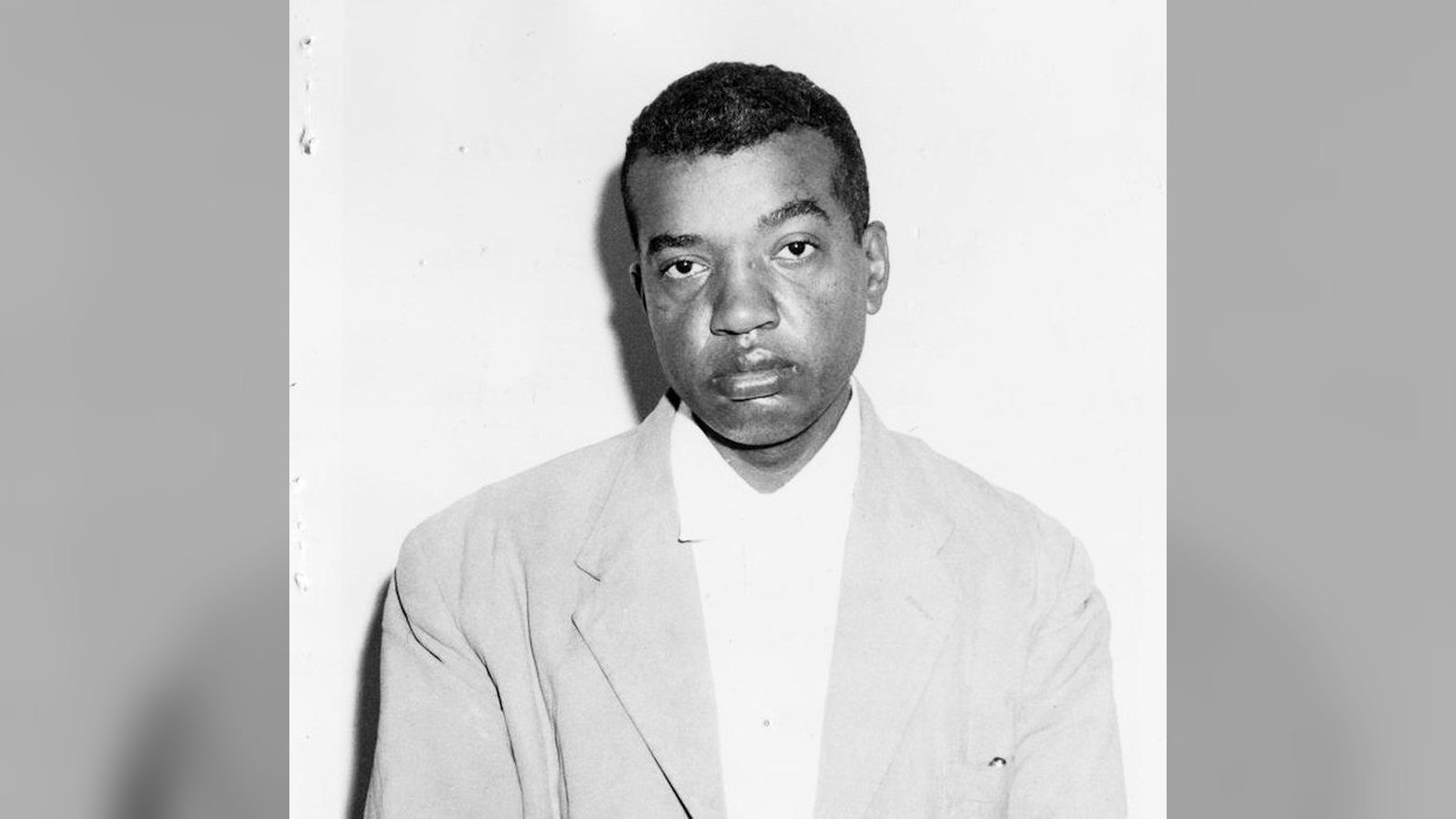
The photograph captures a moment of intense, quiet defiance: Clennon King, a man whose physical presence in a restricted space ignited the full machinery of a segregationist state. In the frame, we see a man standing firm, his posture suggesting a resolve that contrasts sharply with the frantic, heavy-handed response of the authorities surrounding him. This image is not merely a portrait; it is a clinical document of the Jim Crow era, capturing the precise instant when the ‘white power structure’ of Mississippi decided that the most effective way to handle a challenge to the racial hierarchy was to pathologize it. The question this photograph compels us to answer is how a simple application for graduate studies could be transformed into a state-sanctioned psychiatric emergency.
What the photograph shows
In the frame, the composition highlights the friction between the individual and the state. Clennon King is captured in a moment of transition, his expression reflecting a complex mixture of determination and the realization of the overwhelming force arrayed against him. Surrounding him are the figures of the Mississippi establishment—plainclothes officers and members of the state highway patrol—who appear to be exerting physical control. The background, though blurred, suggests the institutional setting of the University of Mississippi, a place that, until that moment, had remained a hermetically sealed bastion of white supremacy. The photograph serves as a visual record of the ‘registration’ process, which turned into a scene of state-sponsored kidnapping.
The moment behind the image
In the summer of 1958, Clennon King arrived in Oxford, Mississippi, with a clear goal: to enroll in the university’s graduate history program. No African American had ever dared to apply to the institution. The state government, led by Governor J. P. Coleman, was not caught off guard; they had been monitoring King’s activities. The moment the shutter clicked, it captured the culmination of a pre-planned operation. King was not treated as a student, but as an intruder. He was forcibly removed from the registration area, placed into a patrol car, and driven to a location that would serve to silence him: a psychiatric ward. The authorities deemed that any Black man attempting to integrate a white university must, by definition, be insane. The judge who signed the order essentially argued that no ‘sane’ person would challenge the racial status quo of Mississippi.
Photographer and provenance
The provenance of this image remains tied to the archives of the Mississippi State Sovereignty Commission and local press photographers of the era. While the specific photographer is often uncredited, the image was likely captured by a wire service photographer assigned to cover the ‘integration threat’ at the university. Because the state was actively tracking King, the documentation of his removal was intended to serve as a warning to others. The photograph survived not as an act of journalistic rebellion, but as part of the state’s own internal record-keeping, later finding its way into public archives like those at Mississippi State University. Its circulation today serves the opposite of its original intent: it exposes the absurdity and cruelty of the state’s reaction.
Historical context
Clennon King was a complex figure, a man whose life defied easy categorization. A history professor and minister, he was an intellectual who often found himself at odds with the mainstream civil rights movement, including the NAACP. He was a vocal critic of the integrationists he viewed as ‘Uncle Toms’ and often held views that were deeply unpopular within the Black community. Yet, his 1958 application to the University of Mississippi was a singular act of defiance that the state could not ignore. By committing him to a mental institution, the state of Mississippi utilized a well-documented tool of the era: the weaponization of psychiatric diagnosis to invalidate the political agency of Black citizens. The incident foreshadowed the much larger, violent resistance that would meet James Meredith four years later, but King’s experience highlights the specific, insidious nature of ‘legal’ repression.
Why it still matters
This image remains a haunting reminder of the lengths to which a society will go to preserve an unjust status quo. It asks us to look closely at the faces of those who enforced the law, and at the face of the man who stood against them. The photograph forces a confrontation with the reality that in 1958, the most radical thing a Black man could do was to ask for the same education as his white peers. It is a testament to the resilience of the individual against the crushing weight of an institutional system that sought to diagnose dissent as disease. By looking at this photo, we acknowledge the cost of challenging systemic inequality and the historical necessity of remembering those who were erased by the state’s false narratives.
Ultimately, the photograph functions as a mirror. It forces the viewer to consider the fragility of civil rights when faced with a state willing to abandon the pretense of democracy. Clennon King’s story, though often overshadowed by later, more prominent figures in the Civil Rights Movement, remains a vital case study in the intersection of state power, mental health, and racial control.