


What the photograph shows
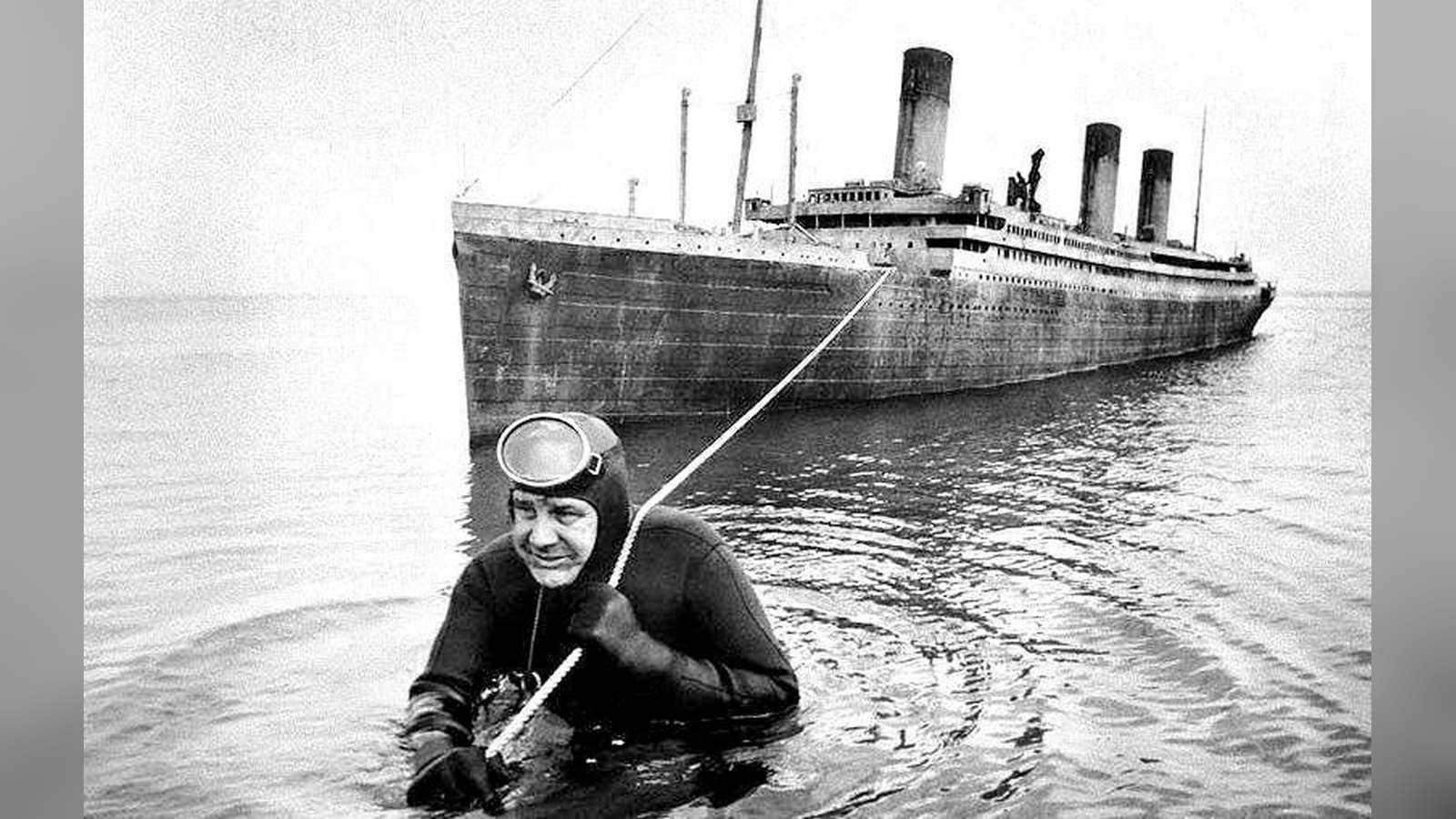
In this striking promotional photograph preserved in the Bettmann Archive via Getty Images, professional frogman Courtney Brown is seen swimming in open water while towing a massive 55-foot scale model of the legendary ocean liner Titanic. The sheer scale of the miniature vessel dwarfs the human figure beside it, creating a surreal visual juxtaposition between man and machine. The model’s rusted hull plates, lifeboats, and superstructure are rendered with meticulous cinematic detail, designed to mimic the wreckage sitting two and a half miles down on the dark floor of the North Atlantic. Sunlight cuts across the water’s surface and illuminates the rippling aquatic environment where the miniature ocean liner is being maneuvered for filming.
The moment behind the image
Taken around 1980 during the chaotic production of the film adaptation of Clive Cussler’s bestselling novel Raise the Titanic!, this frame captures the physical realities of pre-digital special effects. Before CGI dominated Hollywood, filmmakers relied on colossal physical miniatures and practical wizardry to simulate grand spectacles. In the narrative of the film, a daring international team attempts to salvage the actual 46,000-ton wreck of the Titanic. In reality, the production team faced its own engineering nightmares. The miniature model—variously estimated in contemporary production notes and press reports as costing hundreds of thousands to several million dollars—was constructed with immense precision. Yet the physical shoot quickly spiraled into logistical chaos when it became glaringly apparent that the initial water tank designated for filming was simply too small to contain the gargantuan 55-foot replica, forcing producers to construct an entirely new, vastly larger basin at exorbitant expense.
Photographer and provenance
The image is credited to the legendary Bettmann Archive, a monumental repository of historical photography now distributed globally through Getty Images. While individual on-set shutterbugs often operated under studio publicity umbrellas, Bettmann’s preservation of the negative cemented this frame as an iconic document of Hollywood excess. The photograph originally circulated widely in newspapers and wire services ahead of the film’s August 1980 theatrical release by Associated Film Distribution, serving as a visual marvel to drum up public interest in Lord Grade’s multimillion-dollar cinematic gamble.
Historical context
The cultural fascination with the 1912 sinking of the Titanic remained an eternal obsession decades before James Cameron’s 1997 blockbuster. In 1980, the actual underwater wreck had not yet been discovered by Robert Ballard—that historic discovery would not occur until 1985. Consequently, films like Raise the Titanic! operated in a realm of pure imagination regarding what the sunken hulk looked like resting on the ocean floor. The film itself became infamous in industry history for its massive financial losses, prompting studio executive Lord Grade to famously quip that “it would have been cheaper to lower the Atlantic Ocean.” Yet despite the film’s lukewarm box-office reception, behind-the-scenes records like this photograph remain valuable testaments to an era of daring physical craftsmanship in cinema.
Why it still matters
Today, this photograph functions as a fascinating time capsule of analog moviemaking ingenuity. It bridges the gap between historical tragedy and Hollywood artifice, reminding viewers of the immense human labor required to fake an impossible maritime salvage mission. Through the solitary figure of Courtney Brown guiding the giant hull through the water, the image preserves a tangible, awe-inspiring moment of cinematic history before computer-generated graphics transformed the way stories are told on screen.