


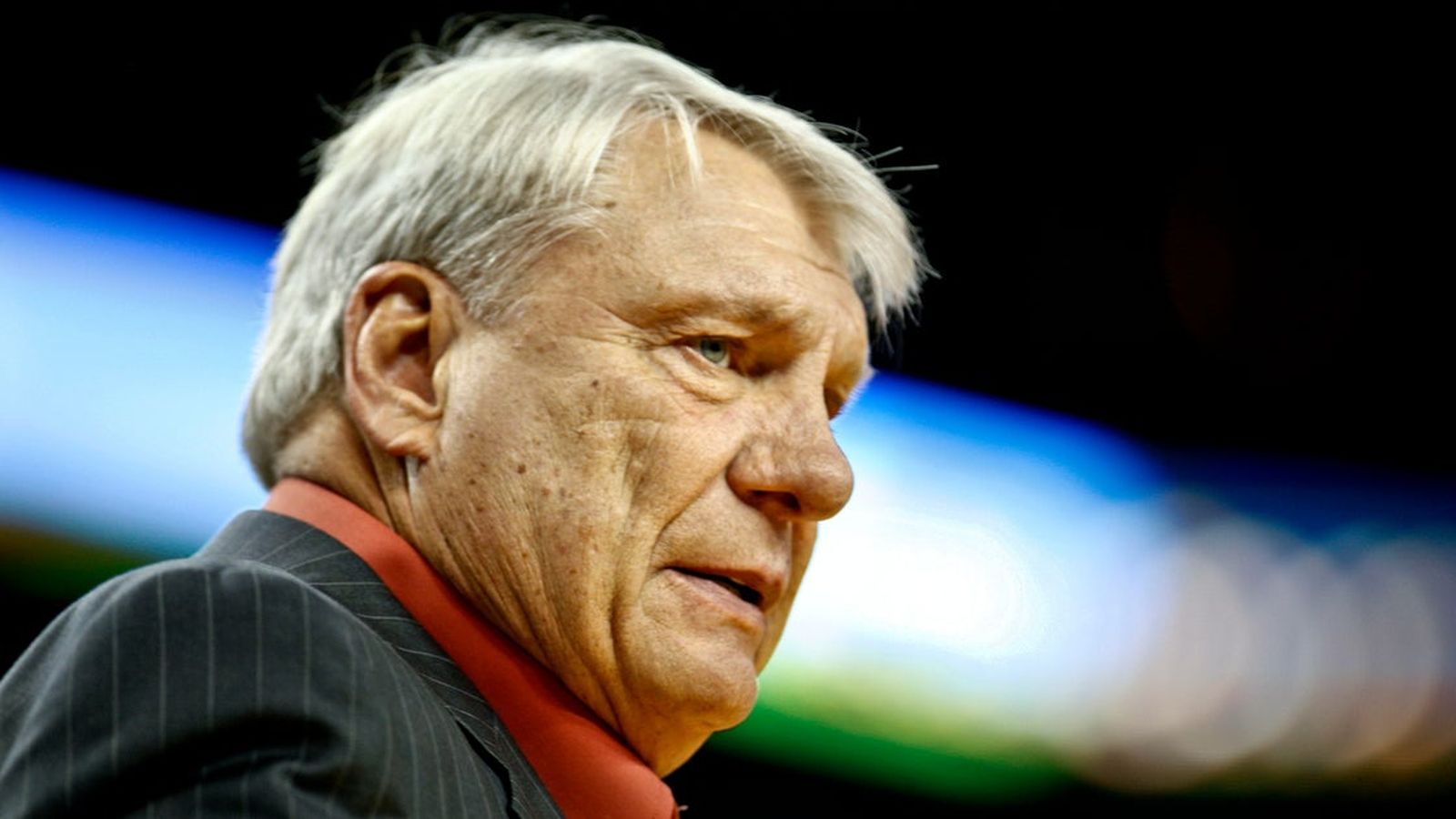
The basketball world is mourning the loss of Donald Arvid “Don” Nelson, one of the most transformative, iconoclastic, and successful figures in NBA history. Nelson passed away peacefully on the morning of Sunday, August 9, 2026, at the age of 86 in Frisco, Texas. His family confirmed that he was surrounded by loved ones and longtime basketball friends during his final days in hospice care, following a stroke he suffered approximately three weeks prior. His passing marks the end of a legendary five-decade journey that reshaped the tactical, executive, and cultural foundations of professional basketball.
Known affectionately across the sporting world as “Nellie,” Nelson built a towering legacy that bridged the classic era of the Boston Celtics dynasty with the modern, high-octane, positionless basketball of the 21st century. Over a career spanning nearly 50 years as a player, coach, and general manager, Nelson refused to be bound by the rigid positional structures of his time. His relentless experimentation gave birth to “Nellie Ball”—a fast-paced, space-oriented offensive system that directly foreshadowed the modern NBA’s three-point revolution and small-ball dominance.
The Genesis of Nellie Ball: Dismantling the Traditional Frontcourt
To understand Don Nelson’s impact on modern basketball, one must look at the tactical landscape of the 1970s and 1980s. It was an era dominated by physical, back-to-the-basket centers and slow, half-court execution. Nelson, however, envisioned a highly dynamic alternative. He traced the roots of his philosophy back to his playing days under the legendary Boston Celtics coach Red Auerbach. Nelson spent 11 of his 14 playing seasons in Boston, winning five NBA championships (1966, 1968, 1969, 1974, and 1976) and delivering one of the most famous clutch shots in Finals history during Game 7 of the 1969 series against the Los Angeles Lakers.
Auerbach’s emphasis on the fast break and physical conditioning stayed with Nelson when he transitioned to coaching with the Milwaukee Bucks in 1976. Yet, Nelson took those principles a step further. Recognizing that his rosters often lacked the dominant, traditional big men of his rivals, Nelson began deploying unconventional lineups. He pioneered the use of the “point forward”—initiating the offense through versatile, forward-sized players rather than traditional guards—and prioritized speed, perimeter shooting, and perimeter mismatches over post-up play.
“The league really hadn’t seen an offense like the one we were running, and the results were undeniable,” Nelson later reflected in a 2016 piece for The Players’ Tribune. His fast-paced philosophy reached its zenith during his first stint with the Golden State Warriors, where he unleashed the legendary “Run TMC” trio of Tim Hardaway, Mitch Richmond, and Chris Mullin. By playing three highly skilled, rapid-firing perimeter players simultaneously, Nelson forced opposing defenses into untenable matchups, proving that entertainment and offensive efficiency could coexist at the highest level.
The Dallas Mavericks Renaissance and the Nowitzki Gamble
In February 1997, Dallas Mavericks majority owner Ross Perot Jr. and minority owner Frank Zaccanelli convinced Nelson to cut short an 11-month retirement and take over basketball operations for a franchise that had spent the 1990s as the worst team in the NBA. What followed was an institutional transformation that altered the trajectory of the franchise forever. Ten months into his tenure as general manager, Nelson took over head coaching duties, eventually bringing in his son, Donnie Nelson, as an assistant.
The defining moment of Nelson’s executive career came on June 24, 1998, during the NBA Draft. Donnie Nelson had scouted a lanky, 19-year-old German prospect named Dirk Nowitzki. When Don Nelson watched Nowitzki play, he immediately recognized a generational talent who could perfectly embody his tactical vision of a shooting, mobile big man. During draft night, the Mavericks executed a high-stakes gamble: they drafted Robert “Tractor” Traylor at No. 6 with the pre-arranged plan to trade him to Milwaukee for the No. 9 pick, Nowitzki.
The decision was fraught with tension. Future Hall of Famer Paul Pierce unexpectedly slid down the draft board and was available when Dallas picked. Ross Perot Jr. recalled asking Nelson what the best long-term solution was. Nelson acknowledged that bypassing the highly publicized Pierce would anger the fanbase, but insisted that Nowitzki was the correct choice. “Not many general managers or owners would have had the conviction to draft Dirk over Paul Pierce,” Perot remarked decades later. “But Don was never in the box.”
Nowitzki, who went on to become an MVP, a champion, and the greatest player in Mavericks history, expressed his deep gratitude following Nelson’s passing. “You didn’t just draft me,” Nowitzki shared. “You believed in me. You saw things in my game before I ever realized I could do them. I don’t think my career could have turned out how it did without you being my first coach and giving me the freedom to play my game.”
The Bay Area Return and Mentoring Stephen Curry
Nelson’s coaching journey eventually came full circle with a second stint at Golden State starting in 2006. It was during this period that Nelson orchestrated one of the most famous playoff upsets in NBA history—the 2007 “We Believe” Warriors, who as the eighth seed defeated the top-seeded Dallas Mavericks in the first round. Nelson’s small-ball lineups completely neutralized Dallas’s frontcourt, showcasing the ultimate realization of his tactical philosophy.
In his final coaching season (2009-10), Nelson served as the first NBA mentor to a rookie guard named Stephen Curry. Nelson’s emphasis on rapid decision-making, high-volume perimeter shooting, and offensive freedom provided the ideal environment for Curry to develop the skills that would eventually spark the modern three-point revolution. Curry paid tribute to Nelson, noting, “One of the big reasons I was drafted by the Warriors was because of Don Nelson. Sending my love to Joy, his family, and all those who were fortunate enough to know him.”
A Legacy of Numbers, Innovation, and Defiance
Don Nelson retired from coaching in 2010 as the winningest coach in NBA history with 1,335 victories—a record that stood until his former assistant and protege, Gregg Popovich, surpassed it. Over his 32-season coaching career, which included stops in Milwaukee, Golden State, New York, and Dallas, Nelson accumulated 2,398 games on the sidelines (second only to Lenny Wilkens). He was named NBA Coach of the Year three times (1983, 1985, and 1992) and was inducted into the Naismith Memorial Basketball Hall of Fame in 2012.
Even in his final public appearance on June 15, 2026—when he received the James Naismith Family Legacy Award in Dallas—Nelson remained characteristically humble and joyful. “I’ve had a life in which I coached and played and general managed in the league for almost 50 years,” Nelson told the crowd. “I feel like I’m the luckiest guy in the room.” His passing leaves a permanent void in the basketball community, but his revolutionary ideas continue to dictate how the game is played on court-floors worldwide every single night.