


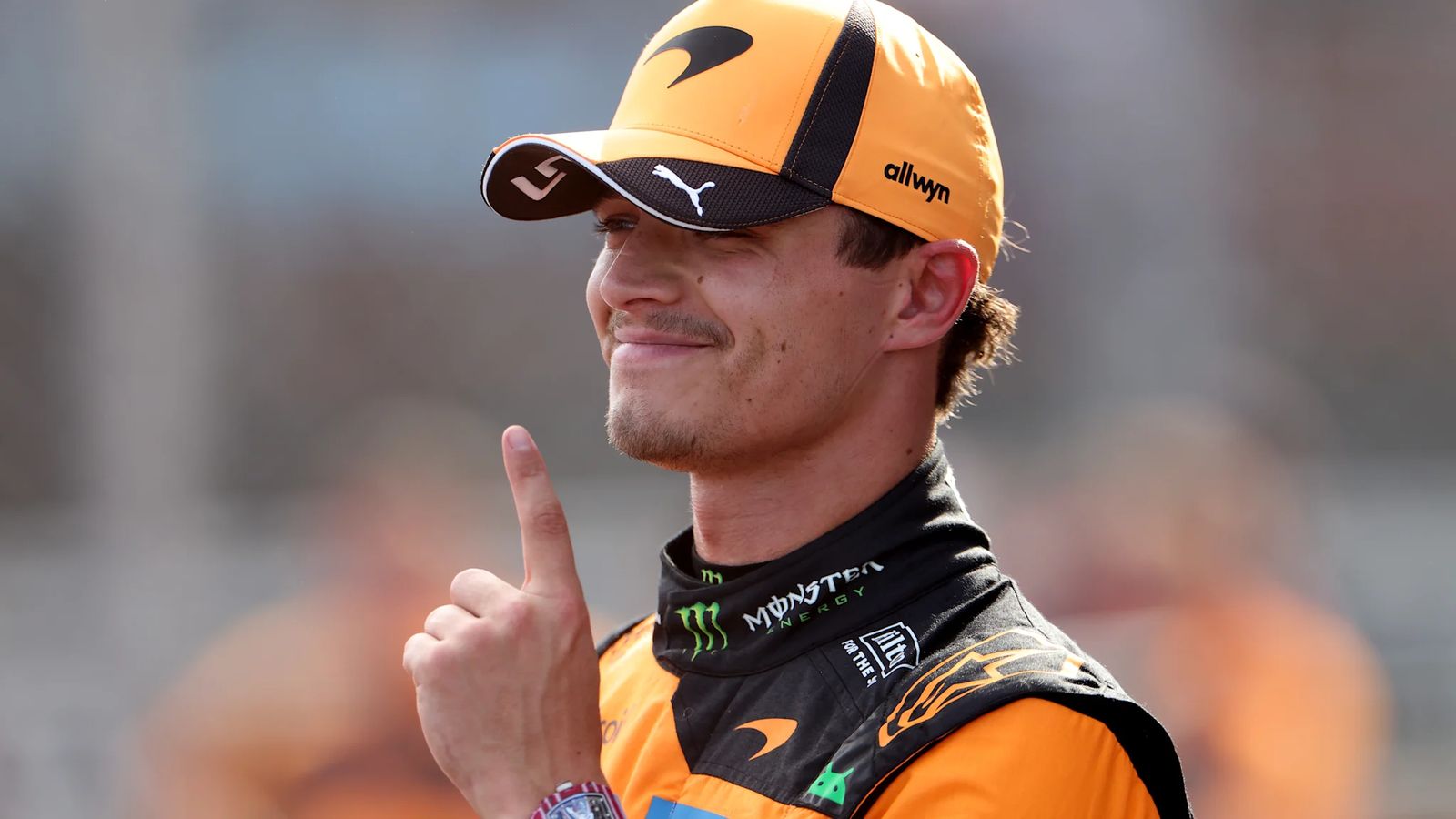
Lando Norris claimed pole position for McLaren ahead of the 2026 Hungarian Grand Prix, recording a 1m 17.207s benchmark in the final segment of qualifying at the Hungaroring. However, the definitive shape of Sunday’s starting grid was dictated by post-session steward decisions that demoted front-row challenger Lewis Hamilton and championship leader Kimi Antonelli.
Hamilton, driving for Ferrari, originally secured the second-fastest lap with a 1m 17.219s time—just 0.012 seconds behind Norris. Stewards subsequently handed Hamilton a three-place grid penalty for impeding McLaren’s Oscar Piastri during a crucial flying lap. Mercedes driver Antonelli received an identical three-place demotion for failing to slow sufficiently under yellow flags. The stewards’ rulings promoted Charles Leclerc to the front row alongside Norris, elevated Piastri to third, and moved Red Bull’s Max Verstappen into fourth position despite a late-session spin.
Grid Penalties Reshape Top Ten Ahead of Race Day
The post-qualifying penalties significantly alter the tactical landscape for Sunday’s main event at Mogyoród. Hamilton was demoted from P2 to P5 on the grid, placing him alongside Mercedes’ George Russell, who qualified sixth after suffering an operational water leak late in Q3. Antonelli’s sanction dropped him from fourth to seventh, forcing the championship leader into a mid-pack starting slot at a track notorious for limited overtaking opportunities.
According to official session documentation released by Formula 1, the incident between Hamilton and Piastri occurred when the Ferrari driver was on an in-lap, unintentionally compromising Piastri’s preparation and final push. The outcome presents Leclerc with a prime opportunity to attack Norris into Turn 1, while Piastri gains direct track position on the clean side of the second row.
Q3 Chaos: Yellow Flags, Spins, and Mechanical Failures
The deciding Q3 session featured escalating track evolution and split tactical timing among the top teams. Ferrari opted to send Hamilton out early for his final attempt, but the seven-time champion was unable to improve on his initial 1m 17.219s benchmark. Norris, benefiting from track evolution as the last driver across the finish line, delivered a clean final sector to snatch pole position.
Norris’s decisive lap was completed amid widespread yellow-flag disruption across the final sector. Max Verstappen suffered a high-speed spin in his Red Bull, reporting over team radio that the car felt severely compromised before recovering to record a best time of 1m 17.725s (+0.518s). Simultaneously, Russell was instructed by Mercedes engineers to stop his car on track near Turn 1 following a critical drop in cooling system pressure caused by a water leak. Norris successfully navigated both warning zones without breaching flag regulations, securing his top starting position.
Technical Development and Upgrades Across the Field
The Hungarian Grand Prix serves as the final round before Formula 1’s mandatory three-week summer shutdown, making technical performance at the high-downforce Hungaroring an indicator of mid-season development trajectories. McLaren introduced a targeted aerodynamic package this weekend, which Norris cited as instrumental in generating front-end compliance through the circuit’s continuous mid-speed corners.
Ferrari demonstrated strong race preparation during earlier qualifying segments, becoming the sole team in Q1 to advance on the durable medium-compound tyres. This compound allocation gave Ferrari an additional set of fresh soft tyres for Q3, though final-sector traffic and temperature shifts limited their ultimate single-lap gains.
Further down the order, Aston Martin deployed the first phase of a three-part structural overhaul, introducing 16 updated aerodynamic and floor components. Fernando Alonso utilized the upgrades to advance to Q2, ultimately qualifying P16, whereas teammate Lance Stroll was eliminated in Q1 in 20th position. Williams suffered a challenging high-downforce session, with Carlos Sainz and Alex Albon eliminated in Q1 at P18 and P19 respectively.
Strategic Implications at the Hungaroring
Often referred to as “Monaco without walls,” the 4.381 km Hungaroring presents extremely difficult overtaking conditions due to its tight, continuous layout and short main straight. Track position established during Saturday’s qualifying session carries immense weight for Sunday’s strategic planning.
With Norris on pole and Leclerc alongside him, McLaren and Ferrari occupy the front row, while Piastri and Verstappen line up directly behind. For demoted contenders Hamilton and Antonelli, pit-stop timing, tyre management, and undercut strategies during the 70-lap race will serve as their primary mechanisms for recovery before the sport enters its summer recess.