


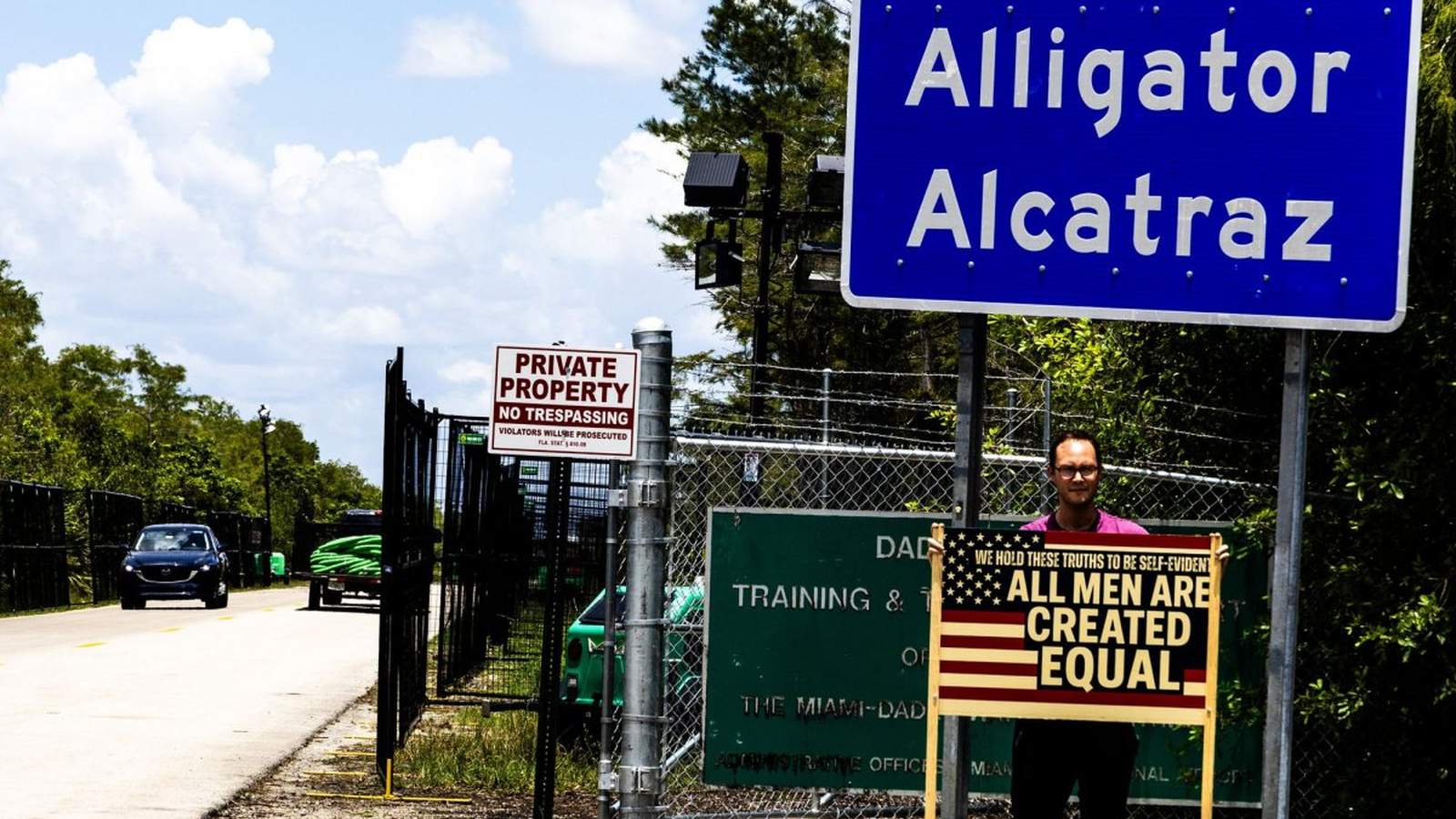
A federal judge has dealt a significant blow to the Trump administration’s immigration policies by halting operations and expansion at the controversial detention facility colloquially known as ‘Alligator Alcatraz.’ Located in Florida’s Everglades, the facility has been a focal point of debates surrounding immigration enforcement and environmental preservation. U.S. District Judge Kathleen Williams issued the ruling on August 21, 2025, following lawsuits filed by environmental advocacy groups and the Miccosukee Tribe.
The Controversy Surrounding Alligator Alcatraz
Built on the grounds of the Dade-Collier Training and Transition Airport in Ochopee, Florida, ‘Alligator Alcatraz’ was hastily constructed to serve as an immigration detention facility. With a capacity of approximately 1,000 beds, detainees were housed in wire-fenced cages, creating widespread criticism from human rights organizations and environmentalists alike. The Trump administration and Florida Governor Ron DeSantis had touted the facility as a model for future detention centers, emphasizing its role in the administration’s hardline immigration policies.
However, the project quickly became a lightning rod for controversy. Critics argued that the facility was built without proper environmental review, violating the National Environmental Policy Act (NEPA). Environmental groups, including Friends of the Everglades and the Center for Biological Diversity, raised alarms about the detention center’s impact on the fragile ecosystem of the Everglades, home to endangered species such as the Florida panther and wood stork.
The Judge’s Ruling
In her 82-page ruling, Judge Kathleen Williams declared that the construction and operation of the facility violated federal environmental laws. She noted that neither the federal nor state governments had conducted the required environmental assessments before repurposing the airport into a detention center. Williams wrote, “Here, there weren’t ‘deficiencies’ in the agency’s process. There was no process.”
The court order mandates that within 60 days, the Trump administration and the state of Florida must halt operations, remove detainees, and dismantle temporary infrastructure such as fencing, lighting, and waste receptacles. The ruling also prohibits the transfer of new detainees to the site, effectively freezing the facility’s operations.
Judge Williams emphasized the broader implications of her decision, referencing over 75 years of efforts to preserve the Everglades. “Every Florida governor, every Florida senator, and countless local and national political figures, including presidents, have publicly pledged their unequivocal support for the restoration, conservation, and protection of the Everglades,” she wrote. “This order does nothing more than uphold the basic requirements designed to fulfill those promises.”
Environmental and Tribal Advocacy
The lawsuits against the facility were spearheaded by environmental groups and the Miccosukee Tribe, whose members rely on the Everglades for sustenance and cultural practices. The court found that the facility posed numerous risks to the environment, including wastewater runoff that threatened to contaminate the Miccosukee Tribe’s water supply. Additionally, the installation of industrial lighting was found to have reduced the habitat for the Florida panther by 2,000 acres.
Eve Samples, executive director of Friends of the Everglades, hailed the ruling as a landmark victory. “This is a landmark victory for the Everglades and countless Americans who believe this imperiled wilderness should be protected, not exploited,” she said in a statement. Elise Bennett, Florida and Caribbean director at the Center for Biological Diversity, echoed these sentiments, emphasizing the urgency of protecting the Everglades’ unique ecosystem.
Political Reactions and Next Steps
Governor Ron DeSantis and the Trump administration have vowed to appeal the ruling. DeSantis dismissed the environmental concerns, stating, “We will ultimately be successful in this. It’s not going to stop our resolve.” Florida’s Division of Emergency Management filed a notice of appeal shortly after the ruling was issued, signaling an ongoing legal battle.
The future of the detainees currently housed at Alligator Alcatraz remains uncertain. Reports suggest that detainees may be transferred to other facilities, including the newly constructed “Deportation Depot” in North Florida. Meanwhile, the Department of Homeland Security has yet to comment on the ruling or its implications for immigration enforcement.
Judge Williams’ decision underscores the tension between federal immigration policies and environmental preservation efforts. As the legal battle continues, the case of Alligator Alcatraz serves as a stark reminder of the complex interplay between policy, law, and the environment.
This ruling marks a pivotal moment in the fight to balance immigration enforcement with environmental stewardship. The implications of this case will likely resonate far beyond the Everglades, shaping future debates on the intersection of federal policies and ecological preservation.