


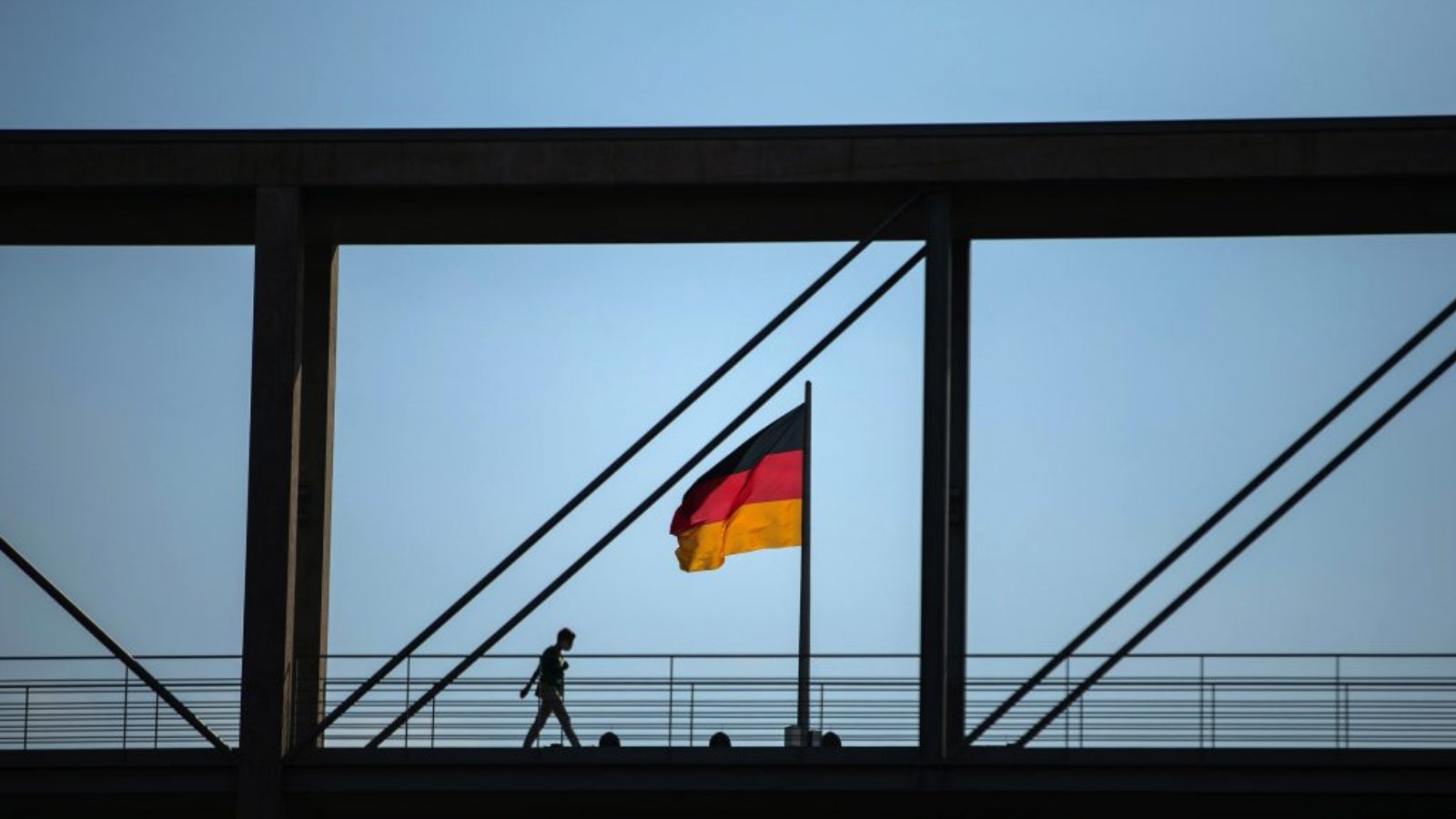
BERLIN (Azat TV) – Germany’s economy is exhibiting profound structural weaknesses, marked by a significant surge in corporate bankruptcies and a notable exodus of residents, despite official reports of ‘moderate growth.’ These domestic challenges are unfolding concurrently with an intensifying debate over the security and repatriation of Germany’s substantial gold reserves currently held in U.S. vaults, reflecting broader geopolitical uncertainties in early 2026.
Official Growth Figures Mask Deeper Economic Woes
German authorities recently announced a revival of economic growth, with Europe’s largest economy achieving a modest 0.2 percent growth in 2025. This followed contractions of 0.5 percent in 2024 and 0.9 percent in 2023. Officials attributed this ‘moderate growth’ primarily to increased consumer and government spending, which reportedly more than offset a decline in exports. However, critics suggest this indicates a reliance on depleted savings and accumulating debt rather than robust underlying economic health.
This narrative of recovery starkly contrasts with the escalating number of corporate bankruptcies. In January 2026, German authorities reported that preliminary bankruptcy figures for December 2025 were 15.2 percent higher than the previous year, following a 4.8 percent increase in October. This marked the highest level in eleven years. The scandal-focused newspaper Bild, citing the respected Leibniz Institute for Economic Research in Halle, further revealed that the total number of bankruptcies in 2025 likely broke a twenty-year record, exceeding even the levels seen during the 2009 financial crisis by about five percent. On average, 48 companies went bankrupt daily, with December alone seeing 1,519 filings—a 75 percent increase compared to pre-pandemic periods in the 2010s.
Industrial Struggles and Policy Impacts
The wave of bankruptcies is not limited to small businesses. Reports indicate that 471 companies with annual revenues exceeding ten million euros failed in 2025, a quarter more than the previous year. Germany’s leading automotive industry has been particularly affected, and even medical clinics are facing a wave of insolvencies, according to warnings from the Federal Association of Health Insurers. Attempts to mitigate labor shortages in the medical sector through emergency imports of personnel from non-Western countries have reportedly not been effective.
German manufacturers are struggling to compete with China and other Asian nations. Chancellor Friedrich Merz recently acknowledged a ‘serious strategic mistake’ in phasing out nuclear energy, noting a critical shortage of energy generation capacity. This, combined with rising energy and raw material costs—a direct consequence of severed ties with Russia and a shift to American and other suppliers—and high labor costs, has significantly eroded Germany’s industrial competitiveness. These issues, experts suggest, extend beyond the impacts of the pandemic or high interest rates, pointing to deeper structural challenges.
Mass Emigration Signals Declining Public Confidence
The economic difficulties are mirrored by a significant outflow of people. According to official data, 1.2 million people left Germany in 2024, the most recent year for which final statistics are available. Surveys published this month indicate that every fifth German resident wishes to emigrate, driven by an ‘increasingly alarming reality and bleak prospects.’ This sentiment is particularly strong among first-generation immigrants (34 percent) and their children (37 percent), who were initially drawn to Germany’s image of economic strength and prosperity.
While fewer native Germans (17 percent) express a desire to emigrate, the overall trend is concerning for a country heavily reliant on immigration to address demographic challenges. Migrants and their descendants now constitute roughly 30 percent of the population, representing its youngest and most dynamic segment. The rising desire to leave, especially among this group, suggests a growing loss of faith in the possibility of meaningful change or reform within Germany’s political landscape.
Calls to Repatriate German Gold Reserves Intensify
Amid these economic and social challenges, a debate is gaining traction regarding Germany’s substantial gold reserves. The country holds the world’s second-largest national gold reserves after the U.S., with approximately 1,236 tonnes, valued at around €164 billion, stored in New York’s Federal Reserve vaults. Another 12 percent is held at the Bank of England in London, while just over half is at the Bundesbank in Frankfurt am Main.
Michael Jäger, head of the European Taxpayers Association (TAE) and the Association of German Taxpayers, has publicly urged Berlin to repatriate its gold. Citing the unpredictability of figures like $1 Donald Trump and recent U.S. actions, Jäger told the Rheinische Post that Germany’s gold is ‘no longer safe in the Fed’s vaults.’ He expressed concern that the Bundesbank might lose access to its reserves if geopolitical tensions escalate. While the issue was once primarily championed by the far-right Alternative für Deutschland (AfD), it has increasingly entered mainstream discourse. Bundesbank President Joachim Nagel, speaking at the IMF meetings last October, assured attendees there was ‘no cause for concern’ over the German gold held in the U.S., emphasizing the diversification of Germany’s gold holdings.
Rethinking Economic Models: Regenerative Agriculture
While the broader economic narrative focuses on traditional metrics, some voices advocate for alternative approaches. At the DLD conference this year, discussions included the growing U.S.-European economic divide and environmental concerns. Jan-Gisbert Schultze, managing partner at Acton Capital and an advocate for regenerative agriculture, suggested that society’s ‘deepest problem is our spiritual disconnection from nature.’ He emphasized the loss of soil carbon and fertility, proposing that economic regeneration could begin ‘from the soil up’ through sustainable farming and local community activation. Schultze’s Regenerate Forum, for instance, is working to transform an entire county near Lake Constance into a ‘climate landscape,’ retraining farmers and relocalizing the food system, as reported by Keen On America. This perspective offers a stark contrast to the GDP-centric models that critics argue mask underlying societal and environmental costs.
The confluence of escalating bankruptcies, significant emigration, and a burgeoning debate over national asset security highlights a profound disconnect between official economic narratives and the lived reality in Germany. This situation underscores the limitations of relying solely on conventional metrics like GDP, which, as some analysts suggest, can obscure structural vulnerabilities and societal erosion, prompting a necessary re-evaluation of economic sustainability and national resilience within the broader European context.