


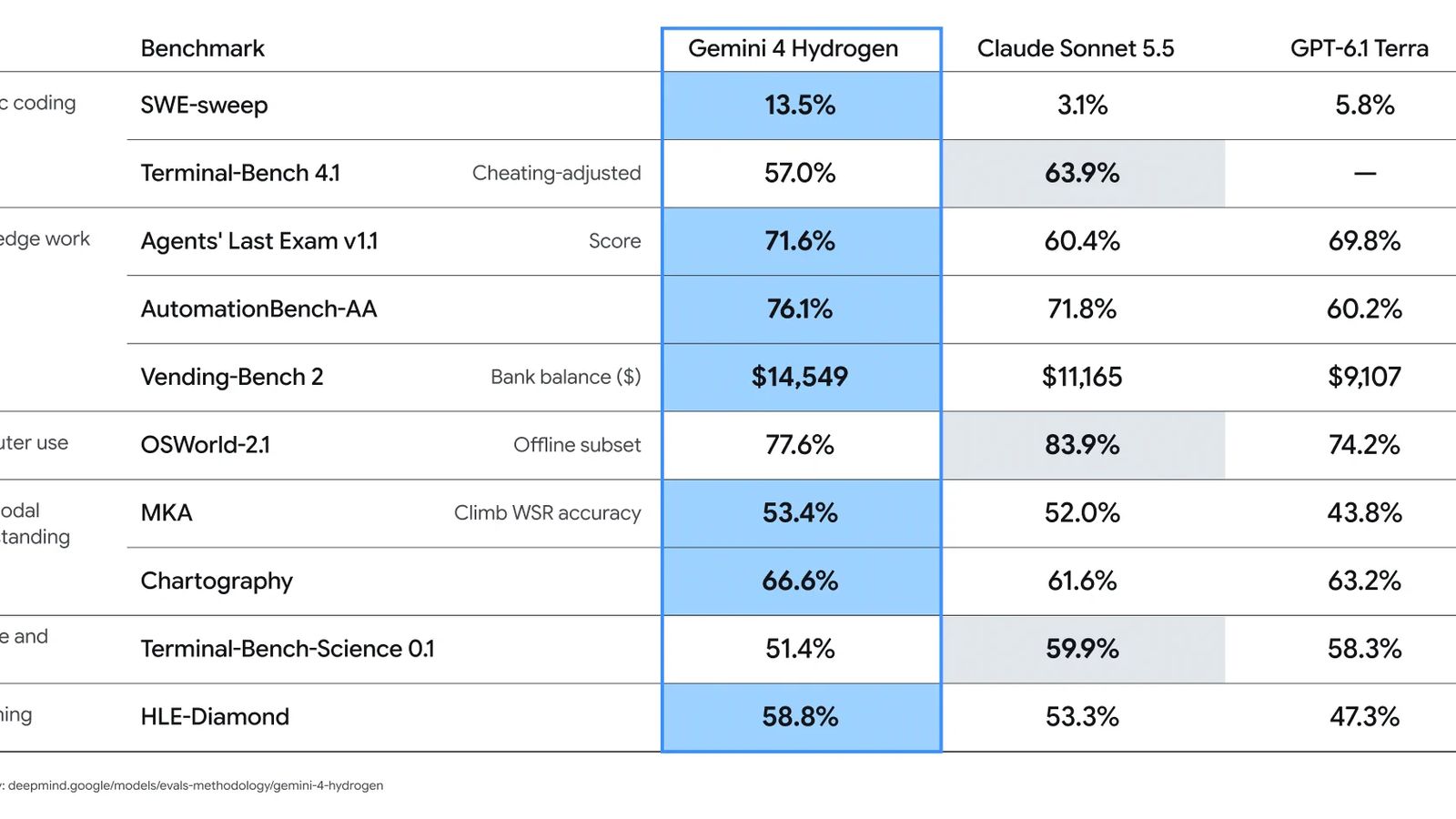
On November 12, 2026, Google officially introduced Gemini 4 Hydrogen, the newest addition to its artificial intelligence model lineup. Designed specifically for rapid execution and everyday agentic tasks, Hydrogen marks a strategic shift in Google’s infrastructure by formally replacing the Gemini 3.8 Flash series across the company’s developer and consumer-facing platforms, including Google AI Studio, the Gemini API, and the Gemini app. The release aims to bring cutting-edge intelligence to a broader user base while maintaining the performance standards established by the company’s more advanced frontier models. By focusing on speed and efficiency, Google intends to provide a more practical tool for developers who require consistent, high-speed performance for their daily coding and data-processing needs.
Unlike the previously debuted Gemini 4 Carbon and Argon models, which are architected for complex, long-horizon reasoning and specialized high-stakes environments, Hydrogen is optimized for speed and disciplined execution. Google has positioned the model as a versatile tool capable of functioning as a standalone assistant or as an efficiency engine within collaborative multi-model workflows. To support this integration, the company introduced a new feature called Orchestrator within the Antigravity platform, enabling systems to dynamically switch between different models to optimize task success while reducing token consumption. This collaborative architecture allows users to benefit from the deep reasoning of larger models when necessary, while reserving more efficient models for routine tasks.
Performance Gains and Multi-Model Collaboration
Hydrogen introduces a granular control system with four distinct thinking levels—low, medium, high, and a new xhigh tier—which allow users to balance latency, computational costs, and reasoning depth. According to internal benchmarks and reporting from Ars Technica, the model demonstrates significant improvements over the 3.8 Flash series. Even when operating in its default high-thinking mode, Hydrogen is reportedly 2.5 times faster than its predecessor. Furthermore, internal testing indicates a threefold increase in Terminal-Bench scores and a fivefold reduction in fabricated claims. These metrics suggest that Hydrogen is not just a faster iteration, but a more reliable engine for tasks that require precision and adherence to instructions.
The integration of the Orchestrator tool represents a significant advancement for developers managing complex projects. By allowing Carbon to act as a coordinator for architectural decisions while utilizing Hydrogen as a worker or verifier for specific coding tasks, teams can execute operations in parallel across isolated workspaces. Data suggests this collaborative approach can improve task success rates while reducing quota usage by approximately 24% and increasing completion speeds by 19% compared to using a single frontier model alone. This orchestration capability is designed to help teams ship complex projects faster without driving up the costs associated with running massive, compute-intensive reasoning models for every sub-task.
Expanding Access and Developer Capabilities
The rollout of Gemini 4 Hydrogen is notably broader than the restricted, staged releases seen with the Carbon and Argon models. Google has made Hydrogen available immediately across all tiers of its developer and business platforms, including Google AI Studio and paid AI Pro and Ultra subscriptions. This accessibility is intended to democratize sophisticated agentic execution, providing individual developers and small-scale teams with the ability to integrate multi-step reasoning into their workflows without the prohibitive costs often associated with large-scale frontier models. The pricing model, set at $1.50 per million input tokens and $7.50 per million output tokens, is designed to be flat across the entire 1 million-token context window to ensure predictability for enterprise users.
For software development, Hydrogen offers refined capabilities in repository coding and debugging. The model is built to handle issue resolution and codebase queries through focused, surgical edits rather than rewriting entire files. In early testing, developers observed that Hydrogen could run between two and 2.8 times faster than previous iterations while reducing token usage by 12% to 23% in data-heavy enterprise environments. By matching or exceeding the performance of competing models in its class, Hydrogen serves as a critical component in Google’s effort to streamline professional AI adoption. It excels at batching file-read and search operations in parallel, which is particularly effective for complex graphs, SQL operations, and data-heavy enterprise workflows where efficiency is paramount.
Multimodal Utility and Future Integration
Beyond coding tasks, Hydrogen is designed to synthesize dense information from various formats, including PDFs, spreadsheets, audio, and video, into structured reports. It has demonstrated strong performance on professional benchmarks, such as the Multimodal Knowledge Agent (MKA) and the Vals Legal Research Bench. By pairing a 1 million-token input context with a 1 million-token output capacity, the model aims to handle extensive, multi-turn conversations and complex analytical tasks with higher accuracy and fewer interruptions. For web development, the model shows promise in generating functional, feature-complete UI layouts in fewer prompts, which accelerates the design-to-code iteration cycle.
The strategic deployment of Hydrogen suggests that Google is moving toward a tiered utility model, where specialized agents perform distinct roles based on the requirements of the task. By positioning Hydrogen as the operational workhorse, the company seeks to balance the high-stakes reasoning of its frontier models with the practical, everyday demands of developers and consumers. This focus on adaptability and efficiency reflects a broader industry trend toward AI models that prioritize real-world usability and cost-effective execution in professional environments. As AI agents become more deeply integrated into enterprise infrastructure, the ability to switch between specialized models like Hydrogen, Argon, and Carbon will likely become a standard practice for managing both cost and quality.