


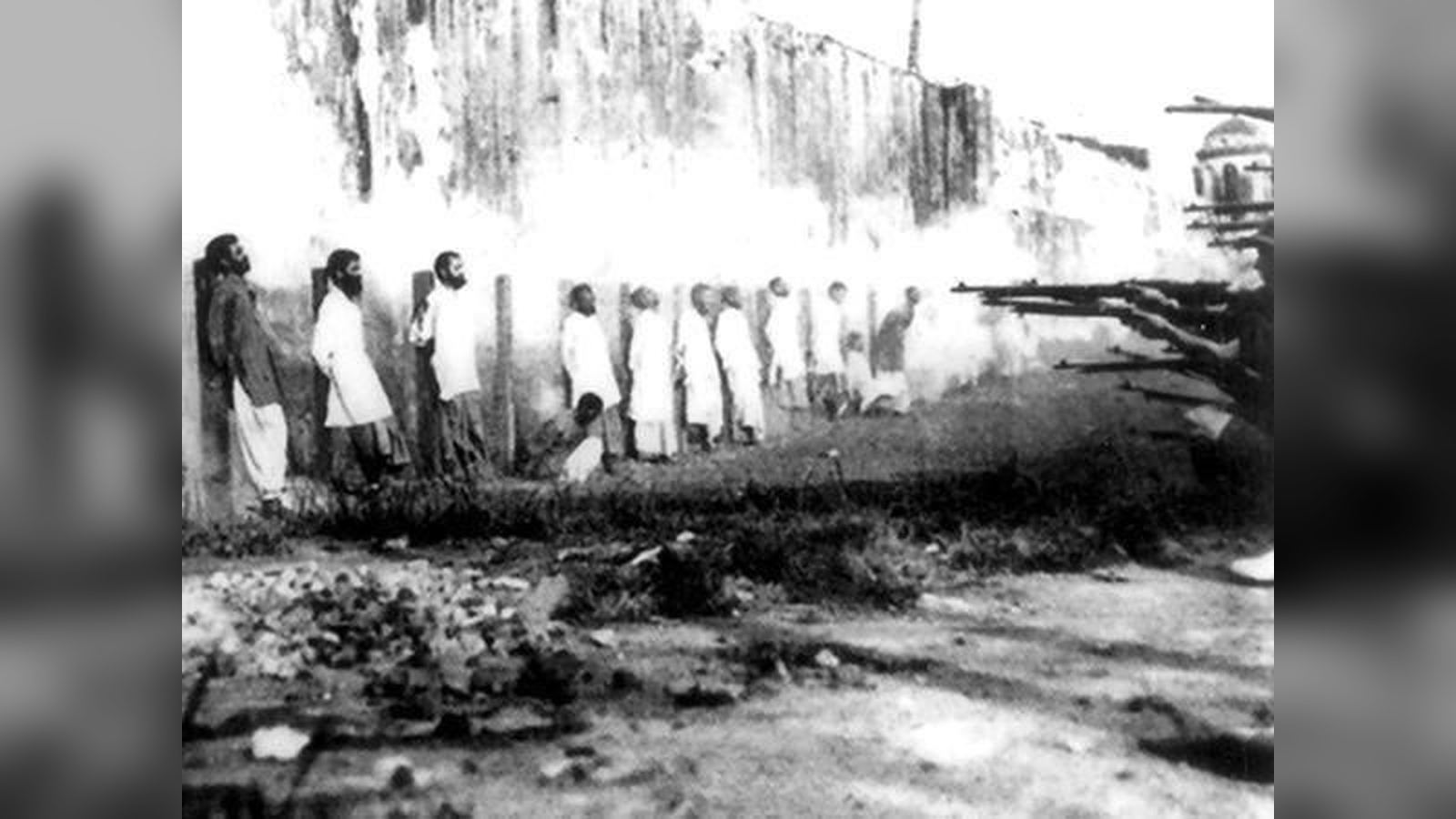
This stark, grainy black-and-white photograph captures a moment of ultimate colonial finality: a line of soldiers standing before a firing squad, their postures rigid yet defeated, waiting for the command that would end their service to the British Empire. It is a haunting visual testament to the brutal discipline imposed on the 1.3 million Indian soldiers who were deployed across global theaters during the First World War. While official imperial narratives often focused on the myth of the ‘loyal sepoy’—the stoic, obedient colonial subject—this image forces us to confront the hidden, violent underside of the British Raj’s war effort, where the refusal to obey was met with immediate, lethal execution.
What the photograph shows
In the frame, we observe the clinical nature of military justice in the field. The composition is stark; the condemned men are positioned in a desolate, open space, likely in a desert or arid region consistent with the Mesopotamian campaign. Their uniforms, though worn and dusty, reflect the standardized attire of the Indian Army at the time. The firing squad, though perhaps partially obscured or standing just outside the immediate focus, represents the faceless authority of the colonial state. There is no triumph here, only the cold, mechanical application of power. The image is a piece of evidence that survived the censors, likely intended as a warning to other units about the consequences of insurrection or desertion. The detail in the soldiers’ posture—shoulders slumped, heads perhaps bowed or held high in silent defiance—speaks to the individual humanity being erased by the state.
The moment behind the image
The photograph reflects the profound cultural and religious dislocation experienced by Indian troops. Many Indian Muslim soldiers were sent to the Mesopotamian and North African theaters to fight against the Ottoman Empire, a conflict that placed them in direct opposition to their own religious leaders and co-religionists. When individual soldiers or small units refused to participate in these campaigns—or when they were suspected of harboring revolutionary ‘Ghadar’ (mutiny) sentiments—the British military response was swift and uncompromising. This photograph serves as a reminder that the ‘Great War’ was, for many, a struggle fought under the constant threat of the very masters they were serving. It captures the tension of 1915, a year marked by near-insurrection within the ranks as soldiers began to question why they were dying for a country that denied them their own freedom.
Photographer and provenance
The provenance of such images is often murky. During the First World War, military photography was tightly controlled by the British press bureaus and intelligence services. Photographs of executions were rarely intended for public consumption in Britain, as they contradicted the propaganda of the ‘heroic volunteer.’ Instead, such images were often taken by official military photographers or intelligence officers as documentation for court-martial records or as internal tools for maintaining discipline. The survival of this image in archives suggests it may have been recovered from private collections or intelligence files long after the war concluded. The anonymity of the photographer underscores the dehumanization of the subjects; they are treated as data points in an imperial report rather than individual humans with lives and families back in the villages of India. We cannot be certain of the exact date or the specific unit, but the visual language of the scene aligns with the period of intense repression during the 1915 mutiny scares.
Historical context
The tension within the Indian Army was not merely a matter of individual conscience but a reflection of a broader, simmering resistance against British rule. Historians such as Dr. Gajendra Singh have documented how British intelligence closely monitored correspondence to identify anti-colonial sentiment. The fear of insurrection was so high that propaganda, sometimes even penned by figures like Rudyard Kipling, was used to paint the Indian soldier’s service in paternalistic, glowing terms to obscure the reality of the trenches and the growing resentment at home. The execution of soldiers for ‘mutiny’ was a tool of terror designed to maintain order in an army that was increasingly questioning its role in a foreign conflict. The British government, while promising self-rule, simultaneously enacted the repressive Rowlatt Act, leading to tragedies like the Jallianwallah Bagh massacre, further alienating the very population that had provided the manpower for their victory.
Why it still matters
For decades, these soldiers were forgotten, their sacrifices ignored by both the British Empire they served and the independent India they helped build. It is only in recent years, with the centenary of the First World War, that archives have begun to shed light on these men. Looking at this photograph today, we see not just a historical event, but the human cost of empire—a story of men caught between duty, faith, and the brutal mechanisms of colonial power. The image remains a powerful, uncomfortable reminder that history is not just written by the victors, but often built upon the silenced, broken bodies of those who were forced to fight for a cause they did not choose. It challenges us to look beyond the triumphal arches and see the individuals who paid the ultimate price for a promise that was never kept.