


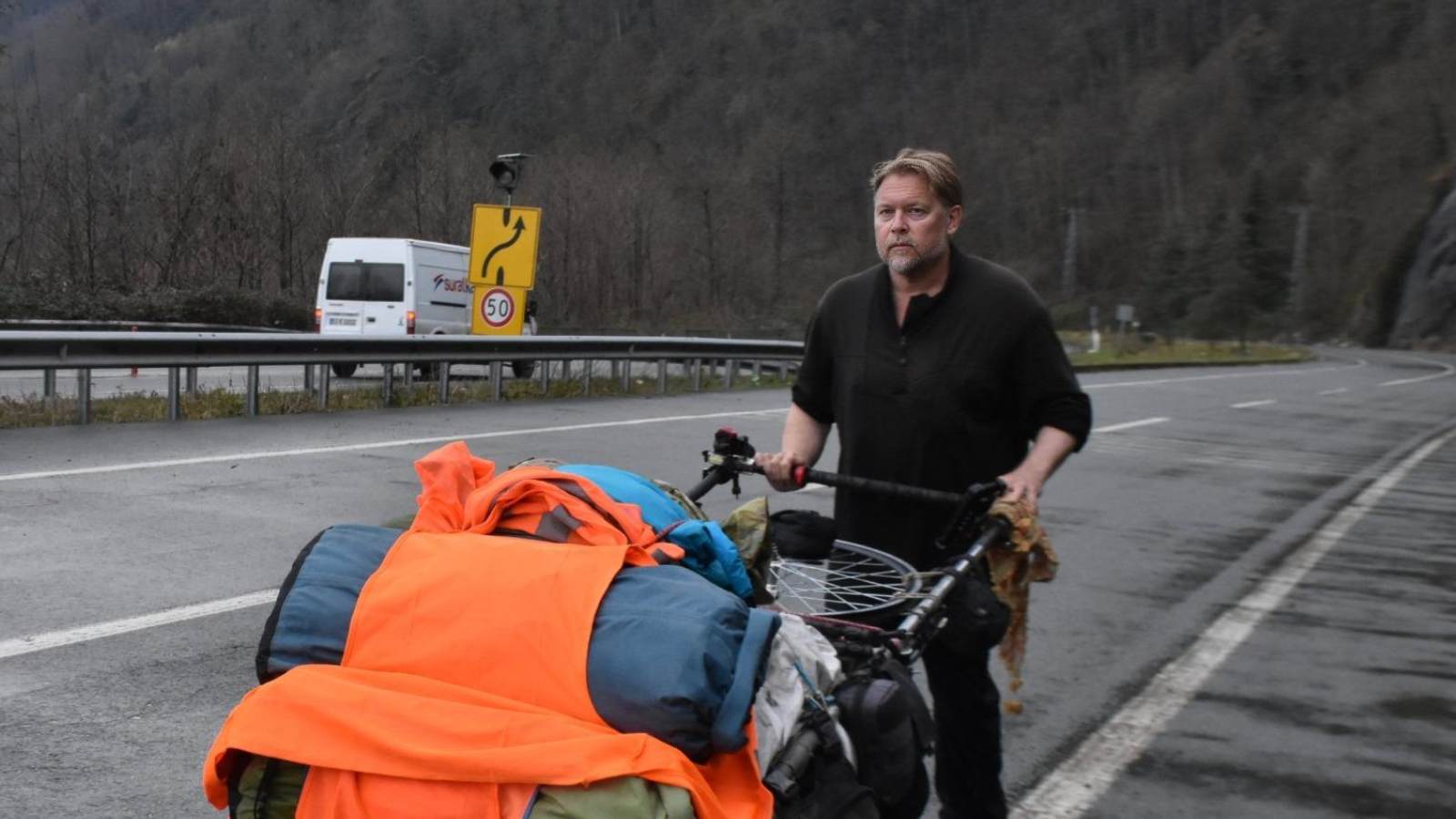
In a world where most journeys are measured in hours and days, Karl Bushby’s odyssey stands apart—spanning decades, continents, and the unshakable bond between a mother and her son. For 27 years, Angela Bushby has waited in Hull, clutching onto hope and memories, as Karl trekked an unimaginable 36,000 miles around the globe, determined to walk home without using any form of transport.
Karl’s departure from Chile on November 1, 1998, marked the beginning of the Goliath Expedition, an adventure he expected would take twelve years. Yet, the world had other plans. Geopolitical strife, wars, and the labyrinthine complexities of international visas stretched his journey far beyond the original timeline. As 2026 approaches, Karl is now transitioning from Hungary into Austria, inching closer to the reunion that his mother, Angela, has dreamt of for almost three decades (BBC, el-Balad).
Back home in Hull’s Sutton Park estate, Angela keeps vigil in the living room where Karl first unveiled his ambitious plan. The space, cluttered with family photographs and decades of newspaper clippings, is more than a shrine to adventure; it’s a testament to a mother’s unwavering love. Angela recalls the moment Karl shared his vision, supported by his father Keith—a former SAS soldier whose own life shaped the family’s resilient spirit. “I was gobsmacked when Karl told me what he planned to do,” Angela admits, echoing the disbelief many would feel at such a feat.
Angela’s pride is interwoven with anxiety. She’s seen Karl just three times since he set off, one of those before he became the first Briton to cross the frozen Bering Strait in 2006. That crossing—14 days over shifting ice in temperatures plummeting to -30°C—was a moment of both triumph and terror for the family. Angela remembers hearing on the radio that Karl had been arrested for entering Russia illegally, her heart dropping at the news.
But Karl’s journey has been more than a test of physical endurance. His path was shaped by adversity long before he set foot outside the UK. Diagnosed with dyslexia at 13 and bullied at school, Karl’s early years were marked by struggle. “He was called thick and stupid,” Angela recalls. “He was neither.” With the diagnosis came understanding, and with understanding, determination. Karl found ways to work around his condition, eventually embracing reading—a skill that would prove invaluable on the road.
His military career, too, was hard-won. Passing P Company, the grueling selection for the Parachute Regiment, took several attempts. Grit, resilience, and a desire to make his family proud saw him through. Childhood photos show Karl and his brother Adrian—both Army men—charting a course from Hull’s fields to the world’s farthest reaches.
Angela’s support has never wavered. She’s kept scrapbooks chronicling every step, collected Christmas presents for Karl each year, and held onto every message—no matter how sporadic. “He will have quite a few to open!” she laughs, reflecting on their tradition. The modern world has offered some reprieve; Messenger calls now bridge the distance that once felt insurmountable.
Angela’s worries are not just about Karl’s safety but about his future. How does one reintegrate into ordinary life after decades spent on the road? “I don’t know what he’s going to do,” she muses. “Hopefully, he will end up here.” But Angela suspects the wanderlust may never fade: “I don’t think he will ever stay put in one place after travelling for so long.”
Karl’s journey has forced him to improvise, most notably when he swam 186 miles across the Caspian Sea in 2024 to avoid re-entering Russia or Iran—an audacious solution to a bureaucratic dead end (el-Balad). These moments of ingenuity and endurance are the hallmarks of an explorer who refused to give up, despite the odds.
For Angela, the anticipation of Karl’s return is bittersweet. The fields where Karl played as a boy are gone, replaced by homes. The world has changed, but her hope remains steadfast. “He’s still my little boy,” she insists, her voice a mix of pride and longing. Every sleepless night, every anxious wait for news, has been a testament to a bond that distance could not break.
As September 2026 nears, Hull prepares for a homecoming unlike any other—a celebration not just of a singular achievement, but of resilience, family, and the relentless pursuit of a dream. The world may have changed, but at the heart of this journey is a universal story: a mother waiting for her son, and a son walking home.
Karl Bushby’s story is a powerful reminder that the greatest journeys are not measured by miles alone, but by the strength to persevere and the love that endures across continents and years. His walk is as much a testament to human endurance as it is to the quiet heroism of those who wait and believe.