


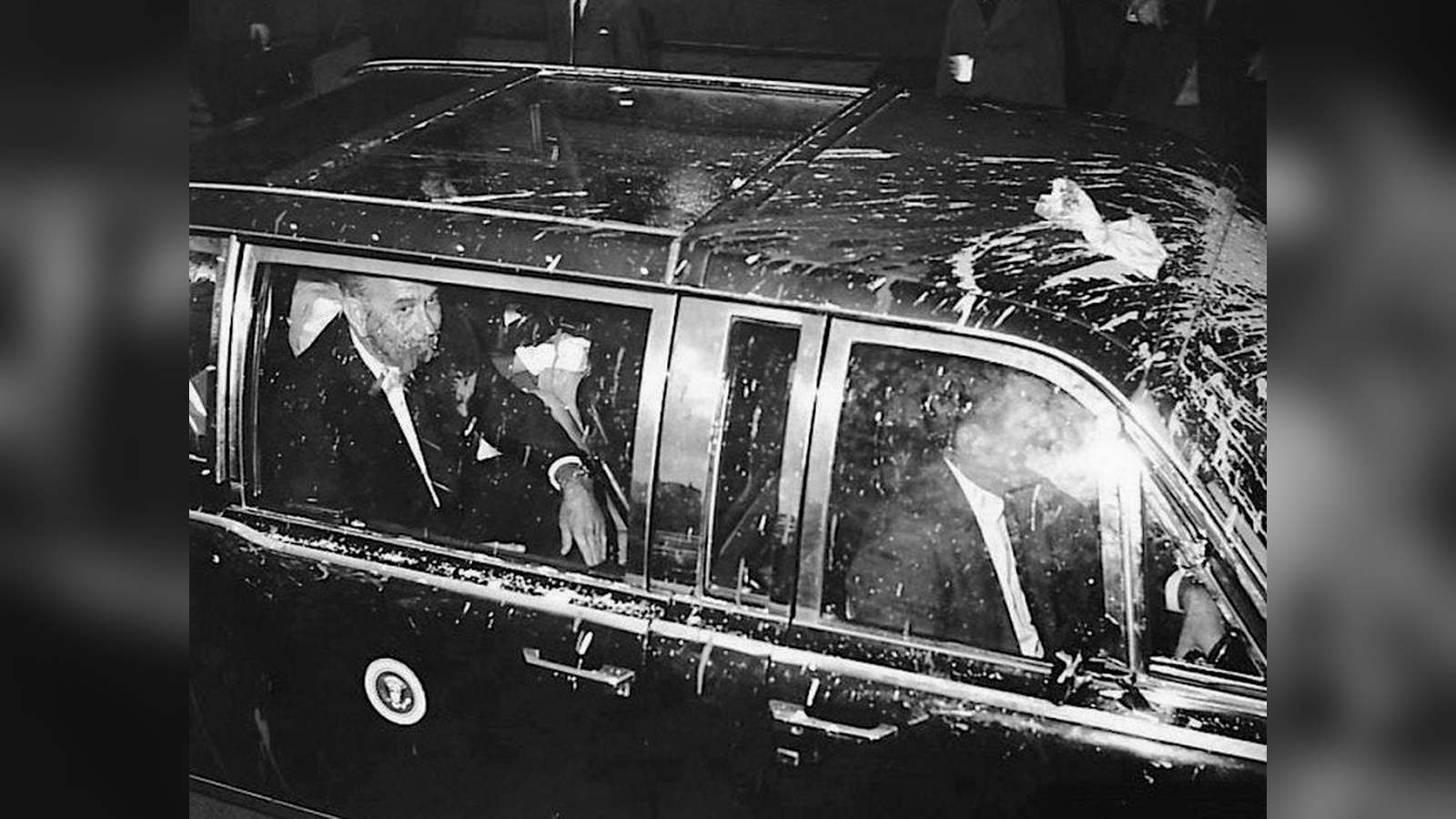
The photograph captures a jarring, visceral sight: the sleek, polished exterior of a U.S. presidential limousine, typically an emblem of absolute state power and untouchable dignity, now marred by chaotic, vibrant splatters of paint. This image from 1966, taken in the heart of Washington, D.C., freezes a critical moment when the escalating conflict in Vietnam spilled over from the jungles of Southeast Asia into the very streets of the American capital. It documents the transition from civil political discourse to direct, physical protest against the administration of Lyndon B. Johnson. By looking closely at this frame, we witness the visual collision between the establishment’s rigid order and the grassroots fury of a generation disillusioned by a war that seemed to have no end.
What the photograph shows
In the frame, the dark, imposing body of the presidential limousine is transformed into a literal target. The paint—likely thrown from balloons, bags, or canisters by anti-war demonstrators—streaks across the doors, fenders, and windows of the vehicle. The stark contrast between the formal, rigid, and expensive design of the vehicle and the messy, defiant nature of the paint captures the profound tension of the era. This was not merely an act of vandalism; it was a symbolic defacement of the presidency itself, a rejection of the authority that Johnson wielded as he aggressively ramped up American military involvement. The observers in the background, their faces obscured or distant, provide a sense of scale, emphasizing that this was a public confrontation in a space usually reserved for the pageantry of power. The damage to the car reflects the damage to the social contract of the 1960s.
The moment behind the image
By 1966, the initial, fragile optimism surrounding Johnson’s ‘Great Society’ legislative agenda was being eclipsed by the mounting death tolls in Vietnam. The anti-war movement had shifted from intellectual debates on college campuses to aggressive, highly visible public demonstrations. When the presidential motorcade moved through the streets, it no longer enjoyed the quiet, automatic respect of the post-WWII era. Instead, it became a focal point for a public that felt increasingly unheard and betrayed. The act of throwing paint was a calculated, high-stakes move to strip the office of its untouchable aura, forcing the president to confront the visual evidence of his plummeting popularity. Immediately after the shutter clicked, security details would have scrambled, likely leading to arrests and a heightened police presence, further fueling the cycle of confrontation. The tension in the air was palpable, as the Secret Service transitioned from protecting a leader to managing a hostile, volatile public.
Photographer and provenance
While the specific photographer is often uncredited in archival collections, the image belongs to the body of work produced by press photographers covering the White House in the mid-1960s. These professionals worked under immense pressure, balancing the need for security clearance with the journalistic imperative to capture the growing civil unrest. The image survived because it perfectly encapsulated the ‘credibility gap’ that defined Johnson’s later years. It circulated widely in newspapers and magazines of the time, serving as an iconic representation of a nation divided against itself. The uncertainty of the photographer’s identity is common for this period, as many images of protests were captured by wire service stringers or freelance photojournalists whose work was quickly consumed by the daily news cycle. The lack of a single definitive credit does not diminish the historical weight of the image; rather, it highlights the collective nature of the media’s attempt to document the unraveling of the Johnson presidency.
Historical context
Lyndon B. Johnson’s presidency was defined by a stark duality: domestic progress and foreign policy catastrophe. While he championed the Civil Rights Act of 1964 and the Voting Rights Act of 1965, the Vietnam War became a bottomless pit for both federal funding and political capital. As the number of troops in Vietnam surged toward 500,000 by 1968, the American home front fractured. The sight of a paint-splattered limousine became a recurring nightmare for the White House, signaling that the administration had lost control of the national narrative. This image serves as a precursor to the 1968 political climate, which eventually forced Johnson to announce he would not seek re-election. The domestic unrest was not just about the war; it was about the failure of the government to address the needs of its people while spending billions on a distant conflict.
Why it still matters
This photograph remains a haunting reminder of the fragility of political legitimacy. It captures the moment when the gap between the government and the governed became visibly, undeniably wide. It is a testament to the power of protest to reach the highest levels of power, even if only through a symbolic act of defacement that left the president’s car as damaged as his public approval ratings. It reminds us that the symbols of state power are only as strong as the public’s willingness to respect them, and in 1966, that respect had been spent on the battlefield. Looking at this image today, we are reminded that history is often written not just in the halls of power, but on the streets where the people meet the machinery of state.