


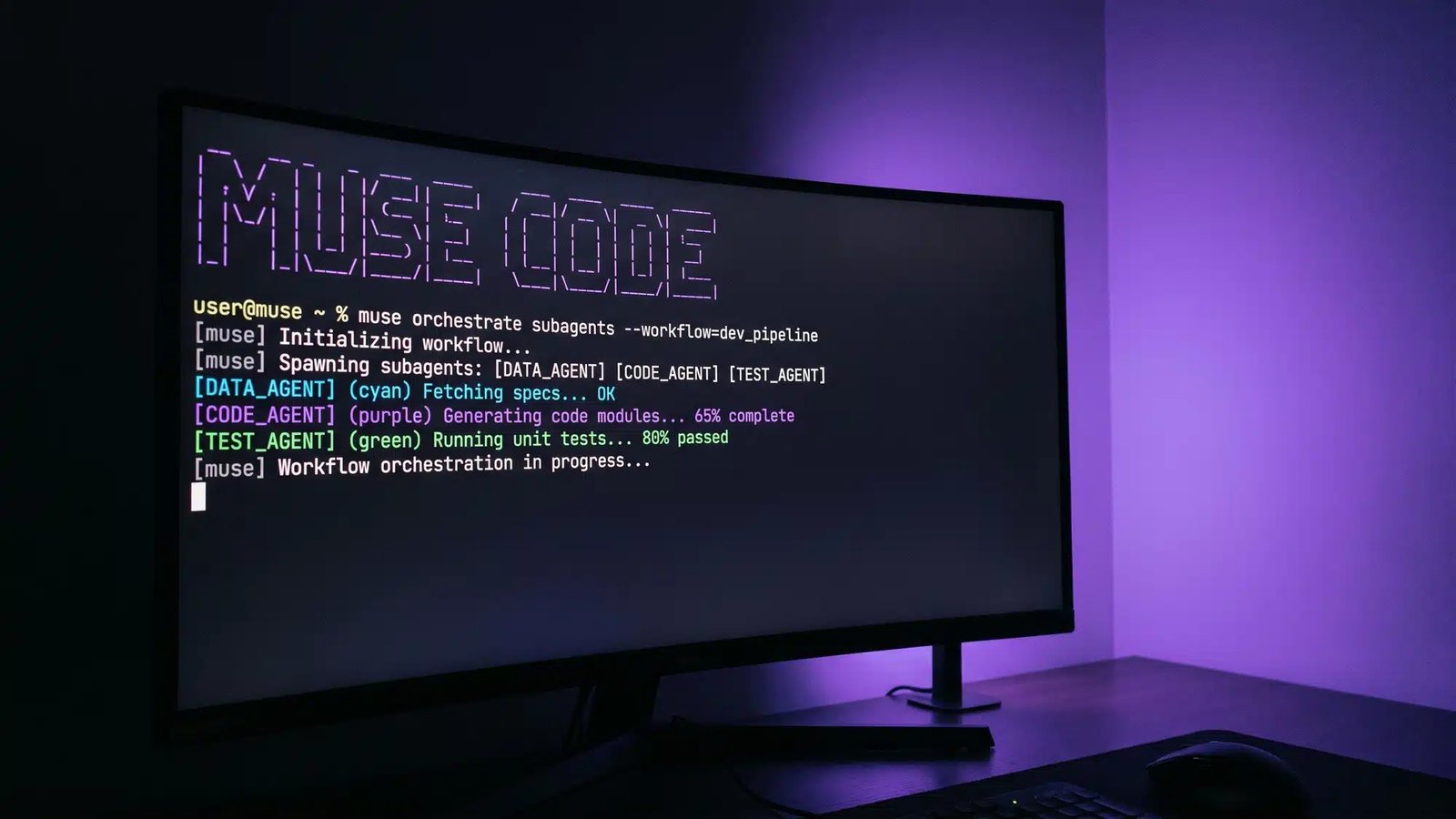
A New Challenger in Terminal-Native Coding
Meta Superintelligence Labs officially exited the public beta for Muse Code on August 31, 2026, positioning the tool as a direct competitor to Anthropic’s Claude Code. Designed as a terminal-native coding agent, Muse Code allows developers to turn project directories into interactive, autonomous coding sessions that can plan, edit, and execute terminal commands.
The launch arrives as developers report increasing constraints on Claude Code, including tighter rate limits and capacity management issues on Pro and Max plans. Meta’s entry aims to capture this market by offering a multi-agent architecture that handles large-scale tasks by automatically fanning out sub-tasks into parallel processes.
This report draws on information published by intelligentliving.co.
Multi-Agent Architecture and Workflow
Unlike competitors that often require manual intervention to spawn agents, Muse Code utilizes an “opinionated” multi-agent design. When presented with a complex task, the parent agent automatically distributes sub-tasks to child agents, each isolated within its own git worktree to prevent file collisions. This allows for simultaneous editing across different parts of a codebase.
The tool includes several key features designed for sustained development, including:
- Rewind: A checkpoint-based recovery system that allows developers to revert code changes based on an append-only event log.
- Workflows: An orchestrator that provides live progress monitoring of sub-agents, with the ability to pause, resume, or save successful task patterns.
- SDK Preview: A TypeScript library that enables developers to embed Muse Code’s session machinery into custom tools using the open Muse Session Protocol.
Pricing and the ‘Contributor’ Discount
Meta has introduced a two-tier pricing structure for its Muse Spark 1.2 model, which powers the agent. The “Standard” tier is privacy-focused, costing $1.25 per million input tokens. However, the “Contributor” tier offers a significant discount, with input costs reduced to $0.10 per million tokens—roughly 12 times cheaper than the standard rate.
The trade-off for this pricing is a data retention clause: by choosing the Contributor tier, users consent to Meta using their prompts and code completions to train future iterations of its models. This pricing strategy positions Muse Code as a highly competitive option for heavy users, particularly those managing overnight agent sessions or multi-hour refactors who are currently hitting rate limits on other platforms.
Platform Support and Integration
Muse Code is natively supported on macOS and Linux. While Meta does not provide a native Windows build, the tool is compatible with Windows via the Windows Subsystem for Linux (WSL). Users can install the Linux binary within a WSL environment and interact with Windows file systems through standard mount points. The tool remains model-agnostic in its API configuration, allowing users to swap providers with simple configuration changes.