


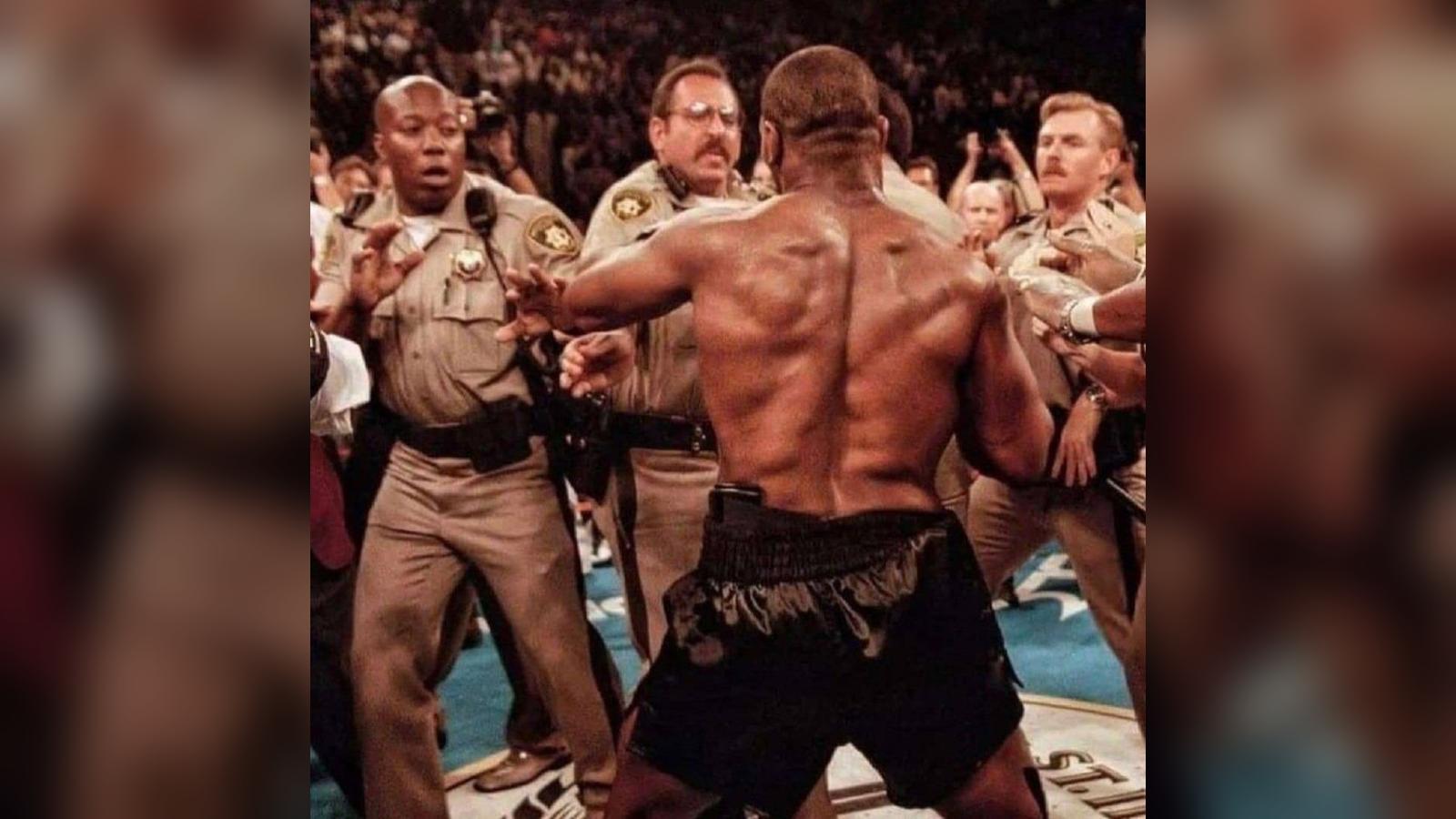
Law enforcement officers and arena security rush the canvas in utter chaos, swarming the squared circle as pandemonium erupts during the heavyweight championship rematch between Mike Tyson and Evander Holyfield on June 28, 1997. This stark photograph freezes the exact second professional sports devolved into street-level violence under the scorching television lights of the MGM Grand Garden Arena in Las Vegas, capturing an infamous milestone in modern boxing history. The image acts as a powerful visual anchor for a night that shocked millions worldwide, laying bare the combustible collision of elite athletic competition, unbridled pressure, and deep psychological trauma. This feature examines the intricate visual composition of the frame, the volatile circumstances leading up to the shutter click, the historical provenance of the photograph, the broader athletic context of the era, and how this shocking image cemented a tragic turning point in Tyson’s legendary and turbulent career.
What the photograph shows
In the center of the frantic frame, police officers in official uniforms and state athletic commission staff push past cornermen and officials in a desperate bid to separate the fighters. The atmosphere recorded by the camera is thick with disorientation and sensory overload. Spectators seated in the expensive ringside rows lean over the apron, hurling debris, plastic cups, and beer cans toward the canvas. Evander Holyfield stands nearby, visibly stunned and holding his bleeding, mutilated ear while cornermen and officials shield him from further chaos and flying objects. Mike Tyson, his face masked by a turbulent mix of adrenaline and raw fury, is being guided away from the center of the ring by security personnel. The composition emphasizes the claustrophobia of the squared circle turned battleground, lit by harsh television illumination that casts sharp shadows across the canvas and illuminates the frantic, sweating faces of security personnel, referees, and handlers.
The moment behind the image
The rematch was billed by promoters as “The Sound and the Fury,” but few observers anticipated the surreal and disturbing depths to which the bout would ultimately sink. Seven months earlier, in November 1996, Holyfield had stopped Tyson in an 11th-round technical knockout, effectively bullying the former champion and utilizing persistent, subtle headbutts that referee Mills Lane allowed to go unpunished. Entering the June 1997 rematch, Tyson was desperate to reclaim his aura of invincibility and prove his doubters wrong. From the opening bell, however, the pattern repeated itself with agonizing familiarity: a clash of heads opened a severe gash over Tyson’s right eye. When referee Lane once again ignored Tyson’s impassioned pleas for intervention, the boxer’s psychological defenses completely crumbled. According to observers and close confidants, Tyson was no longer a polished world champion in that instant; he was the traumatized kid from Brownsville, Brooklyn, striking back against perceived systemic injustice. In a blind rage, Tyson clamped his teeth onto Holyfield’s right ear, severed a piece of cartilage, and spat it out onto the mat before later biting his left ear as well.
Photographer and provenance
As one of the most widely syndicated and discussed sports photographs of the late 20th century, the image was captured by veteran ringside photojournalists working under extreme pressure for major wire services and international photo agencies. Positioned just feet away from the canvas apron, photographers had mere fractions of a second to adjust their manual focus and exposure as the security detail breached the ropes and chaos consumed the ring. The photograph quickly moved from darkrooms and digital terminals to the front pages of newspapers across the globe, defining the surreal brutality of late-90s pay-per-view sports culture. The immediate and widespread circulation of the image transformed a standard sporting disqualification into an international pop-culture spectacle, ensuring its permanent place in journalistic archives and collective memory.
Historical context
The bite incident occurred at a fragile and deeply vulnerable crossroads in Mike Tyson’s life and career. Having emerged from a three-year prison sentence in 1995, Tyson was attempting to navigate a radically altered sporting landscape while carrying the immense psychological weight of his past. The devastating loss to Holyfield in 1996 and the subsequent meltdown in 1997 laid bare the deep emotional fractures of a fighter who had risen from absolute poverty and street violence to unprecedented wealth and fame without adequate emotional guidance or stability. Following the disqualification, the Nevada State Athletic Commission suspended Tyson’s boxing license indefinitely and fined him $3 million, plunging him further into a dark personal period characterized by severe legal troubles, erratic public behavior, and intense, relentless media scrutiny.
Why it still matters
Decades later, this photograph remains the definitive visual shorthand for the perils of unbridled pressure and the tragic collision of raw athletic talent with unaddressed psychological trauma. While Tyson and Holyfield eventually reconciled years later—even sharing humorous commercial appearances that played on the absurdity of the event—the image endures as a cautionary historical artifact. It captures a singular moment when the strict boundaries of sport dissolved completely into human chaos, leaving behind a haunting, unforgettable portrait of frustration frozen forever under the bright lights of Las Vegas.