


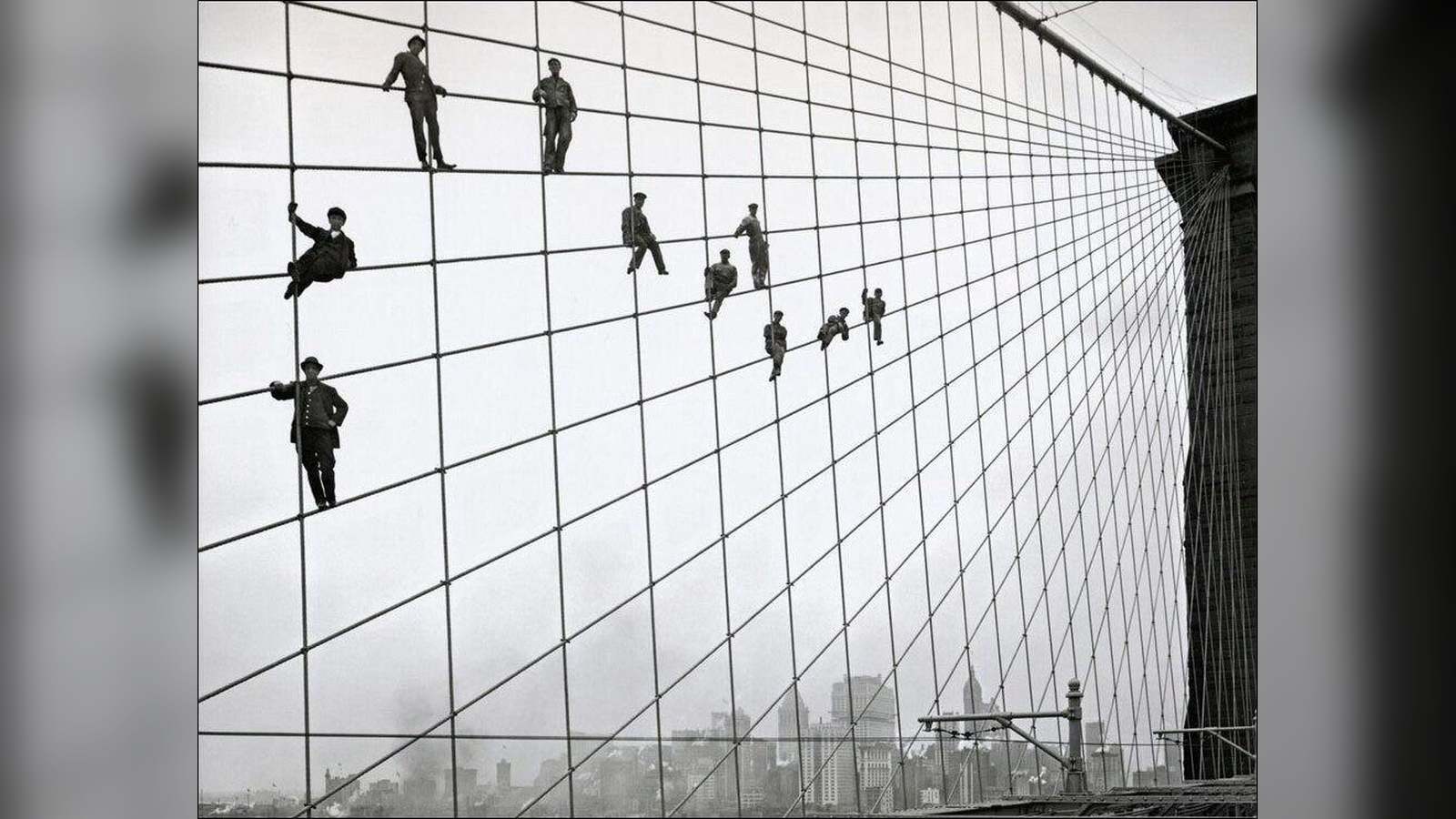
A group of men sit and stand gracefully along the sweeping diagonal stays of a giant suspension bridge, suspended high above the cityscape with extraordinary calm. At first glance, they look almost like notes on a musical staff or birds Resting on telegraph wires, yet a closer look reveals workers holding brushes and paint buckets, balanced precariously over a sheer vertical drop. Taken on October 7, 1914, this photograph captures a routine maintenance crew painting the Brooklyn Bridge, transforming an ordinary municipal task into a striking study of human bravery and architectural scale. How did a routine civil service photograph, taken to document city infrastructure, become one of the most mesmerizing visual records of early twentieth-century New York labor?
What the photograph shows
In the photograph, more than a dozen painters are arranged along the diagonal suspender cables of the Brooklyn Bridge. Their postures are remarkably relaxed: some sit with legs dangling over empty space, others stand upright holding onto parallel wires for balance, and several lean casually against the steel ropes as if standing on solid pavement. They wear the typical work attire of the 1910s—flat caps, heavy cloth jackets, trousers tucked into work boots, and waistcoats. Look closely at their hands and feet, and the physical reality of their labor becomes clear: there are no safety harnesses, tether lines, net catchers, or protective headgear visible anywhere in the frame. The diagonal lines of the steel cables lead the eye upward, while the faint silhouette of New York City and the river beneath provide context for the terrifying elevation at which these men operate.
The moment behind the image
The image was taken on a cool autumn day, October 7, 1914, during a comprehensive repainting and structural check of the Brooklyn Bridge. The bridge, opened in 1883, required constant maintenance to protect its steel and iron components from corrosion caused by salt air, humidity, and soot from urban industry. Painting the structure meant crawling along its outer cables, main suspensions, and high towers. Rather than taking a candid document of active work, photographer Eugene de Salignac gathered the crew and asked them to pose along the cables. The painters complied enthusiastically, stepping onto the thin wire stays and arranging themselves in a staggered, harmonious formation that allowed the photographer to capture their faces and figures clearly against the sky.
Photographer and provenance
The man behind the camera was Eugene de Salignac (1872–1943), a civil servant who served as the official photographer for the New York City Department of Bridges (later the Department of Plant and Structures) from 1906 until 1934. During his nearly three-decade career, de Salignac took over 20,000 large-format glass plate photographs documenting the construction, repair, and daily management of New York’s bridges, ferries, municipal buildings, and streets. Despite his technical mastery and keen eye for composition, de Salignac was not celebrated during his lifetime; he was treated purely as a municipal employee performing administrative documentation. The original glass negative was deposited into the New York City Municipal Archives, where it remained largely unseen by the general public for almost a century until April 2012, when the city released a digitized archive of over 870,000 historic images.
Historical context and labor risks
This image provides a vivid look into the working conditions of American urban infrastructure laborers before the establishment of modern occupational safety standards. In 1914, high-altitude ironworkers and painters relied almost entirely on personal agility, balance, and mutual trust rather than engineered fall protection. While the Brooklyn Bridge was celebrated as an engineering masterpiece of the Gilded Age, the human cost of maintaining such structures was substantial. Ironworkers and painters faced constant risks from strong river gusts, slippery steel, and physical fatigue. The nonchalant demeanors captured in de Salignac’s frame reflect a professional culture where danger was an accepted element of daily employment, and physical daring was a point of pride among municipal work crews.
Why it still matters
Eugene de Salignac’s 1914 photograph endures because it bridges the gap between massive architectural engineering and individual human effort. It reminds viewers that New York City’s legendary skyline and grand bridges were not constructed or preserved by abstract forces, but by working-class individuals who risked their lives on thin steel wires every day. Today, the photograph is widely recognized as a masterpiece of early American industrial photography—a testament to both the fearless workers who maintained the city’s lifelines and the forgotten municipal photographer who gave their labor permanence.