


What the photograph shows
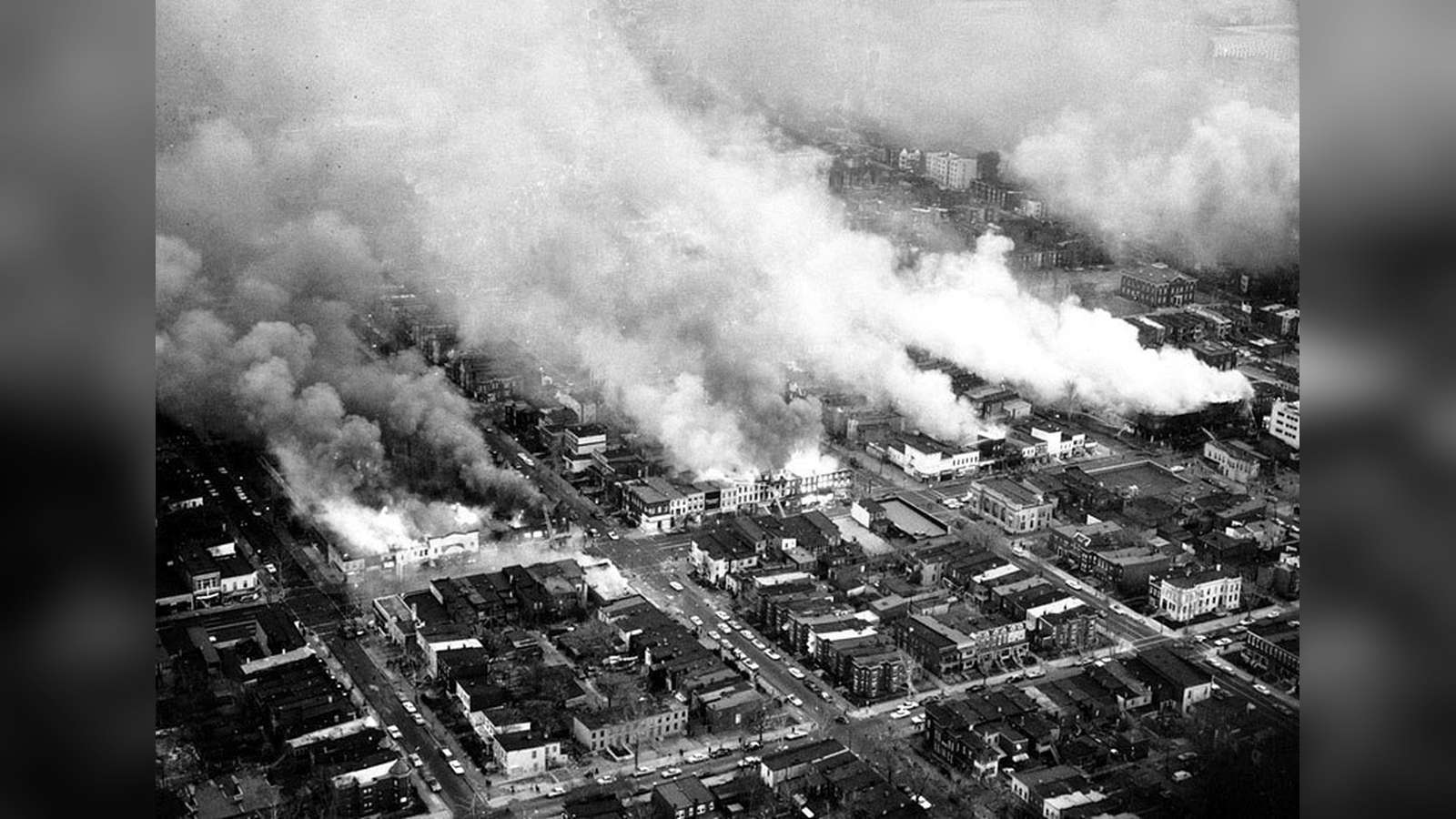
This striking historical photograph captures a moment of intense urban turmoil in the heart of the United States. In the foreground, a military jeep carrying armed National Guardsmen rolls down a smoke-hazed street, its occupants alert and scanning their surroundings. Looming directly behind them is a building engulfed in ferocious flames, sending thick billows of dark smoke into the sky. The stark contrast between the olive-drab military vehicle and the bright, destructive orange of the fire encapsulates the clash of military intervention and civilian upheaval. The composition forces the viewer’s eye from the disciplined machinery of state security to the chaotic destruction consuming the neighborhood, perfectly freezing the volatile atmosphere of April 1968. Every detail within the frame—from the tense posture of the guardsmen to the jagged shards of architectural debris and the harsh, unnatural glow of the fire—contributes to a visual testament of a city suddenly thrust into a state of virtual war.
The moment behind the image
The photograph was taken in Washington, D.C., in early April 1968, amidst the devastating wave of civil disturbances that shook more than 100 American cities. The catalyst for this unprecedented national crisis was the assassination of civil rights leader Dr. Martin Luther King Jr., who was gunned down on a Memphis balcony on April 4, 1968. When news of his murder reached the nation’s capital, deep-seated grief quickly transformed into explosive anger and frustration. What began as gatherings of mourning citizens rapidly escalated into widespread fires and looting, particularly in under-resourced African American neighborhoods. As emergency services struggled to contain dozens of simultaneous blazes, local authorities found themselves overwhelmed by the sheer scale of the unrest. The moments leading up to the shutter click involved frantic dispatches, sirens echoing across empty commercial avenues, and the sudden deployment of federal troops ordered to secure intersections, patrol corridors, and suppress ongoing acts of civil disobedience.
Photographer and provenance
The image was captured by photojournalist Darryl Heikes, whose lens documented the raw reality of the federal response to the riots. Working under hazardous conditions amidst flying debris, tear gas, and active threats, photojournalists like Heikes navigated burning streets to record history as it unfolded. Distributed through major wire services and preserved in historical archives, Heikes’s photograph became one of the definitive visual records of the capital’s occupation. His framing—placing the patrol vehicle directly in front of the raging fire—offers a masterclass in photojournalistic storytelling, balancing human vulnerability with mechanized authority. Photographers covering the 1968 disturbances often faced immense personal danger, operating without modern protective gear while navigating hostile environments where both rioters and law enforcement viewed press cameras with suspicion.
Historical context
The riots of April 1968 were not born of a single moment, but were the culmination of years of systemic grievances, including discriminatory housing policies, entrenched segregation, lack of economic opportunity, and widespread friction with local police forces. For millions of Americans, Dr. King had embodied the ultimate promise of peaceful reform and a better future; his murder shattered that hope for many urban residents. In response to the escalating violence, President Lyndon B. Johnson authorized a massive federal deployment, ultimately sending nearly 14,000 federal troops and National Guardsmen into Washington, D.C., to restore order under curfew and armed patrols. The ensuing military presence transformed the capital into an armed camp, altering the daily lives of residents and leaving deep psychological scars on communities already struggling with poverty and institutional neglect.
Why it still matters
Decades later, Darryl Heikes’s photograph remains a powerful reminder of a fractured nation at a historic crossroads. It transcends its original newsprint format to serve as an enduring artifact of the high cost of racial injustice and the heavy hand of state intervention. By freezing the fires of Washington in a single frame, the image challenges observers to reflect on the turbulent legacy of the civil rights movement and the resilient struggles for equality that continue to shape modern society. It stands as a visual anchor that connects past urban crises with contemporary discussions on policing, civil rights, and the enduring quest for social justice.