


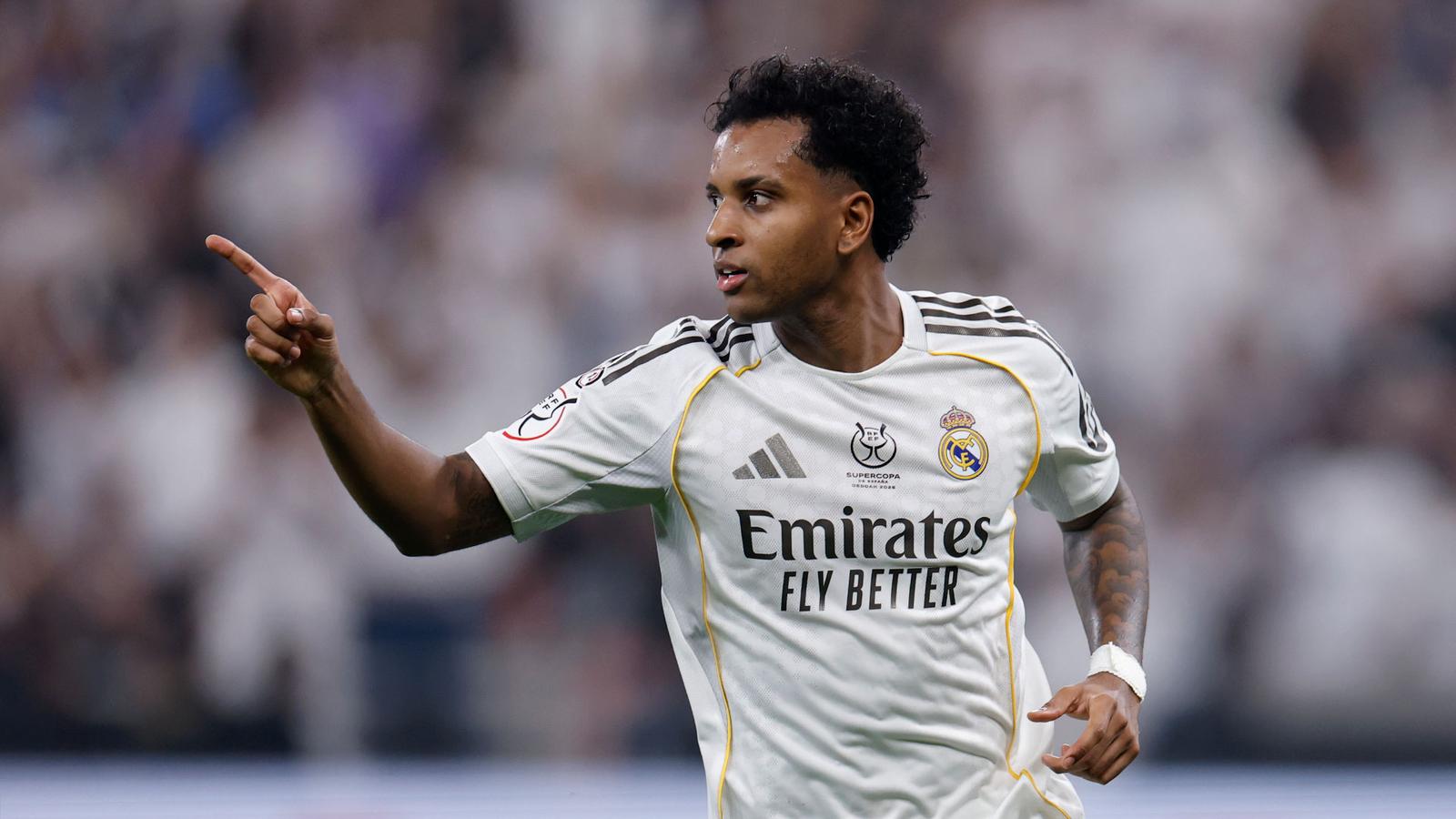
The King Abdullah Sports City Stadium in Jeddah, Saudi Arabia, was once again the crucible for one of football’s most electrifying rivalries, El Clasico. On January 11, 2026, Real Madrid and Barcelona clashed in the final of Spain’s Super Cup, a fixture that promised fireworks and delivered a pulsating 3-2 victory for the Catalan giants. For Real Madrid, however, it was a bitter pill, marking their second successive defeat in this competition’s final against their arch-rivals. Amidst the high-octane drama, moments of individual brilliance and collective struggle defined the narrative, with Real Madrid forward Rodrygo finding himself under the microscope for a crucial missed opportunity.
The stage was set for a classic encounter, building on last year’s final where Barcelona had decisively beaten Real Madrid 5-2. This year, the stakes felt even higher. Barcelona, leading La Liga by four points, had dispatched Real Betis 5-0 in their semifinal. Real Madrid, sitting second in the domestic league, secured their spot by overcoming cross-city rivals Atletico 2-1. The rivalry, the recent form, and the pursuit of silverware converged to create an atmosphere thick with anticipation.
Early Exchanges and Missed Chances Set a Frantic Tone
From the whistle, both teams demonstrated their intent, but it was Barcelona who initially dictated the tempo, forcing Real Madrid into a reactive stance. The early minutes saw Real Madrid ‘chasing shadows,’ as described by Goal.com, often relying on counter-attacks to create their openings. It was during one such break that a significant moment for Real Madrid, and for Rodrygo, unfolded. With the game finely balanced, a chance presented itself, but Rodrygo, and later Gonzalo Garcia, failed to convert. These were the moments that, in a game of such fine margins, could shift momentum decisively. For a player like Rodrygo, known for his attacking prowess, such a miss in a high-stakes El Clasico final invariably draws scrutiny.
The deadlock was eventually broken in the 36th minute by Barcelona’s Raphinha, who expertly cut onto his left foot and unleashed a powerful shot into the net. This goal ignited a period of what Goal.com aptly termed ‘chaos’. Real Madrid, however, responded swiftly and emphatically. Just ten minutes later, Vinicius Junior, showcasing his exceptional talent, weaved past three defenders before slotting home a superb equalizer, adding another gem to his growing collection of goals. The stadium erupted, and the momentum seemed to swing back towards the capital club.
A Whirlwind First Half and Defensive Lapses
Yet, the joy was short-lived. Real Madrid’s defense, perhaps still basking in the glow of Vinicius’s equalizer, momentarily ‘fell asleep,’ allowing Robert Lewandowski to ghost in behind and finish, restoring Barcelona’s lead. It was a lapse in concentration that proved costly, a testament to Barcelona’s clinical efficiency. But the first half wasn’t done with its drama. In a blink, Real Madrid found an answer again, with Gonzalo Garcia dinking home from a corner, sending both teams into the break with the score locked at 2-2 after a breathless display of attacking football.
The narrative around Rodrygo’s performance throughout this frantic period, particularly his early miss, seemed to resonate with the assessment from Goal.com, which labeled him ‘maddening Rodrygo reverts to type.’ This phrase, while not elaborated upon in the provided text, suggests a pattern of inconsistency or moments of brilliance interspersed with frustrating misses. For a player at Real Madrid, especially in an El Clasico, such assessments carry significant weight. The pressure to perform, to convert every half-chance, is immense, and any deviation from perfection can invite sharp criticism. In a match where every attacking player’s contribution is scrutinized, Rodrygo’s moment of imprecision became a talking point, underscoring the unforgiving nature of top-tier football.
The Decisive Blow and Real Madrid’s Late Push
The second half, while not as chaotic as the first, maintained a high level of intensity. Both teams battled for supremacy, knowing that one mistake could decide the trophy. The decisive goal arrived with only 17 minutes left to play, and it carried a touch of fortune. Raphinha, attempting a shot after darting onto his right foot, slipped. The ball, however, took a fortunate deflection off Real Madrid’s Raul Asencio and found its way past a wrong-footed Thibaut Courtois. It was a cruel blow for Real Madrid, who suddenly found themselves trailing again with time ticking away.
Despite the setback, Real Madrid refused to capitulate. They pushed hard for an equalizer in the dying minutes. Alvaro Carreras and Asencio both came close, testing Barcelona’s goalkeeper Joan Garcia, who stood firm. Real Madrid boss Xabi Alonso, speaking with Movistar after the match, shared his ‘mixed feelings.’ He expressed pride in his team’s competitive spirit and commitment but acknowledged the disappointment of losing a ‘hard-fought final.’ Alonso admitted, ‘We lacked the precision to reach penalties. It was a very close game.’ He remained ‘100% convinced we’d have chances to tie it’ even after conceding the third goal, a belief almost validated by the late opportunities. The introduction of Kylian Mbappe in the final minutes was a clear strategic move ‘to create more danger,’ a plan even before the game, though Mbappe wasn’t ready to start.
Alonso’s Reflection and the Road Ahead
Alonso’s post-match analysis highlighted the fine margins of the game. He praised Vinicius Junior’s ‘great performance’ and noted that the team ‘competed and showed up.’ He also extended congratulations to Barcelona, acknowledging their victory. Reflecting on Real Madrid’s strategy, he mentioned, ‘We knew there would be moments where we wouldn’t have the ball and we’d have to stay compact. We defended well in the first 30 minutes before things got a bit crazy towards the end of the first half.’ Despite the loss, Alonso maintained a forward-looking perspective, stating, ‘We have to turn this around, recover our players, and forget about the Super Cup already because there’s still a lot of the season left.’ He even downplayed the significance of the competition, declaring, ‘The Supercopa is the least important competition we have.’
For Barcelona, the victory was a significant milestone. Raphinha’s two goals earned him the Player of the Match award, a fitting recognition for his decisive contributions. Robert Lewandowski, who scored Barcelona’s second goal, succinctly captured the sentiment: ‘Whenever we beat Real Madrid, it’s a big deal.’ He emphasized the team effort, stating, ‘We won as a team,’ and the need for patience against a ‘low block’ defense. The triumph allowed Barcelona to lift their second consecutive Supercopa trophy, with Ronald Araujo proudly raising it amidst fireworks and confetti, cementing their dominance in this particular competition.
The 2026 Supercopa final served as a stark reminder of the unforgiving nature of elite football, where individual moments, like Rodrygo’s missed chance, can be amplified by the outcome. While Xabi Alonso might label the Supercopa as the ‘least important’ trophy, the psychological impact of a second consecutive final loss to Barcelona, especially one characterized by ‘maddening’ imprecision, inevitably casts a shadow, demanding a rapid and resolute response from Real Madrid as they navigate the remainder of their season.