


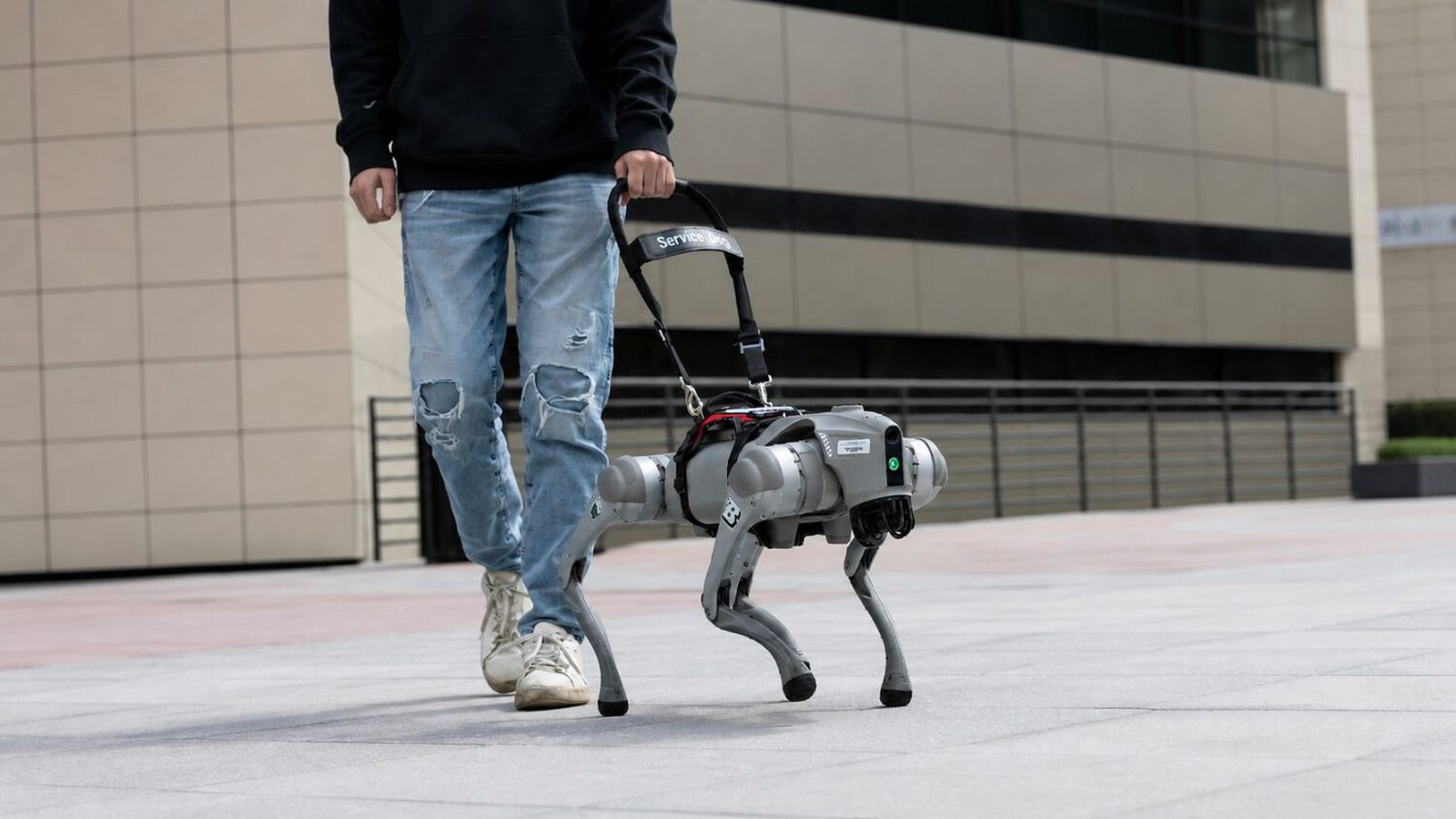
SAN FRANCISCO (Azat TV) – In October 2026, a San Francisco-based startup named Dimensional posted a now-deleted job listing on Facebook offering $20 an hour for part-time “robot-dog walkers” to manually guide 33-pound Unitree robot dogs through the city’s Dogpatch neighborhood. The experiment, which required operators to walk the machines for four to six hours daily, underscored the significant hurdles artificial intelligence currently faces in navigating unpredictable urban physical environments independently.
According to DNyuz, the startup was founded by 26-year-old Stash Pomichter, who aims to develop an open-source operating system called dimOS. The system is designed to allow AI agents to control various robot platforms—including humanoid machines and robotic arms—through natural-language commands. However, the Dogpatch walking experiment revealed a stark technological gap between that long-term vision and current hardware capabilities. Gadget Review reported that Dimensional compared human-controlled routes with AI-agent control and concluded that agents remain exceptionally inefficient at managing physical hardware without continuous human oversight.
The Reality of Robot-Dog Walking
The job required no prior robotics experience, but it demanded physical endurance. Operators used a handheld remote or a mobile app to steer the roughly $2,000 mechanical quadrupeds along sidewalks. If a machine overheated—a common hardware limitation—and stopped working mid-route, the operator was expected to manually lift the 33-pound device and carry it back to Dimensional’s office. Despite the novelty, the listing attracted minimal attention on the “Bay Area Jobs” Facebook group before being removed.
Behind the unusual fieldwork was a data-collection strategy. As Pomichter explained to DNyuz, the walks generated crucial “grount truth” data. Onboard sensors and cameras recorded every block traveled, capturing real-world navigation challenges that AI agents cannot yet resolve on their own. Dimensional purchased more than 100 robot dogs and 50 humanoid robots from manufacturers across the United States, China, and Germany to fuel this software development cycle, relying on Chinese-built Unitree hardware for the San Francisco street trials.
The operational framework of these tests relies on gathering massive logs of spatial data to train machine learning models. Because artificial intelligence lacks intuition regarding uneven pavement, unexpected pedestrian movements, or physical obstacles, the physical presence of human walkers acts as a bridge. The human operator essentially functions as the primary sensor processor and decision-maker, while the hardware simply records the traversal. This data accumulation is central to Dimensional’s broader strategy of refining dimOS so that future iterations of the software might eventually handle basic locomotion without crashing or freezing.
Urban Hurdles and Public Reception
Deploying sensor-equipped mechanical devices onto shared public sidewalks immediately sparks regulatory and social concerns. Pedestrian safety, video data privacy, and public apprehension regarding autonomous hardware remain unresolved issues in neighborhoods like Dogpatch. During the testing phase, the project drew mixed local reactions, including a hostile message alleging the machines could be weaponized—a threat Dimensional promptly reported to local police, though no actual weaponization was established by reporting.
Local residents have voiced varying opinions on seeing mechanical quadrupeds traversing city blocks alongside pedestrians. While some view the trials as a harmless novelty reflective of San Francisco’s tech-heavy culture, others express unease regarding persistent camera surveillance and data collection in public areas. The convergence of consumer tech platforms, machine learning data harvesting, and urban municipal space creates friction that startups like Dimensional must continuously navigate. Security patrol applications, while touted by developers as a practical use case, amplify these anxieties because they merge mobile cameras with automated response logic, even when a human remains embedded in the control loop.
Furthermore, the physical logistics of operating commercial robots in dense urban areas introduce liabilities that extend beyond software bugs. Municipal codes regarding sidewalk obstruction, insurance requirements for autonomous or semi-autonomous devices, and public accountability in the event of a collision or hardware failure remain largely undefined. As tech firms attempt to transition laboratory robotics onto public thoroughfares, they frequently encounter municipal pushback and regulatory grey areas that slow down commercialization timelines significantly.
The Broader Strategy and Next Steps
The broader commercial viability of dimOS depends entirely on whether human-collected street data can eventually bridge the gap toward true autonomy, or whether human operators will need to remain permanently in the loop. Unglamorous variables such as battery life, thermal thresholds, liability insurance, and municipal regulations will ultimately dictate whether robotic labor transitions from experimental trials to widespread commercial deployment.
Pomichter’s vision extends to factory floors, data centers, construction sites, and remote security deployments, yet the physical constraints of current battery technology and thermal management continue to bottleneck progress. Robot dogs running heavy computational loads frequently experience overheating, requiring immediate manual intervention. Until hardware manufacturers solve these fundamental thermodynamic and power storage limits, artificial intelligence agents will continue to rely heavily on human assistants to rescue stalled machines from public streets.
Ultimately, the Dogpatch experiment serves as a pragmatic reality check for the robotics industry. While venture capital and public discourse frequently focus on the abstract brilliance of generative AI and neural network architectures, the physical world imposes strict, mechanical constraints. Whether Dimensional’s strategy of gathering real-world training data via human-guided walks will successfully overcome these barriers remains to be seen. For now, the path toward autonomous physical labor is paved not by autonomous machines, but by human workers carrying 33-pound robots back to the office.