
Quick Read
- A court-ordered disclosure revealed a secret contract allowing anonymous donations for the $400 million White House ballroom project.
- The agreement lacks conflict-of-interest safeguards for the president and executive staff, despite involving major federal contractors.
- Critics warn the anonymity provisions are designed to block congressional oversight and undermine institutional accountability.
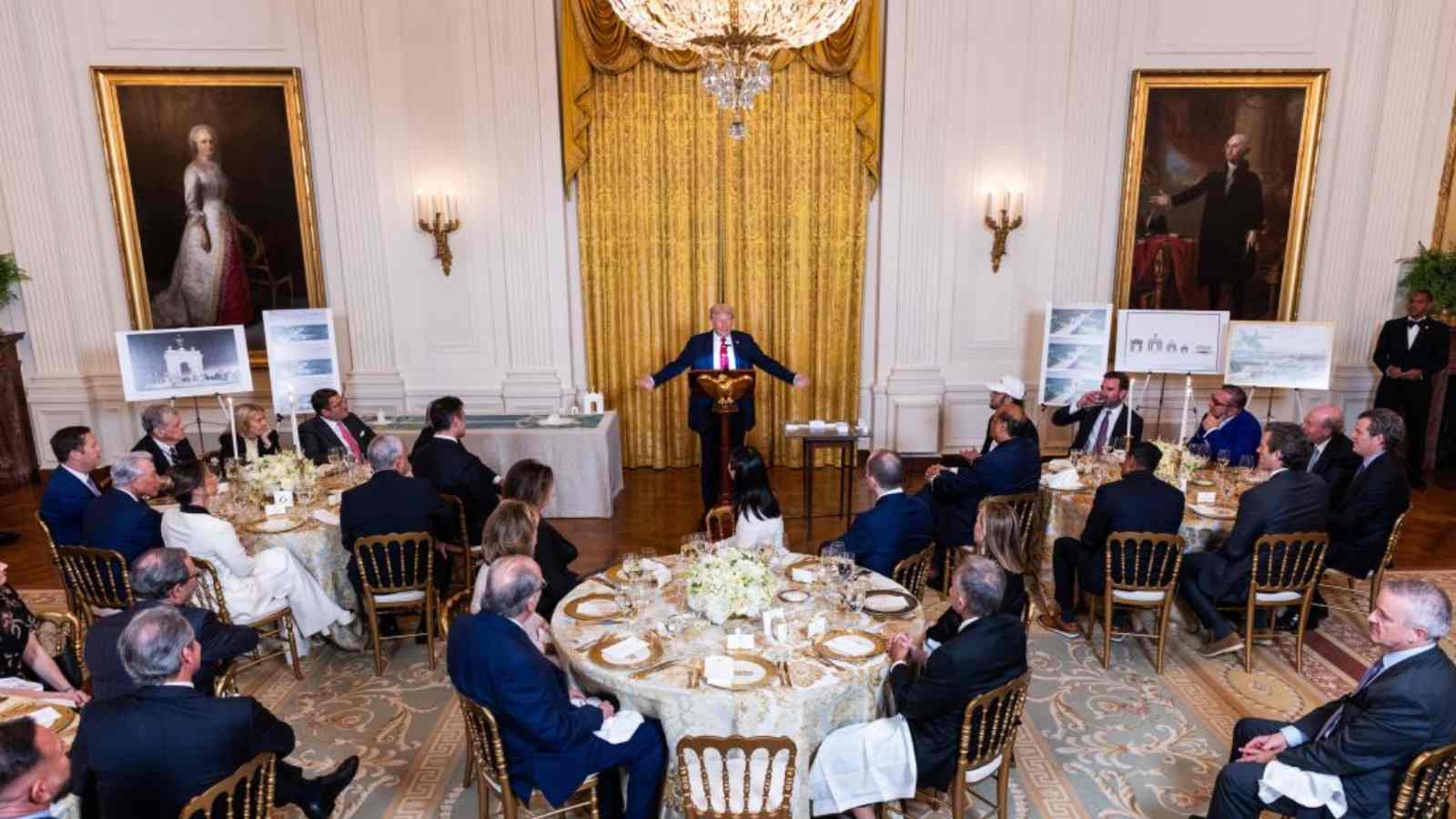
The legal architecture governing the $400 million White House ballroom expansion has finally emerged from the shadows, following a court-ordered disclosure that exposes a significant rift between administrative practice and democratic transparency. The document, signed just weeks before the demolition of the East Wing, codifies a system where private donors can finance a high-profile executive project while shielding their identities from public scrutiny. For a project of this magnitude, the lack of robust conflict-of-interest safeguards—specifically regarding the president and his immediate staff—presents a fundamental challenge to the principle of accountability that underpins a functioning liberal democracy.
The Anatomy of Secrecy
The contract, managed in coordination with the National Park Service and the Trust for the National Mall, explicitly reserves the right for contributors to remain anonymous. While the White House maintains that this is standard procedure for executive residence projects, legal experts and government watchdogs argue that the arrangement is uniquely problematic given the overlapping interests of its known donors. Corporations such as Amazon, Lockheed Martin, and Palantir, which currently hold or seek federal contracts, are among those involved. By allowing these entities to contribute to a presidential pet project without public disclosure, the administration has effectively created a firewall against the transparency required to prevent undue influence.
Institutional Accountability and the Public Trust
The implications for democratic oversight are profound. Charles Tiefer, a former commission member on wartime contracting, warns that these provisions may be leveraged to systematically block congressional inquiries into the project’s funding. This strategy of administrative opacity mirrors broader patterns seen in recent governance, where the executive branch increasingly bypasses traditional checks and balances. In the context of young or developing democracies, such as Armenia, the necessity of absolute campaign and project finance transparency is vital to prevent the capture of state institutions by private interests. When the executive branch operates behind a veil of donor anonymity, it erodes the public’s right to know who is exerting influence on the highest levels of government.
The Costs of Opaque Governance
Beyond the ethical concerns, the project has faced logistical scrutiny, including reports of foreign-sourced steel being utilized for the construction. While the administration frames the use of private funds as a benefit to the taxpayer, the true cost may be measured in the degradation of institutional integrity. The contract’s fee structure, which drops to 2% for funds raised beyond $200 million, further highlights the transactional nature of the endeavor. Ultimately, the ballroom project serves as a case study in how executive power can be exercised to insulate itself from the very accountability mechanisms that ensure a government remains answerable to its citizens rather than its benefactors.
More on trump donor anonymity contract