


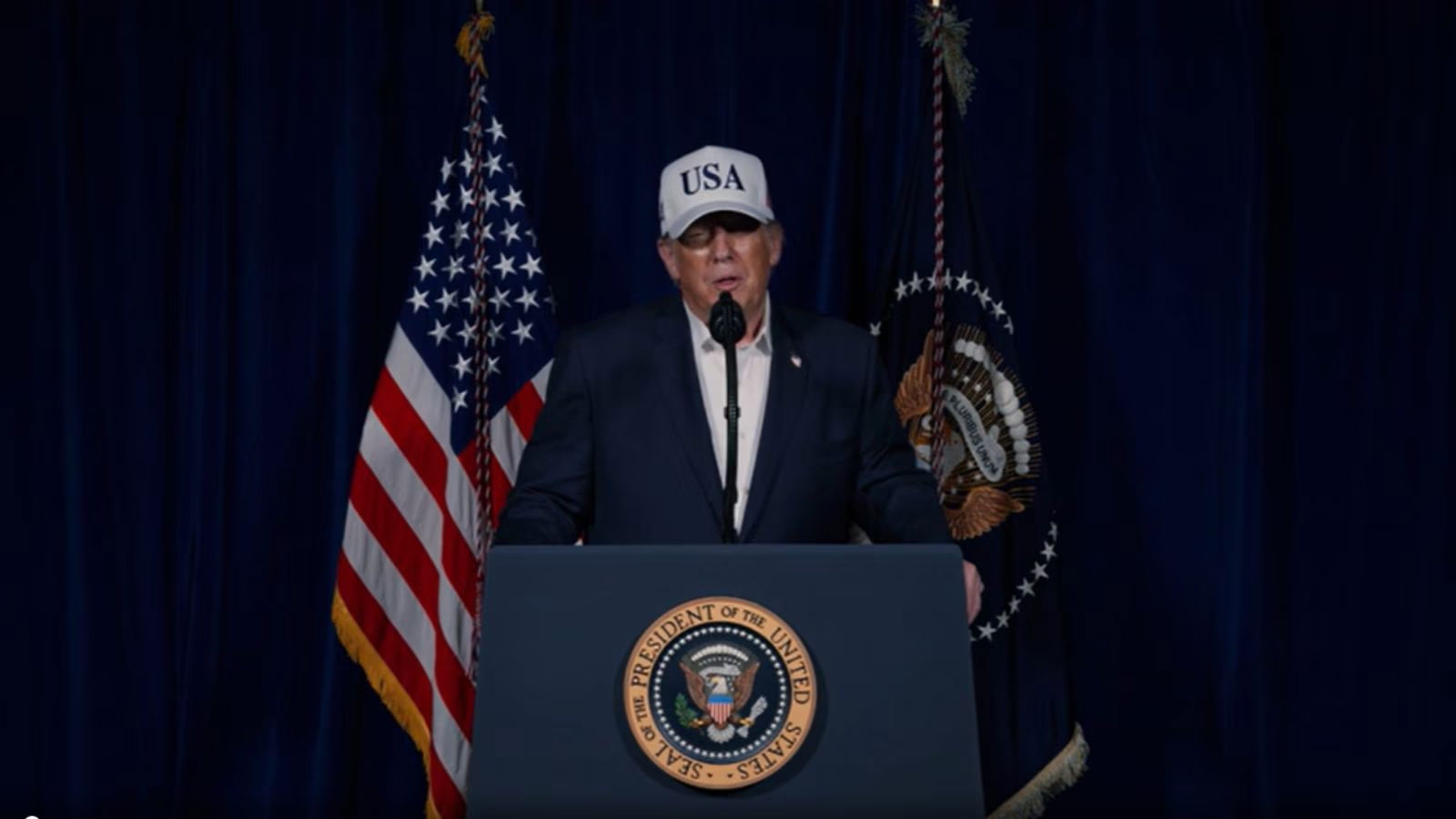
TEL AVIV (Azat TV) – U.S. President Donald Trump announced Saturday that the United States has commenced “major combat operations” in Iran, following a series of preemptive strikes launched by Israel on Iranian targets. The declaration marks a dramatic escalation in Middle East tensions, coming after days of inconclusive nuclear talks and a significant military buildup in the region.

Explosions were reported across Iran’s capital, Tehran, with the first apparent strike occurring near the offices of Supreme Leader Ayatollah Ali Khamenei. Simultaneously, sirens sounded across Israel as the Israel Defense Forces (IDF) braced for potential Iranian retaliation. Both Iranian and Iraqi airspaces have been closed, and mobile phone services in Iran were reportedly cut, signaling the immediate and widespread impact of the hostilities.
Trump Declares ‘Major Combat Operations’
President Trump confirmed the U.S. military involvement in a video shared on social media, stating that the objective of the operation is “to defend the American people by eliminating imminent threats from the Iranian regime — a vicious group of very hard, terrible people.” He vowed to ensure Iran does not obtain a nuclear weapon and called on the Iranian people to overthrow the Islamic clerical regime in Tehran, as reported by DW.
The announcement followed earlier statements by President Trump on Friday, where he expressed his dissatisfaction with ongoing negotiations over Iran’s nuclear program. “I’m not happy with the fact that they’re not willing to give us what we have to have. I’m not thrilled with that,” Trump told reporters, while still indicating he would give negotiators more time. However, that timeline appears to have been dramatically shortened by the weekend’s events.
Coordinated Strikes Target Iranian Sites
The Israeli strikes, described by Defense Minister Israel Katz as a “preemptive” measure “to remove threats,” were reportedly coordinated with the U.S., according to unnamed sources cited by The Associated Press and Reuters. An Israeli defense official indicated that the operation had been planned for months, with the launch date decided weeks ago.
Targets in the Israeli campaign included Iran’s military, symbols of government, and intelligence sites, according to an official briefed on the operation. Iranian media also reported strikes nationwide. It was not immediately clear whether Supreme Leader Ayatollah Ali Khamenei was in his offices at the time of the initial strike, as he had not been seen publicly in days amid growing tensions.
International Alarm Amid Escalating Conflict
The rapid onset of military action has triggered widespread international concern. Prior to the strikes, several nations, including Germany, France, and Australia, had advised their citizens to leave Israel and Iran or avoid travel to the region. The U.S. Embassy in Jerusalem had also implemented an “authorized departure” status for nonessential personnel and family members, urging staff to leave quickly while commercial flights were available, according to NPR.
Airlines like Netherlands-based KLM had already announced plans to suspend flights out of Tel Aviv’s Ben-Gurion International Airport. The U.N. Secretary-General António Guterres had urged Iran and the U.S. “to focus on the diplomatic track,” noting “very worrying military movements throughout the region” shortly before the strikes commenced. Britain’s Foreign Office had also temporarily withdrawn staff from Iran and advised against all but essential travel to Israel.
From Diplomacy to Direct Action
The escalation comes after a period of intense diplomatic efforts that ultimately failed to yield a breakthrough. U.S. envoys had held an inconclusive round of indirect talks with Iran in Geneva just days before the military action. Oman’s Foreign Minister Badr al-Busaidi, a key mediator, had publicly pleaded for negotiations to continue, telling CBS’s Face the Nation that a deal was within reach if negotiators were given “enough room.” He had also met with U.S. Vice President JD Vance to discuss the negotiations.
However, President Trump had reiterated his stance that Iran should not be allowed to enrich any amount of uranium, a position at odds with Iran’s insistence on its right to enrich for peaceful purposes. A confidential report from the U.N. nuclear watchdog, the International Atomic Energy Agency (IAEA), had also confirmed that Iran had not offered inspectors access to sensitive nuclear sites since they were heavily bombed during a 12-day war launched by Israel last June, making it impossible to verify Iran’s claims of halting enrichment.
The commencement of major combat operations, directly confirmed by President Trump, signifies a profound shift in U.S. policy toward Iran, moving definitively from a period of stalled diplomacy to direct military engagement. This decision, made in coordination with Israel, underscores the Trump administration’s resolve to counter perceived threats from Tehran, reshaping the geopolitical landscape of the Middle East and setting the stage for an unpredictable future.