


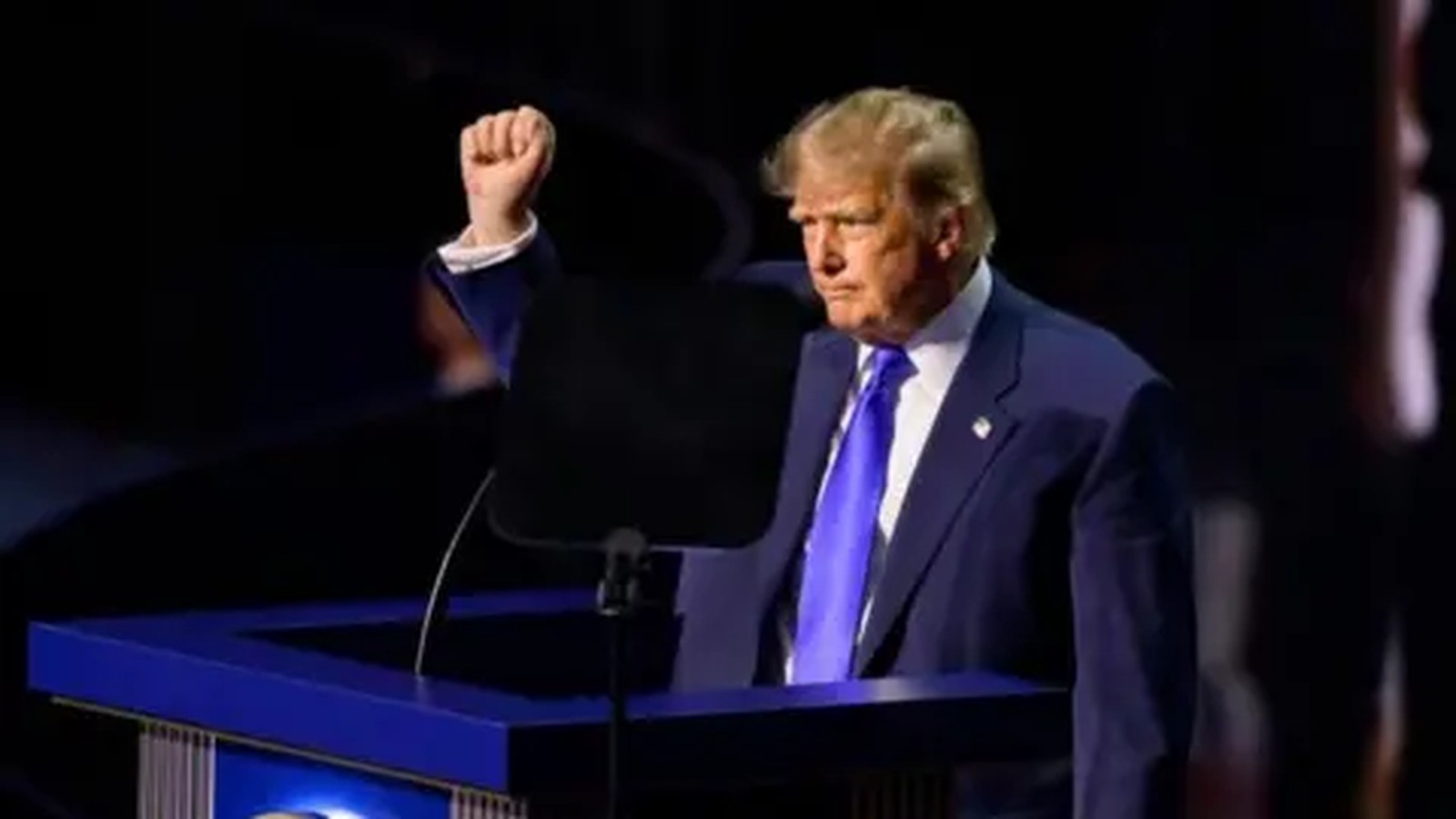
Addressing supporters at the Republican Party’s first-ever midterm convention in Dallas, US President Donald Trump proposed paying a $5,000 cash dividend to every adult citizen in the United States on the condition that the Republican Party retains control of both the House of Representatives and the Senate in the upcoming November midterm elections. The announcement comes as the administration confronts severe economic headwinds driven by soaring energy costs and an approval rating hovering around 38 percent.
The proposal would apply to an estimated 270 million adult citizens, bringing the total direct cost of the liquidity injection to approximately $1.35 trillion. While the pledge drew loud applause inside the Dallas arena, it immediately ignited a fierce debate among legal scholars, fiscal conservatives, and political strategists regarding its legal viability, budgetary feasibility, and impact on congressional midterm dynamics.
A $1.3 Trillion Fiscal Gamble Amid Energy Shock
The economic background behind Trump’s gambit is directly tied to escalating international tensions and domestic inflationary pressure. According to reporting by BBC News, ongoing military friction involving Iran has led to the effective closure of the Strait of Hormuz—a maritime choke point through which approximately one-fifth of global oil and liquefied natural gas shipments normally transit. The resulting spike in crude prices has driven up domestic fuel costs and broadened everyday living expenses across American households.
During his two-hour keynote address, Trump acknowledged the economic strain caused by the conflict while attempting to frame the proposed $5,000 dividend as a mechanism to return federal revenues directly to consumers. However, market analysts and fiscal watchdogs note that injecting over $1.3 trillion in direct consumer stimulus without a clear revenue offset could drastically exacerbate federal budget deficits and trigger fresh inflationary pressures just as the Federal Reserve attempts to stabilize prices.
Trump previously floated lower direct stimulus amounts funded by baseline tariff revenues, including $2,000 check proposals. However, linking a $1.35 trillion federal payout directly to a specific political election result represents an unprecedented policy posture for a sitting commander-in-chief.
Legal Boundaries and the Federal Election Code
Beyond its fiscal burden, the pledge has drawn immediate scrutiny from election law experts and political opponents. Federal statutes strictly prohibit offering monetary benefits or financial remuneration to influence an individual’s vote. In the hours following the speech, leadership at the Democratic National Committee condemned the proposal as an unfeasible political stunt designed to manipulate voters ahead of a challenging electoral map.
Legal analysts interviewed across national media outlets suggest the legal defense of the proposal will depend on how the administration defines the distribution. If structured as a legislative tax credit or an executive economic dividend package to be passed by Congress, courts generally treat such promises as standard campaign platform pledges rather than individual vote-buying. Similar political precedents exist: during the 2021 Senate runoff elections in Georgia, Democratic candidates campaigned on delivering $2,000 pandemic relief checks if their party secured control of the upper chamber.
Nevertheless, conditioning federal fiscal distributions explicitly on a partisan electoral victory tests the outer boundaries of federal campaign laws, making any future legislative implementation vulnerable to immediate court challenges.
GOP Midterm Strategy and Internal Party Divisions
The Dallas gathering marked an unusual effort by the Republican National Committee to organize a centralized, two-day midterm convention—a structural innovation traditionally reserved for presidential election years. As reported by The Guardian, the event featured a mix of high-profile administration officials, UFC fighters, and staunch congressional allies, but was notably skipped by several vulnerable Republican candidates running in highly competitive swing states, including Senator Susan Collins of Maine.
With historical trends favoring the opposition party during midterms and current forecasts indicating Republicans could lose control of the House of Representatives, Trump explicitly urged the electorate to evaluate the congressional races as a direct vote on his presidency. “I’m asking you to pretend that I’m on the ballot,” Trump told the crowd, emphasizing that a Democratic victory would lead to the reversal of key tax cuts, border security policies, and broader economic stability.
Despite the high energy inside the venue, independent observers noted visible pockets of empty seats throughout the arena, contrasting with public RNC statements regarding attendance figures. The attendance dynamics highlight a broader strategic dilemma facing the party: whether hyper-mobilizing the core base through dramatic financial promises and culture war messaging can outweigh the alienation of moderate suburban voters in critical swing districts.
Legislative Feasibility and What Comes Next
Even if Republicans successfully maintain majorities in both chambers of Congress this November, enacting a $1.35 trillion dividend policy would require complex legislative maneuvering. With federal debt already drawing heavy scrutiny from international credit agencies and domestic bond markets, securing the necessary votes within a tight Republican congressional caucus—where fiscal hawks routinely oppose unbudgeted spending—remains highly uncertain.
In the coming weeks, attention will focus on whether congressional Republican candidates formally adopt the $5,000 dividend pledge into their official platform or distance themselves from the proposal due to fiscal and legal concerns. As the November election approaches, the balance between voter economic anxiety and federal policy realities will remain the central battleground of the midterm campaign.