


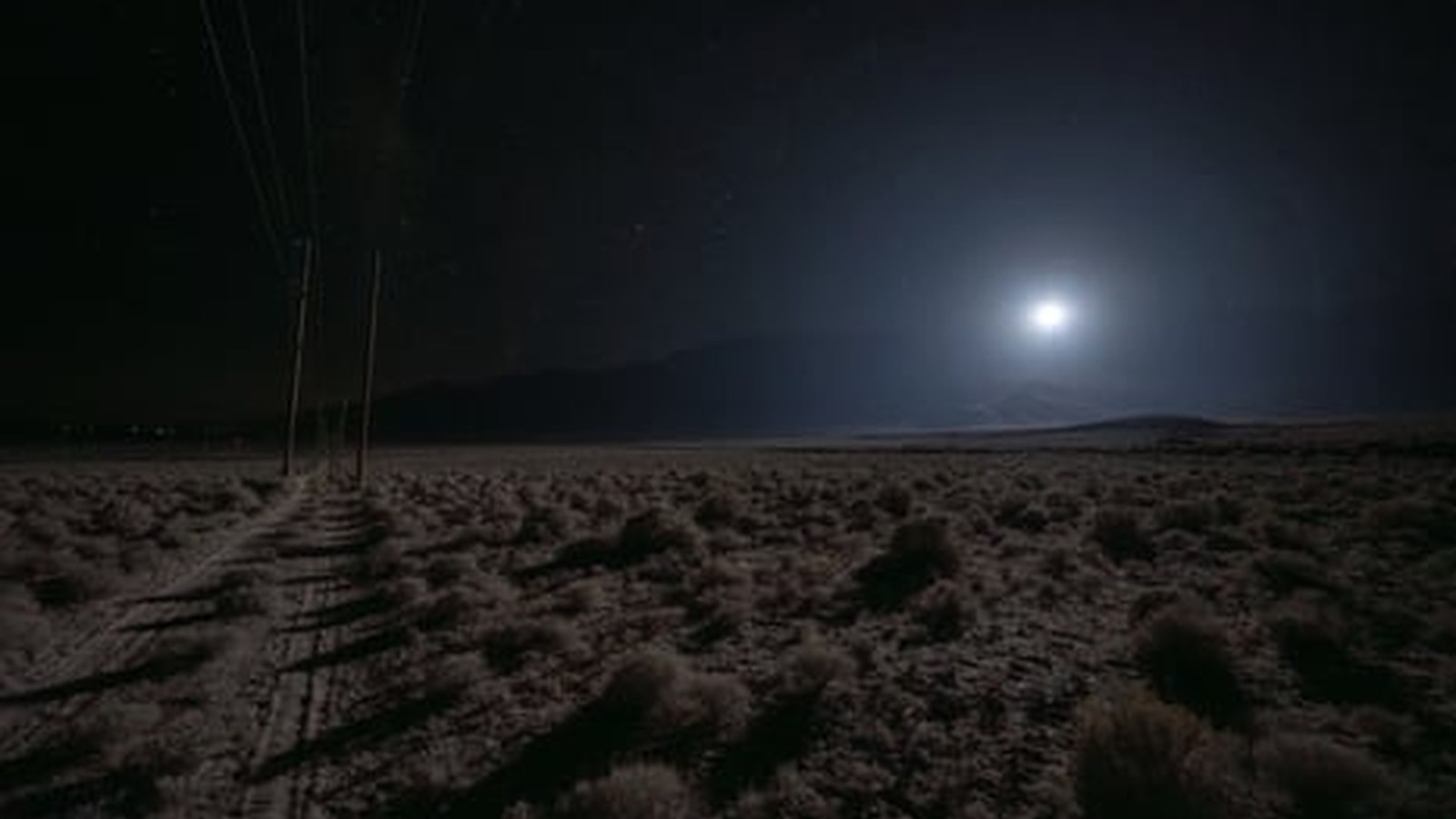
Ground Demonstration Ignites Controversy
LOS ANGELES (Azat TV) – A high-desert test near Lone Pine, California, conducted earlier this month by US startup Reflect Orbital, has thrust the concept of space-based nighttime illumination into an intense public debate. Local residents were startled to see powerful light cutting across the night sky, illuminating a stretch of desert terrain with radiance comparable to a full moon. Unbeknown to many in the Sierra Nevada region, the nocturnal exercise was a terrestrial simulation for a planned constellation of orbital reflectors designed to bounce sunlight down to Earth during hours of darkness.
The company partnered with the China Lake Mountain Rescue group on October 10 to stage grid searches, stretcher carries, and equipment drills under powerful mobile spotlights, as Gadget Review reported. While the test showcased potential utility for emergency responders operating in remote terrain without local generators, it immediately alerted environmental advocates and astronomers to the commercial ambitions behind the technology.
Regulatory Approvals and Scale of Ambition
The ground-level preview precedes the planned launch of the Eärendil-1 experimental satellite, which was authorized by the Federal Communications Commission (FCC) in July. This initial demonstration spacecraft will operate in low Earth orbit at roughly 625 kilometers altitude, carrying an 18-by-18-meter thin-film reflector designed to cast a five-kilometer-wide illuminated ground footprint. However, Reflect Orbital’s long-term business plan extends far beyond a single experimental craft, aiming to deploy up to 50,000 mirror satellites over the coming decade.
The startup envisions multiple commercial markets, including search-and-rescue support, emergency infrastructure, remote construction sites, and agricultural applications that would bathe crops in extra sunlight. Additionally, the company suggests that directing light onto solar farms at night could extend energy generation and reduce dependence on fossil fuels. Despite these intended benefits, the regulatory and environmental hurdles facing the commercial fleet are mounting rapidly.
Environmental and Astronomical Backlash
A coalition of environmental groups and scientific organizations has moved quickly to contest the regulatory approval of space illumination. In August, four organizations represented by the environmental law group Earthjustice petitioned the FCC to reconsider its authorization, warning that widespread orbital mirrors would fundamentally alter the planet’s natural day-night cycle. Jan Hasselman, a senior attorney at Earthjustice, criticized the project as disruptive to all terrestrial life, noting that animals and ecosystems have evolved strictly around natural circadian rhythms.
Astronomers have expressed parallel alarm over the potential worsening of light pollution, which The Guardian reported could severely impair optical observations of the night sky and accelerate an orbital congestion crisis alongside other mega-constellations. Climate scientists have also cautioned that active manipulation of solar energy reaching the Earth carries unpredictable atmospheric risks. Reflect Orbital maintains that it has held substantive discussions with researchers to avoid sensitive ecological areas and astronomical sites, but the unfolding clash signals a major policy battle over commercial access to the night sky.
Technical Realities and the Path Forward
As the debate intensifies, independent researchers and technical experts continue to question whether thin-film reflectors can achieve the precise pointing accuracy required to be commercially viable. Because low-Earth-orbit satellites move rapidly relative to any ground target, maintaining a steady beam of light requires continuous and highly complex adjustments. The upcoming launch of Eärendil-1 will provide the first empirical data regarding brightness, deployment mechanics, and targeting precision under real-world orbital conditions.
Nevertheless, the regulatory framework governing orbital mirrors remains limited. The FCC’s current authorization applies strictly to a single experimental spacecraft and does not extend to a broader commercial constellation. Agency officials noted during the review process that broader concerns regarding optical astronomy fell outside the narrow statutory scope of their review for the test mission. Consequently, any future expansion will require separate regulatory applications, ensuring that the friction between commercial space ventures and environmental preservation will remain a central policy battleground in the years ahead.