


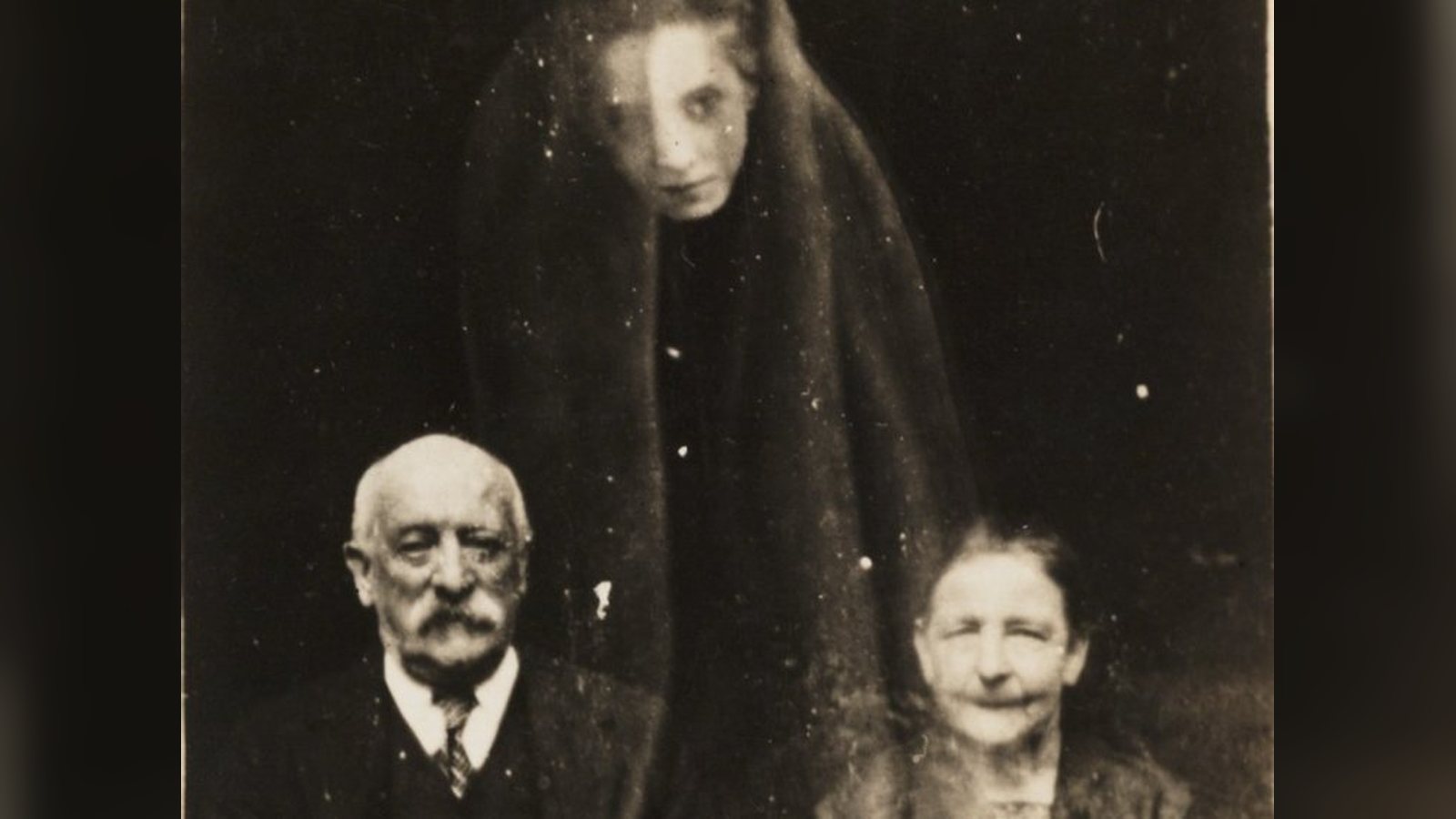
In this sepia-toned studio portrait from around 1920, an elderly man and woman sit shoulder to shoulder in rigid, dignified posture, yet the eye is instantly drawn upward to an impossible presence: a misty, oval cloud hovering above them, out of which gazes the translucent face of another woman wrapped in draped fabric. The living sitters stare directly forward, their expressions heavy with sorrow and quiet anticipation, seemingly oblivious to the spectral apparition materializing just inches over their heads. This extraordinary photograph is not merely a curiosity of early camera trickery; it stands as an intimate artifact of early twentieth-century mourning, capturing a culture desperately attempting to bridge the chasm between the living and the dead through the mechanical authority of the lens.
What the photograph shows
The composition is structured like a traditional formal portrait from the Edwardian or early interwar period. The elderly man is dressed in a dark, structured wool suit with a high stiff collar and necktie, his hands resting unseen as he faces the camera with a firm, weathered countenance. Beside him, his wife wears a dark, patterned blouse or dress fastened tightly at the neck, her hair neatly swept back in the practical fashion of the era. Their postures are tense, a characteristic often produced by the prolonged stillness required under dim studio lighting, but here heightened by the ritualized solemnity of a spiritualist seance.
Suspended in the upper center of the frame, partially overlapping the space between and above their heads, floats the photographic anomaly: an ethereal, vaporous shape often described by spiritualists as ectoplasm. Inside this luminous halo appears the clearly defined face of an adult female, titled slightly, her features framed by white drapery resembling a burial shroud, a nun’s wimple, or sheer gauze. Unlike the living sitters, whose skin and garments exhibit natural depth, texture, and shadows consistent with studio sidelight, the apparition has a flat, almost two-dimensional quality. Its edges feather into an unnatural white mist, characteristic of a contact print or double-exposed photographic vignette placed directly over the negative emulsion.
The moment behind the image
This image was produced during a sitting organized by William Hope, an English medium and photographer who operated from Crewe, Cheshire. Hope presented his photo sessions not as technical operations, but as sacred spiritualist ceremonies. Clients typically arrived at his studio having suffered profound domestic loss. Before the lens was uncapped, Hope led his sitters in collective hymn singing, spontaneous prayers, and silent meditation, creating a psychological atmosphere dense with longing, reverence, and heightened suggestibility.
To convince skeptical clients that no earthly trickery took place, Hope frequently invited sitters to inspect the camera, examine the dark slides, and even accompany him into the darkroom to watch the development of the glass plates in the red glow of the chemical trays. As the silver halides reacted with the chemical bath, the sitters would watch in astonishment as a familiar face slowly bloomed out of the darkness alongside their own likenesses. The elderly couple in this frame almost certainly left the Crewe studio convinced that their departed daughter, sister, or first wife had returned from the spirit world to reassure them of life beyond the grave.
Photographer and provenance
William Hope was born in 1863 and worked as a carpenter before claiming to have accidentally discovered his mediumistic gifts around 1905, when an unexpected extra face appeared on a photograph he took of a friend. Soon after, he founded the “Crewe Circle,” a spiritualist collective that attracted thousands of clients from all strata of British society, including aristocrats, bereaved parents, and prominent intellectuals. Hope used traditional stand cameras and glass plate negatives, methods that allowed substantial opportunity for manipulation.
The provenance of this specific print traces back to the extensive documentation of the British spiritualist movement. Collections of Hope’s original glass plate negatives and contemporaneous silver prints were later preserved in archives such as the National Science and Media Museum in Bradford, England, and the archives of the Society for Psychical Research. Hope’s deceptive methods were dramatically unmasked in February 1922 by the prominent paranormal investigator Harry Price. Working with the Society for Psychical Research, Price secretly marked Hope’s glass plates with an invisible, X-ray-etched Imperial Dry Plate Company lion emblem. When Hope produced the “spirit” image, the chemical development revealed that he had swapped Price’s marked plates for a pre-exposed glass slide carrying a previously prepared negative of a deceased person’s photograph.
Historical context
To understand why an elderly couple would sit before Hope’s camera and accept a double-exposed face as genuine supernatural evidence, one must look at the immense trauma of the surrounding era. Between 1914 and 1918, the First World War claimed nearly a million British lives, leaving countless families without bodies to bury or graves to visit. This catastrophic loss was immediately compounded by the 1918–1920 influenza pandemic, which swept across the globe, killing millions more in sudden, agonizing isolation. British society was enveloped in an unbearable burden of unprocessed grief.
Spiritualism transformed from a fringe Victorian pursuit into a widespread cultural phenomenon because established religious and civic institutions struggled to provide comfort to the bereaved. Photography occupied a peculiar place in the public imagination: ordinary people viewed the camera as an objective, scientific instrument incapable of lying. If the camera lens could record invisible phenomena like X-rays and microscopic bacteria, many reasoned it was equally capable of capturing spiritual vibrations beyond the range of human sight. Even after Harry Price exposed Hope’s fraud, influential figures such as Sir Arthur Conan Doyle passionately defended the photographer, publishing entire volumes to clear Hope’s name and maintaining that skeptics were part of a materialist conspiracy.
Why it still matters
A century after its creation, William Hope’s photograph remains a profoundly moving study in human vulnerability and the ethics of belief. While contemporary viewers immediately recognize the mechanical hallmarks of double exposure, montage, and manipulated emulsion, viewing the image purely as an amusing scam misses its deeper historical significance. The elderly faces seated in Hope’s studio reflect an ache that transcends technical analysis. The photograph documents a moment in media history when visual technology first began to distort truth on a mass scale, anticipating our modern dilemmas regarding manipulated imagery, digital deepfakes, and the timeless human instinct to believe what we most desperately wish to be true.