


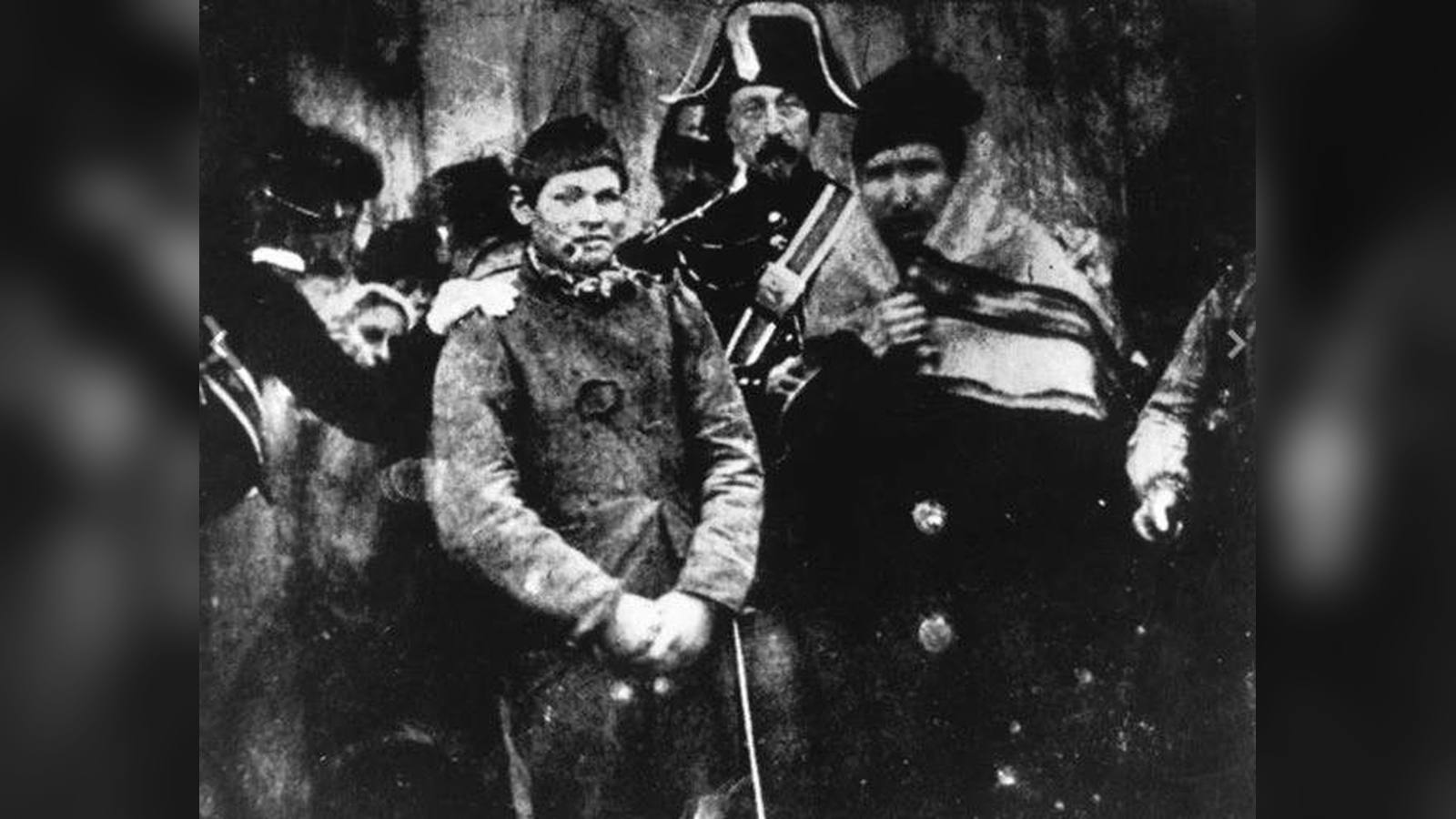
What the photograph shows
This remarkable daguerreotype presents a stark, unvarnished scene from mid-19th-century France: a man under arrest, captured in sharp metallic monochrome. Unlike the staged, highly formal studio portraits characteristic of early photography in the 1840s, this frame focuses squarely on a real-world judicial event. The subject’s posture, the weary slump of his shoulders, and the surrounding details reflect the immediate tension of an apprehension. Every surface detail on the polished metal plate tells a story of physical containment and civil friction, offering a rare window into everyday law enforcement before the advent of portable roll film and instantaneous cameras.
Visual inspection reveals the characteristic mirror-like sheen of the unique direct-positive plate, where light hits the silver surface to create an image of haunting clarity. The man’s clothing—typical of a European working-class citizen of the 1840s—includes a heavy coat and a brimmed hat, elements that ground the subject in a specific socioeconomic reality. There are no artistic flourishes or studio backdrops; the background is ambiguous, suggesting an outdoor or provisional interior courtyard where authorities held suspects before formal booking. This lack of staging separates the frame from contemporary portraiture and aligns it directly with the ethos of visual reporting.
The moment behind the image
Taken in 1847—just months before the sweeping, continent-shaking revolutions of 1848—this photograph documents a fleeting encounter charged with profound social friction. The shutter moment caught a specific instance of state authority intersecting with civilian life in France during a period of rising economic hardship and political unrest. While the exact identity of the arrested individual and the precise misdemeanor or political infraction remain lost to time, the visual record itself captures the palpable gravity of a mid-nineteenth-century police action.
In the moments leading up to this exposure, the suspect would have been brought to a temporary holding area. The arresting officers, likely municipal guards or gendarmes in traditional uniforms, stood nearby, maintaining order while the camera operator set up the heavy, cumbersome daguerreotype apparatus. The process required the subject to remain relatively still for several seconds, transforming a chaotic moment of apprehension into an eerie, suspended stillness. After the plate was exposed and treated with mercury vapor, the raw confrontation between citizen and state was permanently etched into metal.
Photographer and provenance
The identity of the photographer remains anonymous, a common reality for early experimental daguerreotypes where operators worked without institutional backing, syndicates, or press credentials. Produced on a polished silver-plated copper sheet, the unique positive image survived through private collections, antique markets, and specialized photographic archives. Because daguerreotypes could not be easily replicated before the invention of negative-positive processes, this singular plate owes its survival to careful preservation by historical societies and early photography enthusiasts who recognized its extraordinary documentary value.
Working in 1847 meant operating under severe technical constraints. The daguerreotype process, invented by Louis Daguerre and announced in 1839, demanded immense skill, toxic chemicals, and bright natural light. The anonymous operator had to transport fragile glass plates, chemical boxes, and a tripod-mounted camera to the scene. That someone chose to point this revolutionary, expensive, and unwieldy apparatus at an arrested criminal rather than a wealthy patron or a scenic monument underlines an early, instinctual understanding of photography’s power as an instrument of witness.
Historical context
In 1847, photography was still in its infancy, having been introduced to the world less than a decade prior. Most practitioners focused almost exclusively on portraiture for the wealthy, architectural studies, or topographical surveys. These commercial ventures required subjects to remain motionless for long seconds under glaring natural sunlight, resulting in stiff, solemn poses. Using the medium to record a sudden, contentious event like a street arrest represented a radical departure from convention.
The broader historical backdrop of 1847 France was one of simmering discontent. Crop failures, food shortages, and economic depression had strained the regime of King Louis Philippe, ultimately culminating in the February Revolution of 1848. Against this turbulent socioeconomic landscape, police actions against ordinary citizens were increasingly frequent and politically sensitive. By capturing an anonymous detainee on a silver plate, the anonymous photographer inadvertently created a sociological mirror of an era on the brink of explosion, proving that the camera could record social history as it happened.
Why it still matters
Long before photojournalists rushed to the scenes of breaking news with 35mm Leica cameras and high-speed film, anonymous pioneers were already testing the physical and conceptual limits of the medium. This 1847 daguerreotype bridges the gap between historical artifact and journalistic precursor. It reminds modern viewers that the impulse to document reality, crime, and civil society arose almost simultaneously with the invention of photography itself.
Today, as we live in a world saturated by instantaneous digital imagery and smartphone documentation, this singular metal plate stands as a foundational monument to visual truth. It challenges us to look past the technical limitations of nineteenth-century gear and recognize the enduring courage of those who first used the camera not just to flatter the elite, but to hold up a mirror to the raw, unedited realities of human society.