


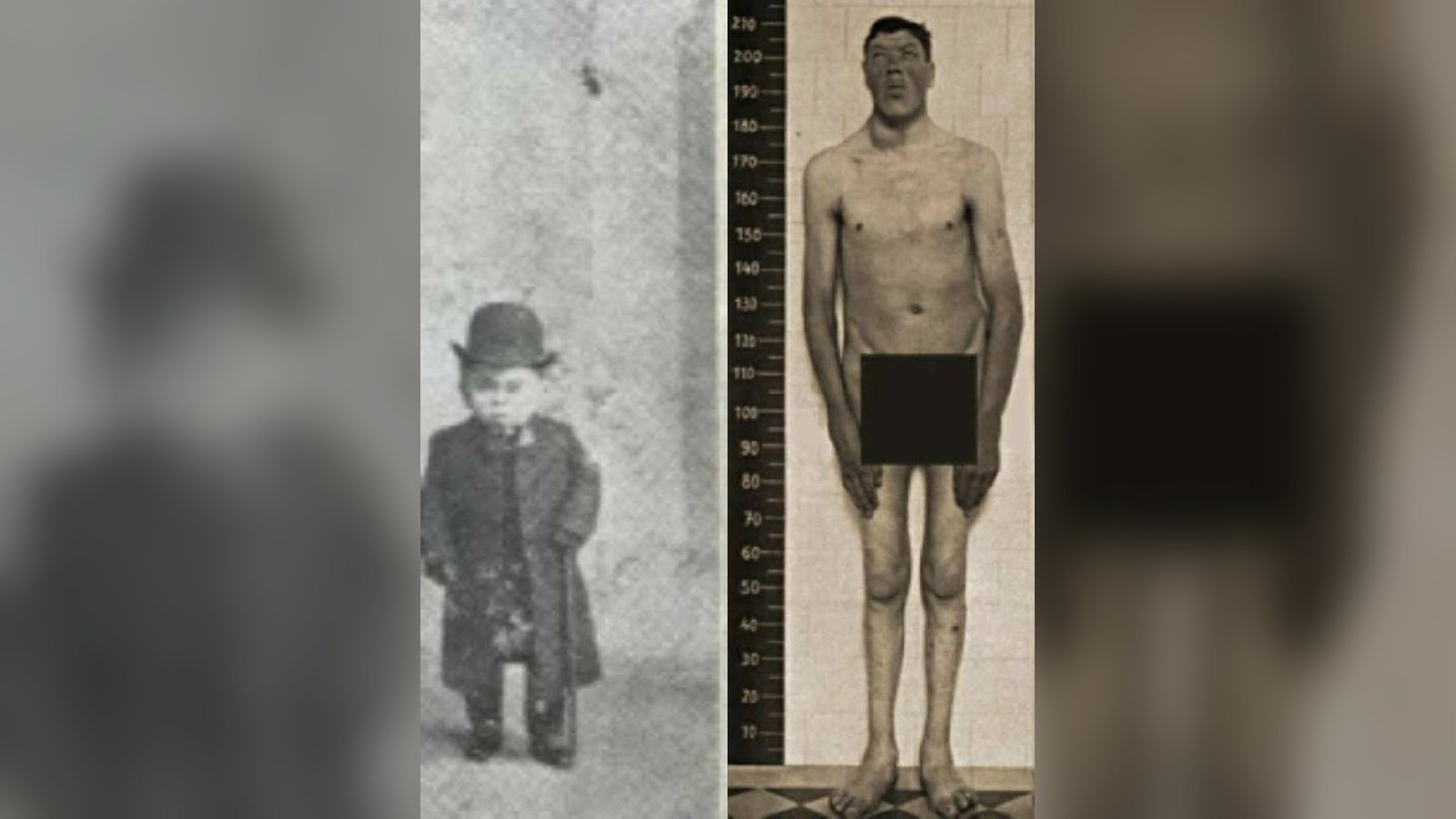
This rare historical photograph serves as the visual anchor for one of the most astonishing case studies in the annals of endocrinology and human biology. Preserved not within the sensationalized pages of early-twentieth-century sideshow broadsheets, but inside sober clinical archives and medical journals, the image captures Adam Rainer—an Austrian man who holds the unique and thoroughly documented distinction of having been classified as both a medical dwarf and a biological giant. In this frame, we confront the stark physiological reality of a human body subjected to contradictory growth extremes driven by a malfunctioning endocrine system. By examining the visual composition, the known provenance, and the documented medical history surrounding this photograph, we can unpack how a single clinical exposure preserves a life defined by extraordinary biological anomalies.
What the photograph shows
A careful visual inspection of this authenticated photograph reveals the profound physical transformations wrought by late-onset acromegaly. The subject exhibits distinctly coarsened facial features, including an exceptionally prominent, heavy brow ridge, an enlarged and protruding mandible, and thickened lips and nose tissues that depart significantly from normative human proportions. Unlike the numerous misidentified photographs circulating online—which frequently depict unrelated French circus performers like Baptiste Hugo or anonymous neurological patients from historical textbooks—this verified clinical image focuses directly on the structural changes of Rainer’s skull and facial architecture. The lighting is clinical and stark, typical of mid-century medical photography designed to record objective anatomical data rather than to flatter the subject. Every shadow cast across the heavy jawline and deep-set eyes underscores the relentless, unchecked influence of growth hormone overproduction, presenting a silent, powerful testament to a physiological condition that fundamentally rewrote the physical boundaries of a single human existence.
The moment behind the image and provenance
The known provenance of this photograph traces back to the meticulous clinical investigations conducted in Austria and published decades after Rainer’s passing. Specifically, the definitive authentication of these rare images was championed by Dr. Oscar Hirsch, an eminent physician who published a comprehensive medical paper in 1961 examining Rainer’s complete physiological trajectory. These photographs were captured under sterile, professional supervision within medical facilities, serving as objective clinical records rather than commercial curiosities. While popular culture and modern digital platforms frequently miscaption sensational imagery—confusing European sideshow giants with Rainer’s distinct medical profile—medical historians and archivists rely exclusively on these documented clinical files. The photographer operated under the strict methodological constraints of medical documentation, prioritizing clinical utility, accurate scaling, and diagnostic clarity over artistic composition. Consequently, the image survived because it was embedded within peer-reviewed medical literature, shielding it from the ephemeral fate of popular press prints.
The medical reality behind the growth
The backstory of the human being captured in this frame is rooted in a rare and perplexing endocrine disorder. Born in Graz, Austria, in 1899, Rainer experienced an exceptionally stunted childhood and early adulthood. Records indicate that at the age of 19, he stood merely 4 feet 8 inches tall (approximately 142 cm), a diminutive stature that officially deemed him unfit for military service when the First World War engulfed Europe. Yet, lurking silently within his cranial cavity was a pituitary tumor—an abnormal growth on the gland responsible for regulating growth hormones. For the first two decades of his life, this tumor remained largely dormant or suppressed in its systemic effects. However, in his early twenties, the tumor shifted into a state of aggressive hypersecretion, flooding his adult skeletal system with massive quantities of growth hormone long after normal epiphyseal fusion should have locked his bones in place. This unleashed an unprecedented biological reversal: Rainer’s hands, feet, jaw, and overall skeletal structure began expanding at an alarming rate, forcing him into progressively larger shoes, hats, and garments as he surged past the threshold of normal human height.
Historical context and later years
To fully comprehend the visual impact of the photograph, one must understand the broader medical and social landscape of early-to-mid-twentieth-century Europe. Acromegaly and gigantism were poorly understood during Rainer’s formative years, and modern neurosurgical interventions were in their absolute infancy. By the time anthropological and medical departments took formal measurements of Rainer in his early thirties, he had already surpassed 7 feet 1 inch (over 218 cm), eventually reaching an astonishing 7 feet 8 inches (234 cm) by the end of his life. Popular legends often propagated the myth that Rainer was completely bedridden and helpless for decades due to his immense size; however, contemporary medical records provided by his attending physician, Dr. H. Kammerlander of Rottenmann, Austria, paint a more nuanced and dignified picture. Following his discharge from specialized hospitals in Vienna, Rainer lived in a modest Austrian community and eventually resided in a local home for the aged. While physically clumsy and burdened by the immense strain of his condition, he remained surprisingly mobile, capable of caring for himself, and maintained a gentle disposition toward his roommates. He passed away on March 4, 1950, at the age of 51, following complications from a perforated large intestine and subsequent peritonitis, leaving behind a medical legacy that remains entirely unparalleled.
Why it still matters
In our contemporary digital age, where historical imagery is routinely torn from its context, colorized, re-captioned, and thrust into viral circulation without verification, authentic photographs like this one carry an immense responsibility. They serve as archival anchors against misinformation, reminding us that behind every historical anomaly lies a real, complex human life. This photograph of Adam Rainer matters because it strips away the carnival sideshow myths and replaces them with verifiable clinical truth. It challenges our understanding of the human body’s malleability, honors the rigorous standards of mid-century medical archiving, and preserves the dignity of a man who navigated two entirely contradictory physiological worlds within a single lifetime.