


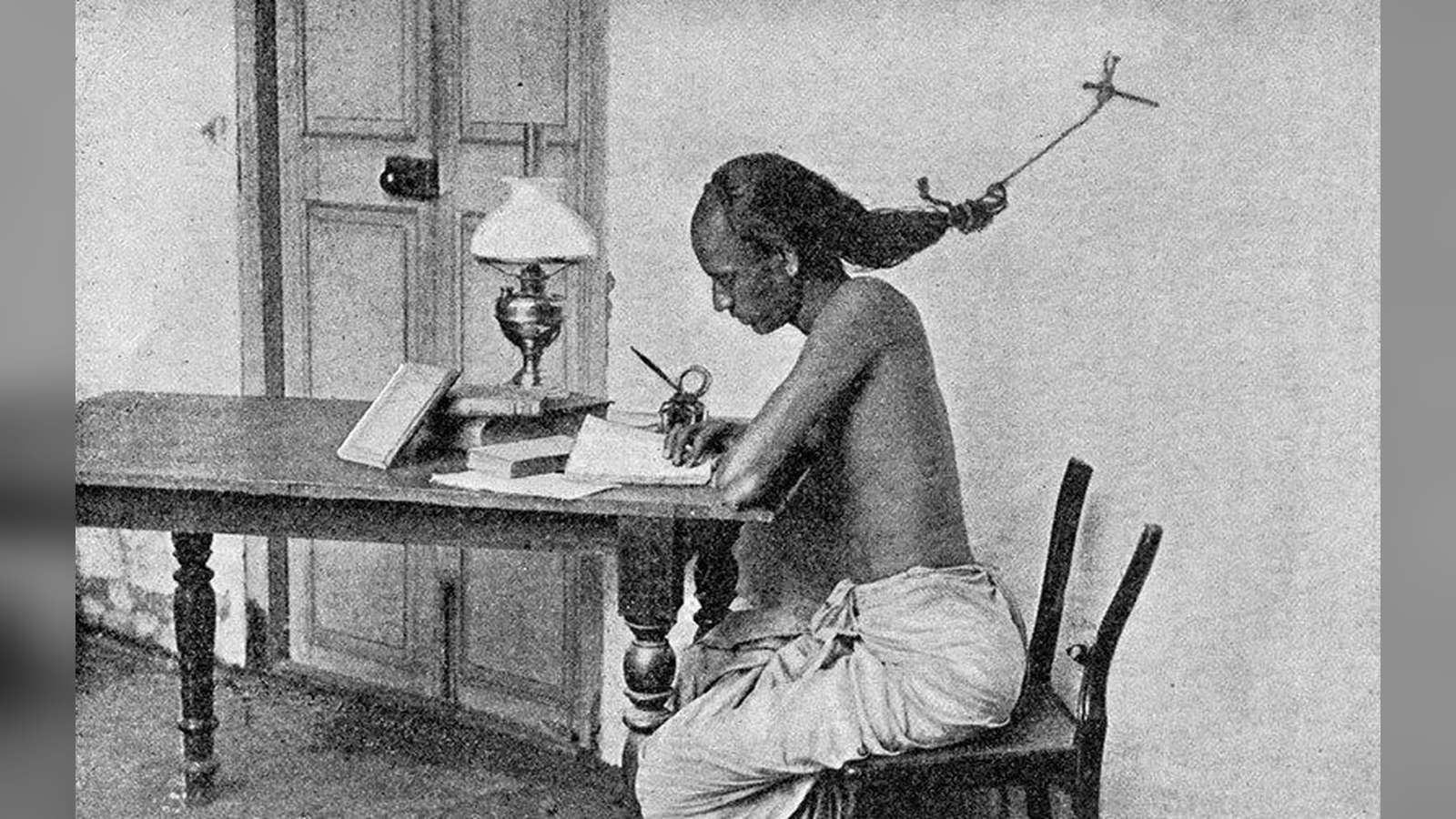
This striking photograph opens a rare window into the raw intensity of academic persistence, capturing a young man leaning over his books with his hair physically tied to a nail in the wall. Taken circa 1948, the frame immediately arrests the viewer’s attention through its display of sheer determination; any lapse in concentration or nod of exhaustion would result in an instant, painful tug at the scalp. This vintage image, widely circulated across historical archives and digital platforms, poses a compelling question: how far are individuals willing to push their physical limits in the pursuit of knowledge and social mobility?
What the photograph shows
Within the tight composition of the frame, a student is seated at a modest study space, surrounded by heavy volumes and papers characteristic of mid-20th-century higher education. Identified in historical records as a Tamil Brahmin student associated with the University of Madras, his posture reflects total immersion in his texts. The most startling detail is visible just above his head, where strands of his hair are secured to a small iron nail embedded in the plaster wall. The lighting in the room is stark and focused, casting deep shadows that emphasize the isolation of late-night cramming. Every visual element—from the furrowed brow of the young scholar to the austere surroundings—conveys an atmosphere of absolute focus and relentless pressure.
The moment behind the image
The shutter moment captures a precise micro-second of quiet endurance during a nocturnal study session. While the exact photographer and the specific commission remain uncredited in standard archival circulation, the authenticity of the practice is well-documented in regional oral histories and academic lore. Before the era of caffeinated energy drinks and digital study aids, students facing grueling university examinations devised ingenious, albeit harsh, physical deterrents against sleep. The tension in the photograph lies in the invisible tether holding the student upright; it is a visual metaphor for the friction between human biological limits and uncompromising intellectual demands.
Historical context
The photograph dates to 1948, a monumental year in South Asian history occurring immediately after India gained independence. Established in 1857, the University of Madras stood as one of the oldest and most prestigious institutions of higher learning in the country. During this transitional post-colonial period, educational credentials offered a vital pathway to stability, professional standing, and societal advancement. Competition for degrees was fierce, and families invested heavily in the academic success of their sons. Southern India, renowned historically for its high literacy rates and scholarly traditions, fostered an environment where academic rigor was worn as a badge of honor, even when it exacted a severe physical toll.
Photographer and provenance
Like many powerful vernacular photographs from the mid-20th century, the original creator of this image remains anonymous, preserved instead through educational blogs, vintage photography collections, and digital repositories like Vintage Everyday and Vintage News Daily. The photograph survived not through high-art gallery circulation, but because its subject matter struck a universal chord with students across generations. It traveled through print and digital networks as an astonishing artifact of student life, reminding viewers of a time when the pursuit of an education required literal physical restraint against the pull of exhaustion.
Why it still matters
Decades after the shutter clicked in a Madras room, this image continues to resonate because it speaks to the timeless anxiety of examinations and the universal desire to succeed against the odds. While modern study methods have evolved, the photograph endures as an iconic testament to human willpower. It invites contemporary viewers to reflect on the sacrifices embedded in the history of education, transforming an ordinary snapshot of late-night studying into a poignant monument to perseverance.