


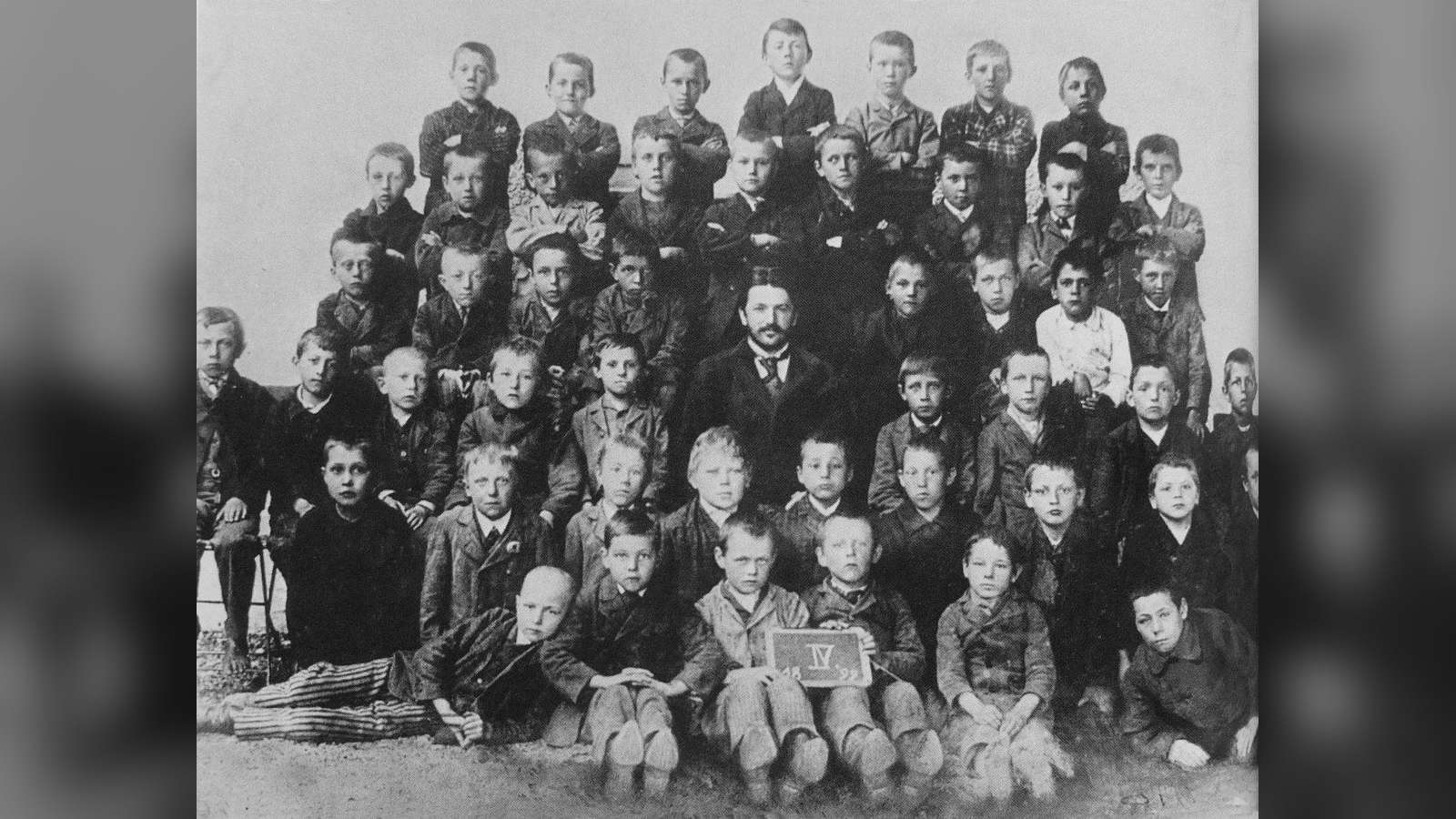
This stark, century-old classroom photograph captures a rigid line of young Austrian boys posing for the camera at the village school in Leonding in 1899. At the very center of the back row, standing slightly taller than his peers with a steady, unsmiling gaze directed straight at the lens, is a ten-year-old Adolf Hitler. This article examines the visual composition, documented provenance, and eerie historical dissonance of a simple archival artifact that freezes a future dictator in an entirely ordinary childhood moment.
What the photograph shows
The frame is a classic nineteenth-century institutional group portrait. A dozen or more boys, ranging roughly in age from nine to eleven, are arranged in strict tiers before a neutral background, likely an exterior wall or a studio backdrop used by a traveling local photographer. The children wear stiff collars, dark jackets, and waistcoats typical of provincial turn-of-the-century Austrian school attire. Their expressions vary from anxious and distracted to curious. Yet the eye is inevitably drawn to the central position in the back row. Ten-year-old Adolf stands with his arms at his sides, his hair parted on one side, staring into the camera with a severe, intense expression that later observers have often sought to imbue with retrospective meaning, though it largely mirrors the forced solemnity expected of school children of that era.
The moment behind the image
In 1899, Leonding was a quiet rural parish near Linz, Austria, far removed from the geopolitical upheavals that would later define the twentieth century. Alois Hitler, Adolf’s father, had recently moved the family to a small property in the area, and young Adolf was attending the local Volksschule. Daily life was governed by strict discipline, rote learning, and modest provincial routines. The shutter click of a school portrait was a rare, formal event—an annual or semi-regular ritual designed to document a cohort of students passing through primary education. There was no outward indication in the classroom of the psychological volatility, domestic friction, or ideological obsessions that contemporaries and biographers would later trace in his youth.
Photographer and provenance
The identity of the individual photographer who arranged the children and squeezed the bulb remains lost to history, classified in library archives simply as an unknown local professional working in Upper Austria at the close of the 1800s. The physical print survived decades of obscurity before finding its way into institutional repositories, most notably preserved within the holdings of the Bayerische Staatsbibliothek in Munich. It has since been reproduced in numerous standard historical works, including historian Ian Kershaw’s definitive 2008 biography of Hitler, serving visual editors and researchers as one of the few verified photographic records of his early childhood.
Historical context
To view this photograph without projecting the horrors of the Nazi regime is a persistent challenge for the modern observer. At the time of the exposure, Hitler was an unremarkable student experiencing typical childhood conflicts, including a strained relationship with his demanding father and early academic struggles at the secondary level that would follow soon after leaving Leonding. The image captures the waning years of the Austro-Hungarian Empire, a stable, conservative society where institutional structures like the village school seemed permanent and unassailable. The children in this frame were destined to grow up into the generation that would fight the First World War, an experience that profoundly scarred and radicalized the surviving veterans, including Hitler himself.
Why it still matters
Photographs of dictators as children occupy a strange and unsettling space in visual culture. They strip away the terrifying machinery of power, propaganda, and mass mobilization, reducing a historical monster to a fragile, vulnerable human scale. This 1899 Leonding class picture endures not because it reveals the seeds of tyranny etched onto a child’s face, but precisely because it does not. It stands as an unsettling reminder of the banality of early life, forcing viewers to confront the paradox that immense historical devastation can spring from the most ordinary, indistinguishable human beginnings.