


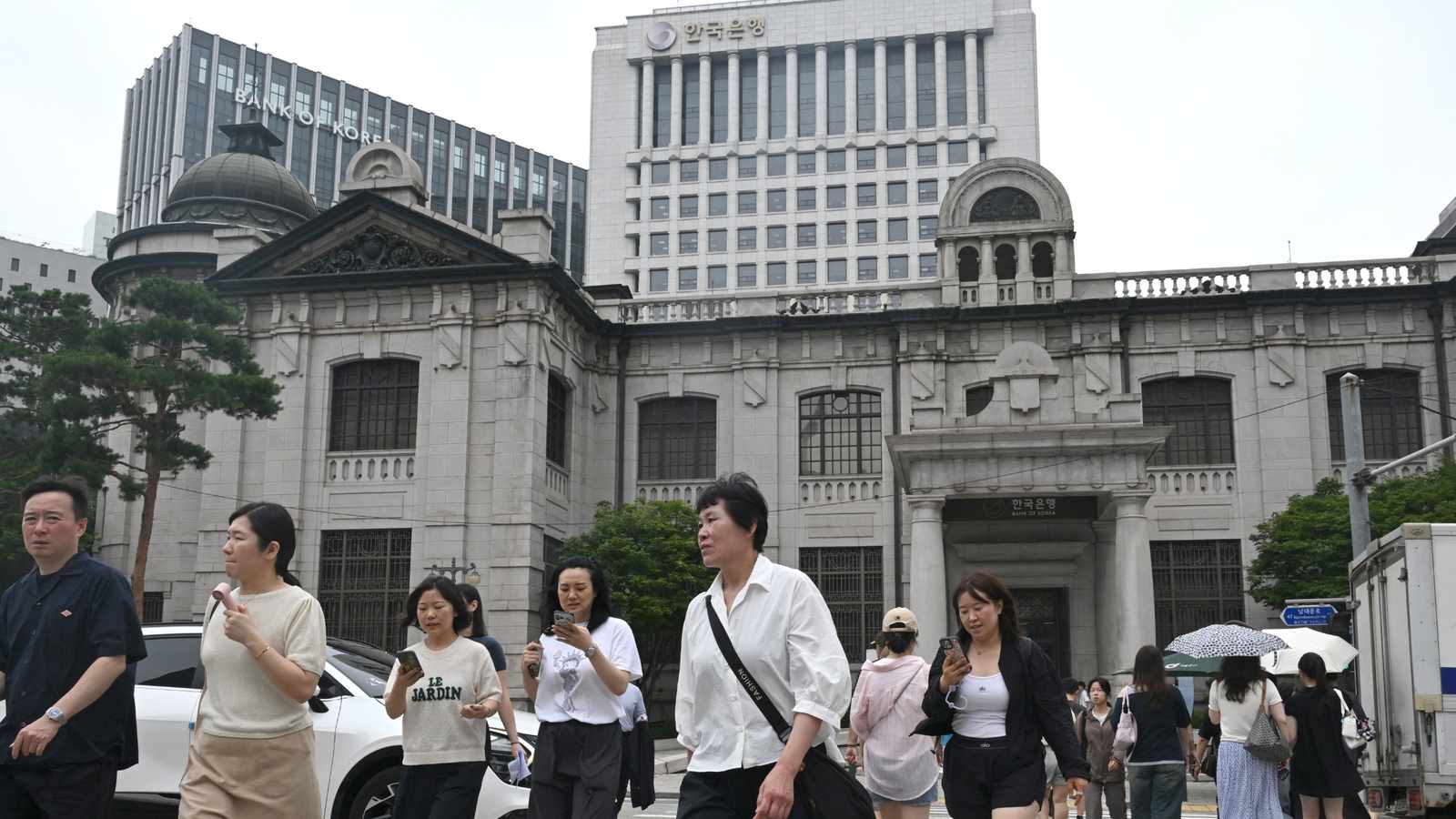
SEOUL (Azat TV) – South Korea’s central bank raised interest rates for the first time in three and a half years on Thursday, July 16, signaling the start of a new tightening cycle. The Bank of Korea’s (BOK) Monetary Policy Board unanimously lifted the seven-day repurchase rate by 25 basis points to 2.75 percent, ending a 14-month pause. Governor Shin Hyun-song explicitly characterized the move as the beginning of a cycle designed to curb inflation generated by a historic export boom in artificial intelligence (AI) hardware.
The Economic Paradox of the Chip Boom
The BOK’s decision highlights a unique economic irony: the inflation forcing the central bank’s hand is not the result of a stagnant economy, but rather the most spectacular export surge in South Korea’s history. In June 2026, the country’s monthly exports crossed the $100 billion threshold for the first time, reaching $102.25 billion—a 70.9 percent year-on-year increase. Semiconductor exports alone accounted for $44.82 billion of that total, surging 199.5 percent as global AI infrastructure investment reached unprecedented levels.
The primary driver is High-Bandwidth Memory (HBM), specifically the HBM4E architecture produced by industry leaders SK Hynix and Samsung Electronics. These chips are essential for powering large-scale AI systems, such as those from Nvidia and AMD. This boom has significantly improved South Korea’s terms of trade, increasing domestic purchasing power and fueling demand-side inflation. Large performance bonuses within the semiconductor sector have flowed into the Seoul property market, further amplifying price pressures.
Inflationary Triggers and Global Pressures
Beyond the domestic chip boom, external factors have pushed consumer prices to 3.2 percent in June, well above the BOK’s 2 percent target. Ongoing geopolitical conflicts involving the United States, Israel, and Iran have kept global energy prices elevated, a trend the BOK expects to persist for at least another year. Additionally, a persistently weak South Korean won has made imports more expensive. Governor Shin noted that offshore derivative markets—specifically the nondeliverable forward (NDF) market—have contributed to exchange rate vulnerability, despite recent 24-hour onshore trading experiments.
Impact on Households and Borrowers
The shift to a tightening cycle carries immediate consequences for South Korean borrowers. According to BOK data, the 25-basis-point hike adds approximately 1.8 trillion won ($1.3 billion) to the annual interest burden of households. Floating-rate loans, which accounted for 75.4 percent of new household borrowing as of May 2026, mean that the rate transmission will be felt rapidly. Average individual borrowers can expect an annual interest payment increase of roughly 300,000 won ($217).
The Road to August and the “Chip Paradox”
Markets are already pricing in at least one additional hike at the upcoming August 27 meeting. Analysts from Korea Investment and Securities and Hana Securities project a terminal rate of 3.25 to 3.50 percent for this cycle. However, this creates what Governor Shin calls a policy bind: an aggressive tightening cycle intended to cool inflation could also raise the cost of capital for the massive fabrication plant expansions Samsung and SK Hynix require to maintain their AI memory dominance through 2027. If semiconductor prices remain elevated, the BOK warned that the tightening cycle may last longer than initially anticipated.