


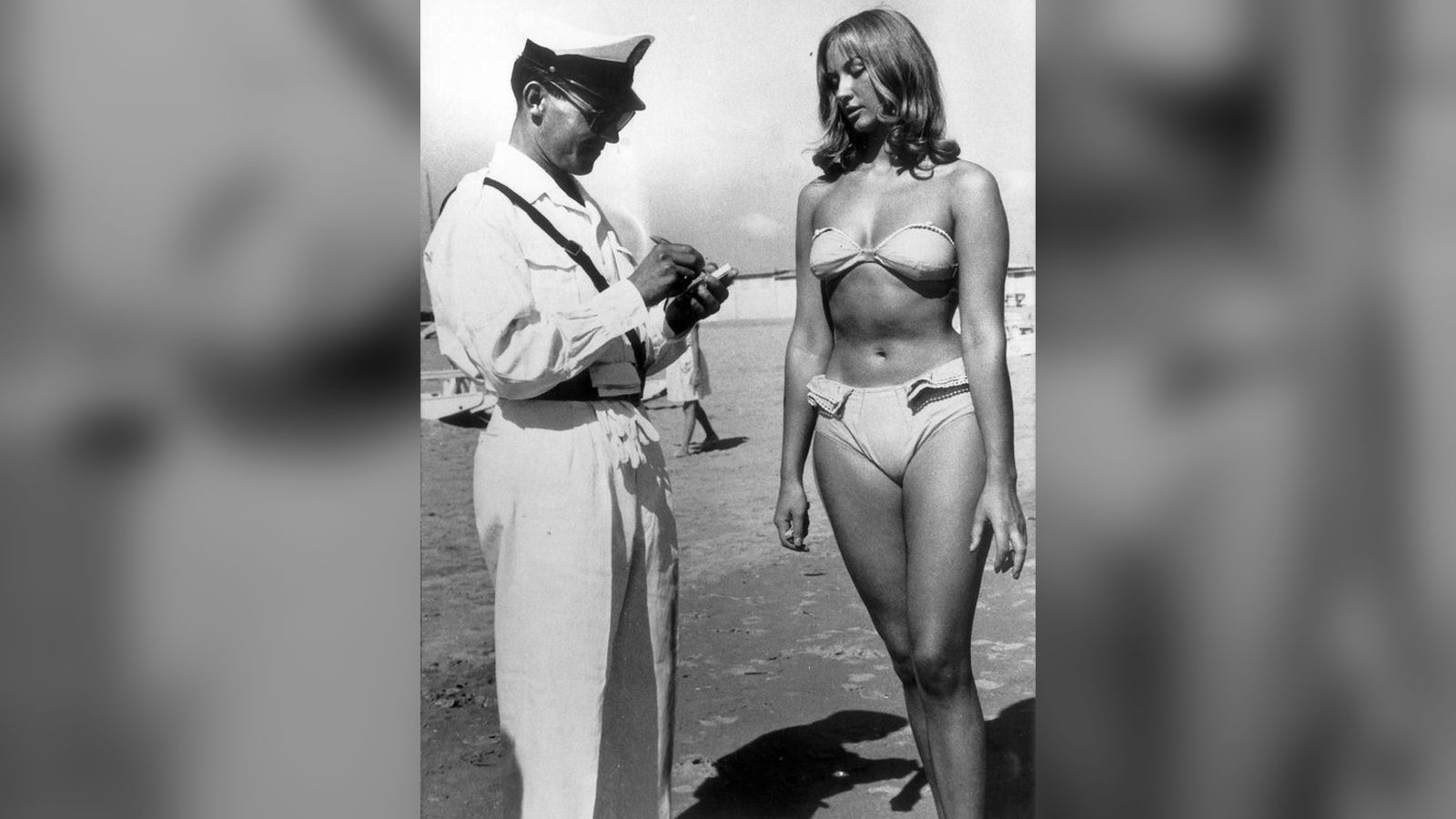
A smiling young woman in a modest two-piece bikini stands on a crowded shoreline, looking down with an amused expression as a uniformed man writes on a small notepad. This striking monochrome image has circulated across Reddit, X, and Facebook for years, embraced by millions as a humorous historical artifact documenting an era when swimwear was supposedly heavily policed. Yet beneath the meme-friendly veneer lies a web of unverified claims, missing agency archives, and lingering questions about whether the shutter captured a genuine punitive encounter or a playful publicity stunt.
What the photograph shows
In the center of the frame, a woman wears a striped, light-colored bikini typical of the late 1950s—high-waisted and relatively modest by modern standards, yet scandalous for its era. Her posture is relaxed, even cheerful, leaning slightly toward a man dressed in a crisp white uniform, peaked cap, and dark trousers. The man holds a small booklet and a pen, his expression neutral or mildly attentive as he looks down at his writing. In the blurred background, beachgoers lounge under umbrellas along a sunlit coast. The composition is balanced and sharp, free of digital manipulation, yet its visual narrative immediately invites skepticism regarding the true nature of the interaction.
The moment behind the image
For decades, internet captions have insisted that the photo depicts a municipal police officer in Rimini, Italy, in 1957, ticketing a beachgoer for violating decency laws regarding the two-piece swimsuit. However, historians and archival researchers have found no contemporary newspaper accounts, police logs, or municipal decrees confirming that an active ticketing campaign targeting bikinis occurred in Rimini that summer. While postwar Italian municipalities certainly maintained strict public modesty bylaws, and seaside resorts occasionally debated appropriate beach attire, investigators have repeatedly noted that the photo could just as easily depict actors, a staged magazine feature, or an entirely unrelated administrative interaction.
Photographer and provenance
The traceable history of the photograph largely begins in August 2016, when it appeared in a New York Times article examining the historical regulation of women’s beachwear. The image was credited to the German photo agency Ullstein Bild and its partner, Picture Alliance. When questioned by researchers, representatives from both archives stated that the image originated from the American newswire United Press International (UPI). However, UPI’s modern online archives contain no record of the negative or its original caption. Local Italian newspapers, including Il Resto del Carlino and NewsRimini, launched public appeals in 2016 and 2022 to identify the woman and the officer in the frame, but both individuals remain entirely anonymous.
Historical context
The bikini was introduced to the world in Paris in 1946 by designer Louis Réard, named after the nuclear tests at Bikini Atoll. In conservative Catholic nations like Italy, Spain, and parts of France, the two-piece swimsuit met with intense resistance from local authorities, moral guardians, and the Church throughout the late 1940s and 1950s. Some coastal towns attempted to ban them outright or enforce strict coverage rules. Whether or not the Rimini photograph captures a real fine, it vividly encapsulates the genuine cultural friction of an era when the modern leisure industry collided head-on with traditional morality.
Why it still matters
The enduring fascination with the 1957 Rimini beach photo speaks volumes about how modern audiences consume history online. Stripped of original context and amplified by viral algorithms, a decades-old wire photo transformed from an obscure archival item into a universal symbol of female autonomy versus bureaucratic control. Until documentation surfaces to confirm the identities of the subjects or the photographer’s exact assignment, the image remains a compelling optical illusion—a sharply focused historical document whose true story continues to slip through our fingers.