


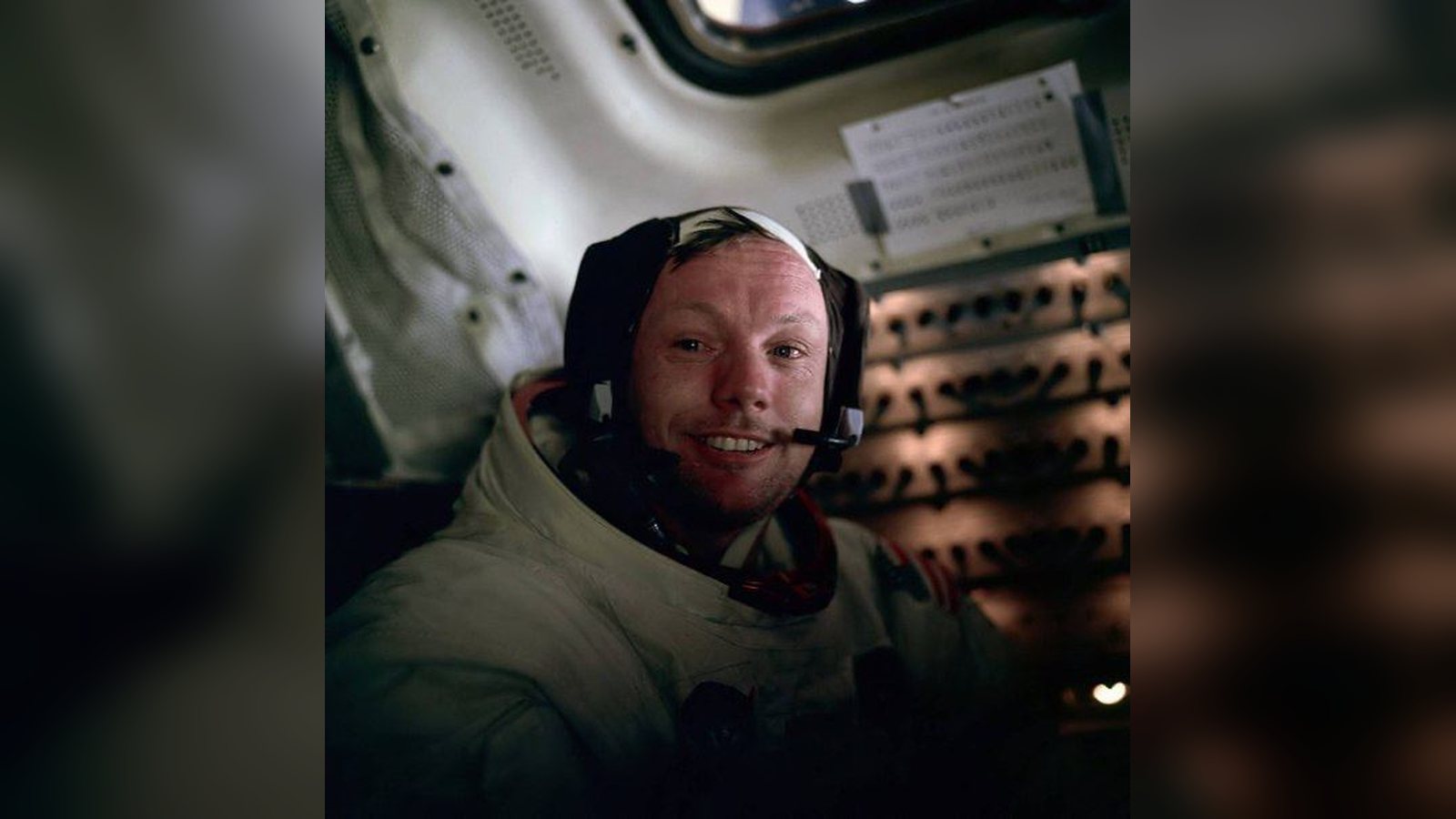
This striking photograph, widely circulated and often misidentified, does not show Neil Armstrong after his moonwalk, but rather his fellow Apollo 11 astronaut, Buzz Aldrin, with visibly teary eyes, captured by Armstrong himself. The image, taken shortly after the crew’s safe splashdown and recovery in July 1969, offers a rare glimpse into the profound emotional aftermath of humanity’s greatest journey, prompting us to consider the immense personal toll and triumph behind such a monumental achievement.
What the photograph shows
The frame focuses tightly on Buzz Aldrin’s face, his expression a mixture of exhaustion, relief, and overwhelming emotion. His eyes are noticeably red-rimmed and moist, suggesting tears, though no active weeping is visible. A slight smile or perhaps a grimace plays on his lips, hinting at the complex feelings of the moment. He appears to be looking slightly off-camera, possibly at Neil Armstrong, who is behind the lens, or perhaps simply lost in thought. Aldrin is wearing what appears to be a light-colored garment, possibly a medical gown or a casual shirt, indicating he is no longer in his bulky spacecraft or quarantine suit. This attire suggests a period of relaxation and transition, far removed from the confines of the Apollo capsule. The background is indistinct, suggesting an interior setting, likely aboard the USS Hornet, the primary recovery ship, or within the Mobile Quarantine Facility (MQF) where the crew was isolated. The lighting is soft but direct, illuminating the details of his face and emphasizing the raw humanity of the moment. The image is unposed, capturing a genuine, unguarded reaction that speaks volumes about the experience he has just endured and completed.
The moment behind the image
This photograph was taken in the immediate hours or days following the Apollo 11 mission’s successful conclusion. After spending over 21 hours on the lunar surface (Aldrin and Armstrong) and orbiting the Moon (Collins), the crew re-entered Earth’s atmosphere and splashed down in the Pacific Ocean on July 24, 1969. They were recovered by the USS Hornet and immediately transferred to the Mobile Quarantine Facility to prevent any potential contamination from lunar pathogens. The moment captured is likely during this initial period of recovery and debriefing, a time when the adrenaline of the mission would have begun to subside, giving way to the full weight of their experience. The tears, or teary eyes, are widely interpreted as an expression of the immense relief, the sheer joy of survival, and the overwhelming realization of what they had just accomplished—landing humans on the Moon and returning them safely to Earth. It was a moment of profound decompression after an unparalleled period of stress, danger, and historic achievement, a transition from the stoic professionalism required for spaceflight to the raw human emotion of its aftermath.
Photographer and provenance
The photographer of this iconic image was Neil Armstrong, the first man to walk on the Moon and the commander of Apollo 11. It is a testament to the close bond and shared experience of the crew that such an intimate and powerful moment was captured by a fellow astronaut, rather than a professional photojournalist. While the exact camera used for this specific shot might not be definitively documented, the Apollo missions utilized Hasselblad cameras extensively, both on the Moon and inside the spacecraft, for scientific and documentary purposes. These cameras were chosen for their reliability and image quality in the harsh conditions of space. This photograph, therefore, is part of the vast archive of images captured by NASA astronauts, documenting their historic journey from a unique, insider perspective. Its circulation began shortly after the mission, becoming a powerful symbol of the human side of space exploration. Despite its clear subject, the image has been frequently misattributed as showing Neil Armstrong’s own emotional state, a testament to the public’s desire to connect with the personal feelings of these pioneering figures, even if the identity is confused.
Historical context
The Apollo 11 mission, launched on July 16, 1969, and culminating in the Moon landing on July 20, was the culmination of a decade-long national effort initiated by President John F. Kennedy. His 1961 challenge to land a man on the Moon and return him safely to Earth before the decade was out galvanized the American space program. It was a monumental victory for the United States in the Space Race against the Soviet Union, a geopolitical and technological contest that defined much of the Cold War era. The success of Apollo 11 was not just a technological triumph but a profound moment for humanity, demonstrating the extraordinary capabilities of human ingenuity and cooperation. The return of Armstrong, Aldrin, and Collins as global heroes was met with unprecedented public enthusiasm and celebration. This photograph, capturing Aldrin’s raw emotion, humanizes the astronauts, reminding us that beneath the helmets and the scientific jargon were individuals who experienced profound fear, immense pressure, and unparalleled exhilaration. It provides a counterpoint to the triumphant, often sanitized, narratives of space exploration, grounding the extraordinary in the deeply personal.
Why it still matters
This image transcends its initial context as a post-mission snapshot. It has become an enduring symbol of human resilience, the emotional cost of groundbreaking achievement, and the powerful bond between those who share extraordinary experiences. Despite its frequent misattribution, the photograph’s power lies in its ability to connect viewers to the very human core of the Apollo 11 mission. It reminds us that even the most stoic heroes are susceptible to the overwhelming emotions that accompany the realization of a dream, especially one as audacious as reaching another celestial body. The image serves as a potent reminder of the human spirit’s capacity for wonder, courage, and deep emotion in the face of the unknown. It invites contemplation on the personal sacrifices and profound psychological impacts of such an endeavor, ensuring that while the technological marvels of Apollo 11 are remembered, so too are the very human beings who dared to make the impossible a reality. This photograph ensures that the legacy of Apollo 11 is not just one of scientific achievement, but also of human triumph and vulnerability.