


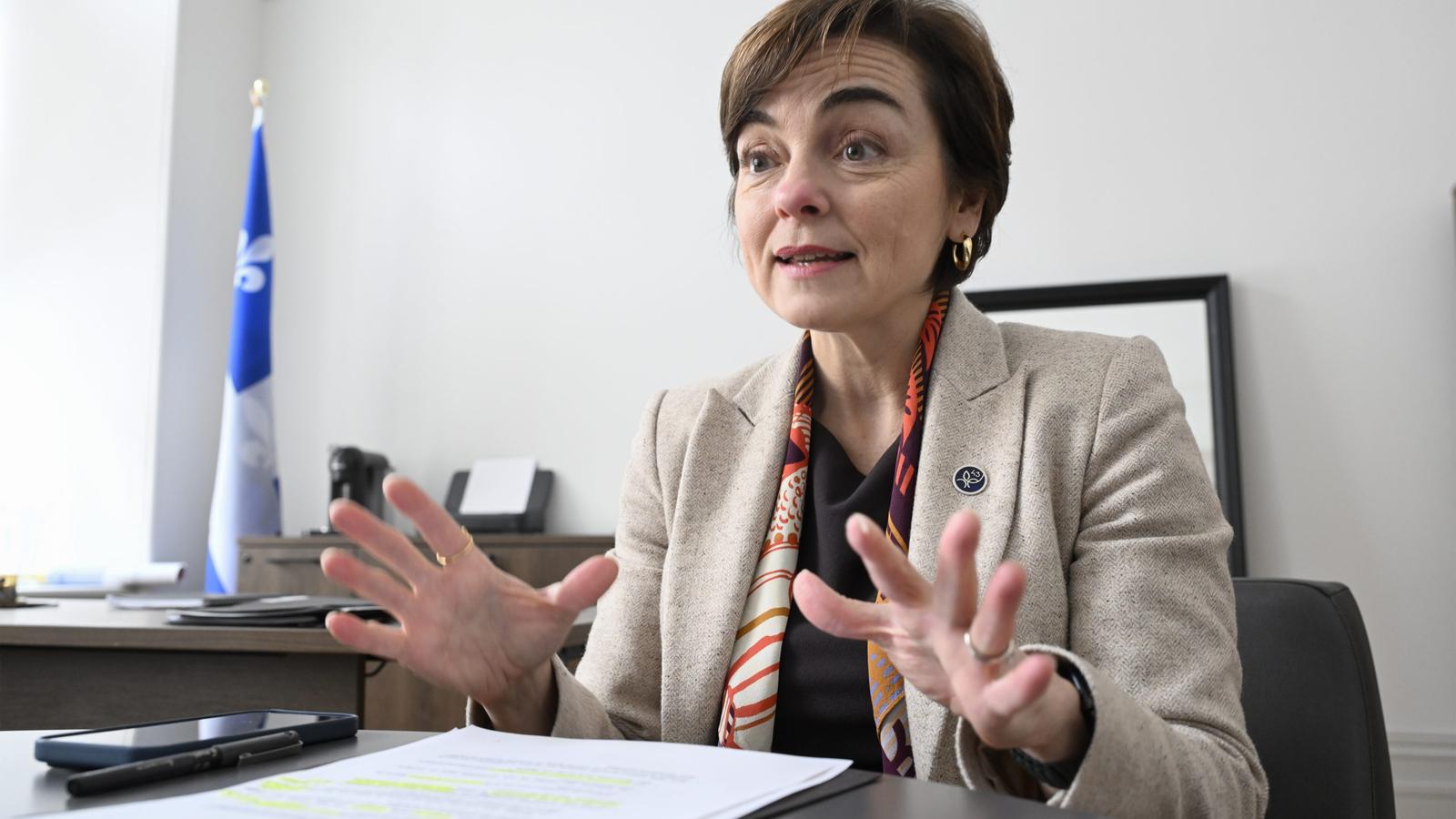
Quebec Economy Minister Christine Fréchette is poised to become the first official candidate in the Coalition Avenir Québec (CAQ) leadership race, with an announcement slated for Sunday in Trois-Rivières. Her early entry, coupled with significant caucus support, marks a pivotal moment in the succession battle for Premier François Legault, who is stepping down after nearly eight years, setting the stage for a contest that will ultimately determine Quebec’s next premier by April 12.
The Race to Succeed Premier Legault Takes Shape
Premier François Legault, who announced his impending departure last Wednesday, has emphasized the enduring relevance of the Coalition Avenir Québec, positioning it as a vital third way between the Parti Québécois’s economic instability and the Liberals’ perceived failure to protect French in Montreal. Legault, who formed the CAQ in 2011, stated he would remain neutral in the leadership race, refraining from backing any specific candidate. Instead, he articulated his hopes that the October election would focus on his two main priorities: a strong economy and the protection of the French language.
Despite the upcoming departures of several veteran ministers, including Municipal Affairs Minister Geneviève Guilbault and Education Minister Sonia LeBel, Legault expressed confidence in the party’s strength. He acknowledged that after nearly eight years in office, it is natural for some individuals to move on from the demanding life of politics. Legault affirmed his intention to continue governing until his successor is chosen, likely in mid-April, ensuring a stable transition for the province. The new CAQ leader will automatically assume the premiership, adding a significant layer of importance to this internal party contest.
Legault also used the opportunity to comment on broader political issues, complimenting Canadian Prime Minister Mark Carney’s recent speech at the World Economic Forum in Davos. He stressed the need for Canada to diversify its markets, particularly in Europe, given the uncertain trade relationship with the United States under President Donald Trump. Legault conceded that renegotiating the Canada-United States-Mexico Agreement (CUSMA) did not appear to be on the immediate horizon, necessitating a ‘Plan B’ for Quebec’s economic future.
Christine Fréchette’s Early Momentum and Background
Christine Fréchette’s decision to enter the leadership race, which she will officially announce Sunday at 10 a.m. in her hometown of Trois-Rivières, positions her as a frontrunner from the outset. Her campaign team indicated the announcement details on Friday, highlighting her strategic move to gain an early advantage over potential rivals. A relative newcomer to the CAQ, Fréchette was first elected in the riding of Sanguinet during the party’s second mandate in 2022, rapidly ascending to her current role as Minister of the Economy, Innovation and Energy.
Fréchette, 56, brings a robust background to the political arena. She is the $1 of the Chambre de commerce de l’Est de Montréal, demonstrating her strong ties to the business community and her understanding of economic issues. Fluent in three languages, her political experience also includes serving as associate chief of staff to former Parti Québécois leader Jean-François Lisée until 2014, when she departed due to the party’s controversial ‘charter of values’ initiative. This history suggests a pragmatic approach, potentially appealing to a broad spectrum of CAQ members.
Her candidacy is already bolstered by significant support within the CAQ caucus. As of Friday, Fréchette had secured the endorsements of 11 CAQ Members of the National Assembly (MNAs), including five cabinet ministers: Gilles Bélanger, Mathieu Lacombe, Benoit Charette, Family Minister Kateri Champagne Jourdain, and Public Security Minister Ian Lafrenière. Lafrenière, who himself had been on the list of potential candidates, publicly announced his support for Fréchette on Wednesday, emphasizing that the ‘ballot-box question will no doubt be about the economy,’ aligning with Fréchette’s portfolio and Legault’s stated priorities.
Rules of Engagement and Other Potential Contenders
The rules for the CAQ leadership race were officially announced on Thursday in Quebec City, outlining a clear path for candidates. To qualify, aspirants must gather the signatures of 1,000 CAQ members from at least 75 ridings across the province. This includes securing support from a minimum of 15 Members of the National Assembly and 100 members of the party’s youth wing, ensuring broad representation. Financially, candidates are required to make a non-refundable lump sum contribution of $30,000, and election expenses are capped at $150,000. Interested individuals have until February 21 to submit their candidacies, setting a tight timeline for potential contenders to formalize their campaigns.
While Fréchette is the first to officially declare, other prominent CAQ figures are actively considering a run. Justice Minister Simon Jolin-Barrette and Environment Minister Bernard Drainville have both confirmed they are in serious reflection. Jolin-Barrette, who currently enjoys the support of seven members of caucus, has articulated a vision centered on a strong economy and ‘uninhibited nationalism.’ Drainville, a former PQ cabinet minister, has the backing of two caucus members and aims for the CAQ to be a ‘nationalist and economic force’ that is ‘close to the regions and close to the people and families.’ Both are generally associated with the nationalist-identity wing of the CAQ, contrasting with Fréchette’s more financial profile.
Finance Minister Eric Girard, after much speculation, announced he would not seek the leadership, concluding he could not win. However, Girard, who previously held the portfolio for relations with English-speaking Quebecers, stated his intention to run again in the October general election in his riding of Groulx. In his decision, he notably suggested that the CAQ might need to ‘rethink some of its nationalist policies to make them more inclusive,’ acknowledging that ‘not all Quebecers saw themselves in what we were proposing.’ This observation highlights a potential area for debate within the party as the leadership race unfolds. Other potential candidates still mulling over a run include former cabinet minister François Bonnardel and Natural Resources Minister Jean-François Simard.
Fréchette’s strategic early move and her established support base within the CAQ caucus position her as a formidable contender from the outset, signaling a concerted effort to define the race’s initial narrative and potentially challenging other candidates to quickly articulate their own distinct visions. Her background in economy and her relatively fresh presence in the party could appeal to those seeking a balance between Legault’s stated priorities of economic strength and linguistic protection, while also signaling a potential shift towards more inclusive policies, as subtly hinted by figures like Eric Girard.