


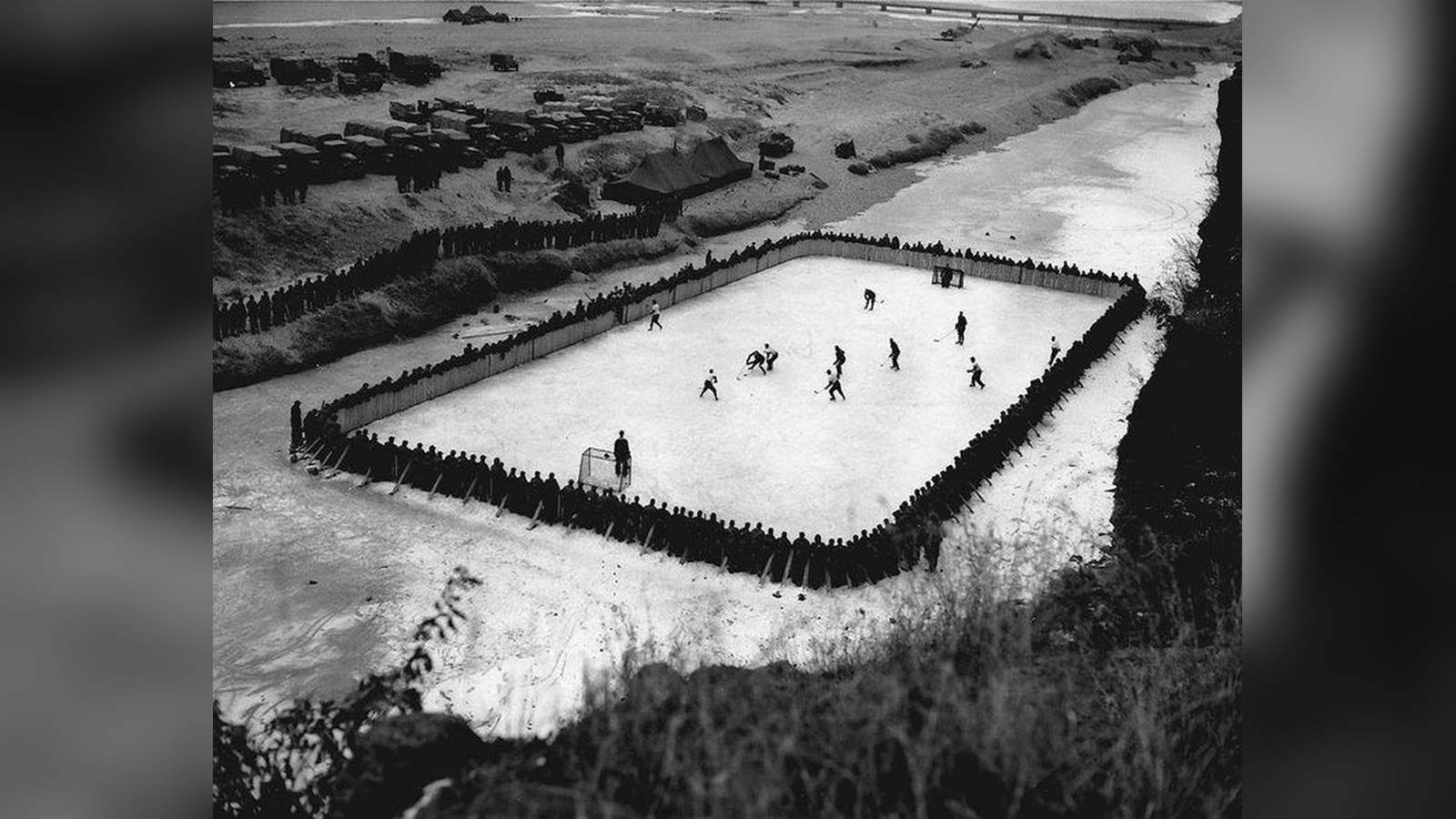
A wide, frozen expanse of the Imjin River stretches across the frame, framed by the bleak, snow-dusted hills of war-torn Korea in the winter of 1952. In this unlikely setting, a group of young men clad in heavy military parkas and woolen caps are captured mid-stride, their hockey sticks raised and eyes locked on a puck sliding across the rough, natural ice. This photograph captures a surreal moment of respite during one of the Cold War’s bloodiest conflicts, where Canada’s national pastime was transposed directly onto the front lines of the Korean War. Why did these soldiers, pulled from the grueling trenches of the battlefield, risk organizing an ice hockey game within range of enemy artillery, and how did this single photograph survive to become an iconic symbol of cultural survival?
What the photograph shows
In the center of the frame, several players are locked in a battle for possession of the puck. Unlike the pristine, indoor arenas of North America, this ice rink is raw and imperfect, showing the cracks, ridges, and uneven texture of a naturally frozen river. The players do not wear the colorful, padded uniforms of professional athletes; instead, they are dressed in bulky, olive-drab military winter gear, heavy trousers, and thick gloves. Some wear ice skates brought from home or shipped by families, while others navigate the slippery surface in standard-issue combat boots. In the background, the desolate and barren Korean hills rise sharply against an overcast sky, a stark reminder of the harsh winter conditions and the devastating environmental toll of the ongoing conflict. The makeshift nature of the game is evident in the goalposts, which were often fashioned from discarded wooden ammunition crates or ration boxes.
The moment behind the image
The photograph was taken on March 11, 1952, on a frozen stretch of the Imjin River, situated only a few miles from the active front lines. The players were members of two historic Canadian regiments: the 2nd Battalion, Princess Patricia’s Canadian Light Infantry (PPCLI) and the 2nd Battalion, Royal Canadian Regiment (RCR). These men had been engaged in some of the most intense and exhausting combat of the war, including the pivotal Battle of Kapyong in April 1951, where they successfully held off a massive enemy advance. The hockey game was organized during a brief period of rotation off the direct front lines. It was a highly anticipated match, complete with a makeshift trophy and hundreds of fellow soldiers lining the snowy banks of the river to cheer on their respective regiments. For a few hours, the terrifying sounds of artillery were replaced by the familiar scraping of steel blades on ice and the friendly roar of a hometown crowd.
Photographer and provenance
This image was captured by an official military photographer deployed with the Canadian Department of National Defence (DND). During the Korean War, official photographers were tasked with documenting not only the strategic developments of the campaign but also the daily lives, morale, and human stories of the troops. The photograph was sent back to Canada, where it was widely distributed to national newspapers and magazines. For families waiting anxiously at home, the image offered a comforting, deeply familiar sight: their sons, brothers, and husbands participating in a beloved national tradition, seemingly untouched by the horrors of the battlefield. The original negative is preserved in the Library and Archives Canada collection in Ottawa, where it remains one of the most requested and recognizable images from the Korean War era.
Historical context
The Korean War (1950–1953) is often referred to as the ‘Forgotten War,’ yet it represents Canada’s third-deadliest foreign military conflict, with over 26,000 Canadian personnel serving in the theatre. The Imjin River was a highly strategic geographic barrier and the site of several fierce engagements. Constructing a hockey rink on this river was a logistical triumph and a psychological necessity. It allowed the soldiers to reclaim a sense of normalcy, home, and sanity in an environment defined by violence and extreme cold. Furthermore, the game served as an early point of cultural contact; local Korean civilians and military personnel watched the game with fascination, witnessing a piece of Canadian culture brought to life on their own frozen river. This historic exchange has left a lasting legacy, symbolizing the deep bond between Canada and South Korea that persists to this day.
Why it still matters
Decades after the armistice, the image of the Imjin River hockey game continues to resonate. It has inspired numerous historical commemorations, including modern-day reenactments of the match played on the same river by Canadian and South Korean teams. Most recently, the story of these soldiers and their cultural impact has been transformed into an original musical titled ‘R:LINK,’ a collaborative artistic project involving Canadian Indigenous theatre artists from the University of Saskatchewan, Capilano University, and South Korean artists. This creative endeavor, marking the Canada-Korea Year of Cultural Exchanges and the 75th anniversary of the Korean War, proves that the spirit captured in this 1952 photograph—one of unity, resilience, and the search for humanity in the midst of conflict—remains as powerful and relevant today as it was on that cold March afternoon on the frozen Imjin.