


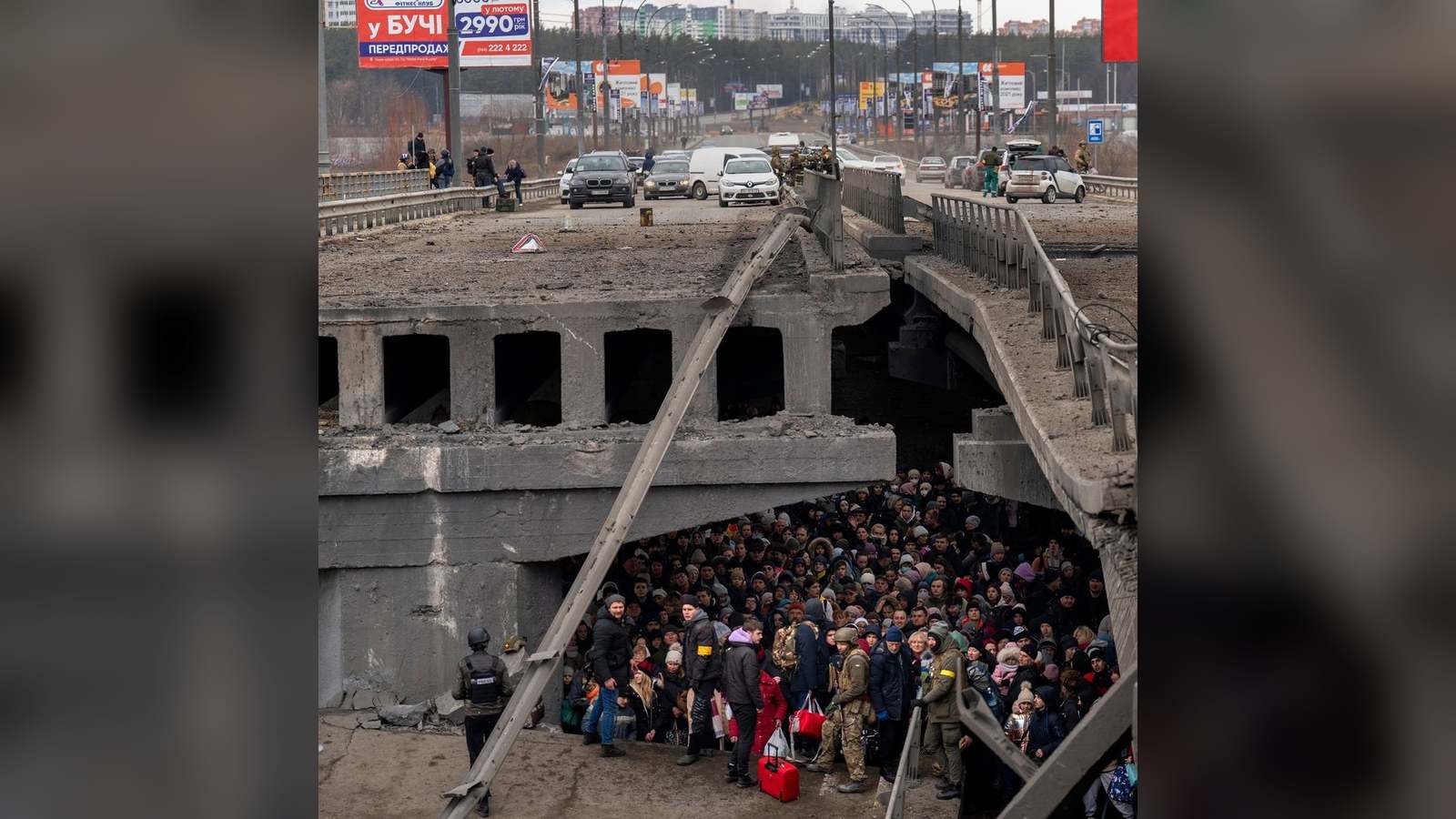
What the photograph shows
This powerful photograph frames a dense, anxious crowd of Ukrainian civilians huddled beneath the jagged, fractured concrete of a destroyed bridge. Individuals of all ages—carrying bulky bags, pulling luggage carts, clutching pets, and holding small children—trudge through shallow, muddy waters and makeshift wooden planks. The shattered span of the bridge looms overhead like a broken skeleton, its reinforced steel bars twisted by explosive force. The composition uses natural daylight filtering through the ruin to illuminate the weary expressions and hurried postures of the evacuees, emphasizing both their vulnerability and their sheer determination to reach safety.
Every element in the frame contributes to an atmosphere of urgent displacement. To the left and right, people form an unbroken line extending from the muddy banks toward makeshift ramps. Some carry infants bundled tightly against the cold March wind, while others manage heavy suitcases or pets cradled in anxious arms. The water below flows darkly, reflecting the gray sky and the heavy mood of the day. There is no symmetry in the composition, mirroring the chaotic and unpredictable nature of flight under fire. The absence of official order highlights how ordinary citizens improvised their own survival networks when state infrastructure failed under sudden attack.
The moment behind the image
Taken on March 5, 2022—just ten days after the full-scale Russian invasion of Ukraine began—the scene unfolds at the Irpin River on the northwestern outskirts of Kyiv. The town of Irpin had rapidly transformed into a ferocious frontline battleground as Russian forces attempted to encircle the capital. To stall the armored columns, Ukrainian military engineers had deliberately blown up the concrete bridge days earlier. With official transport cut off, this makeshift crossing beneath the wreckage became one of the few remaining pedestrian escape routes for families fleeing constant artillery bombardment, airstrikes, and encroaching ground troops.
In the hours leading up to this shutter click, artillery shells had fallen repeatedly in the surrounding neighborhoods, shattering windows and terrifying residents. Families who had spent days sheltering in cold basements made the agonizing decision to abandon their homes. As they approached the river, they found that the original concrete roadbed was entirely gone, leaving only twisted rebar and broken pillars. Ukrainian soldiers and volunteers worked frantically at the water’s edge, lending a steady hand, laying down wooden planks to create a stable footpath, and helping the elderly and terrified children across the freezing current.
Photographer and provenance
The photograph is credited to veteran Associated Press staff photographer Emilio Morenatti, based in Barcelona, working alongside colleagues like Vadim Ghirda and Efrem Lukatsky to document the unfolding humanitarian crisis around Kyiv. Operating under extreme personal risk, constant incoming fire, and the bitter cold of early March, AP photojournalists captured definitive images that bypassed political rhetoric to show the raw, immediate reality on the ground. Morenatti’s frame was distributed globally by the AP wire service, quickly appearing on the front pages of international newspapers and winning critical recognition for its unflinching documentation of war.
Morenatti, who had previously covered numerous global conflicts and sustained severe injuries in Afghanistan, brought a profound sense of empathy and professional discipline to his work in Ukraine. His camera focused not on distant explosions or military hardware, but on the intimate human scale of tragedy. Working alongside local stringers and support staff, AP teams navigated checkpoints, curfews, and active combat zones to ensure these visual records reached international desks. The provenance of this image is tied directly to the rigorous daily output of the Associated Press wire, designed to inform the global public with speed and unquestionable accuracy while adhering to the highest standards of photojournalistic ethics.
Historical context
The early weeks of March 2022 saw frantic, chaotic evacuations as nearly 1.5 million refugees fled Ukraine within the first fortnight of fighting. Towns like Irpin, Bucha, and Hostomel bore the brunt of heavy shelling aimed at breaking the defenses of Kyiv. Civilians trapped by sudden airstrikes were forced to abandon their homes with only what they could carry. The destroyed Irpin bridge crossing became an enduring symbol of both civilian resilience and the brutal devastation inflicted on civilian infrastructure during the opening phase of the conflict.
During these critical days, international attention was riveted on the northern approaches to Kyiv, where long columns of Russian armor and artillery posed an existential threat to the capital. While diplomats conferred and humanitarian corridors repeatedly collapsed amid broken ceasefires, millions of ordinary Ukrainians faced immediate danger. The destruction of bridges across the Irpin, Bucha, and Dnieper river basins was a military necessity for the defending forces, yet it instantly transformed geography into an obstacle course for fleeing non-combatants. This photograph encapsulates that painful paradox: defensive military actions meant to protect a city also cut off its escaping population, forcing them to brave ruined terrain in search of sanctuary.
Why it still matters
Years after the shutter clicked, this image remains an essential historical document of the war’s opening chapter. It transcends daily news reporting by freezing a moment of profound human displacement and survival. By forcing viewers to look directly into the eyes of parents shielding infants beneath a fallen bridge, the photograph preserves an irrefutable record of the immense cost borne by ordinary people caught in the path of modern warfare.
As historical distance grows, images like Morenatti’s frame serve as a permanent counterweight to abstract geopolitical analysis. They remind viewers that modern conflicts are experienced not in maps and troop movements, but in mud, cold air, heavy bags, and the terrified grip of a child’s hand. The photograph stands as an archival testament to human endurance, documenting a specific historical afternoon when thousands of ordinary individuals stepped across a ruined riverbank into an uncertain future.